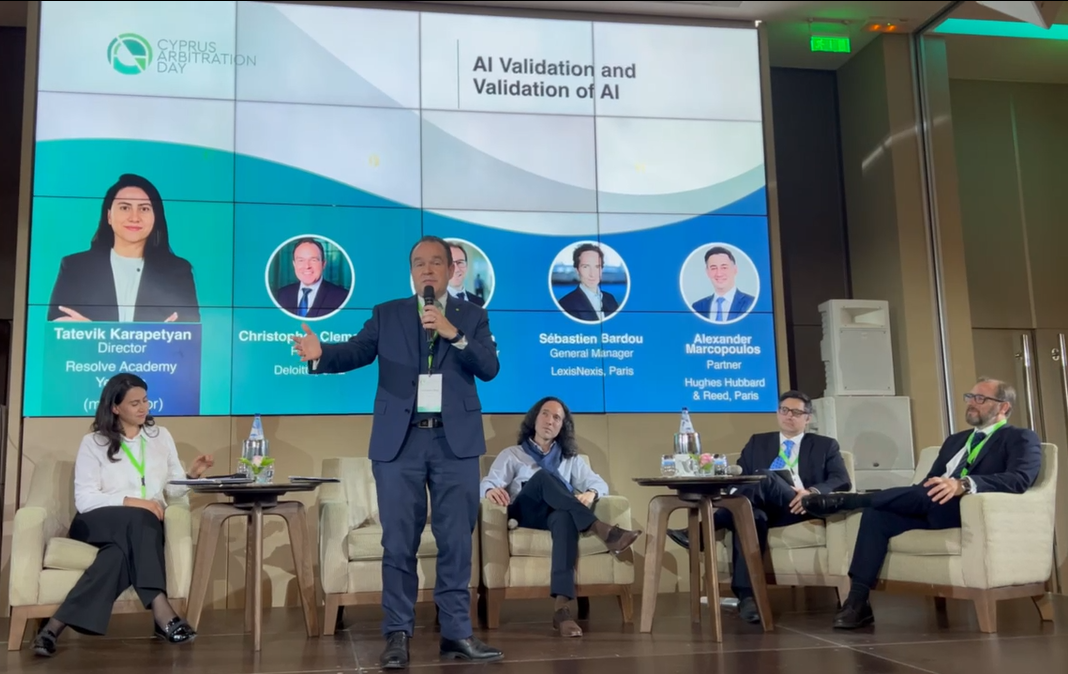
Session 3 of Cyprus Arbitration Day 2026 titled, “AI Validation and Validation of AI” brought together arbitration practitioners, expert witnesses, and legal technology specialists to examine how artificial intelligence is reshaping arbitral proceedings and dispute resolution practice.
The panel consisted of Mr. Christopher Clements, Partner, Deloitte, UAE; Mr. Daniel Correa, Managing Director, DAC Consulting, London; Mr. Sébastien Bardou, General Manager, LexisNexis, Versailles; and Mr. Alexander Marcopoulos, Partner, Hughes Hubbard & Reed, Paris. Moderated by Ms. Tatevik Karapetyan, Director of Resolve Academy, the session examined the governance and ethical frameworks required to ensure responsible deployment of AI in arbitration and legal practice.
The Governance Framework: Confidentiality, Risk Matrices, and Operational Control
Mr. Christopher Clements framed his contribution around a practical concern that is the rapid pace of AI development means that specific techniques for identifying hallucinations or inaccurate outputs may become obsolete within months. According to Mr. Clements, organisations require durable governance frameworks capable of adapting as the technology evolves.
Addressing confidentiality concerns, Mr. Clements identified three critical safeguards for practitioners using AI systems. First, organisations must understand the data-sharing provisions contained within AI user agreements, including where information is transmitted and how it may be stored. Second, practitioners should verify whether ring-fenced or one-way gate configurations are available to prevent sensitive information from being externally retained or redistributed. Third, he stressed the importance of obtaining explicit client consent, particularly in jurisdictions with strict data sovereignty obligations, including certain Middle Eastern jurisdictions where data may not legally leave a client’s premises.
Mr. Clements also proposed a four-tier risk matrix for classifying AI use according to the consequences of potential error. At the lowest tier were administrative and operational tasks such as meeting summaries and scheduling outputs, where efficiency gains are clear and risks remain limited. The second tier involved factual summaries and document digests requiring human review before reliance. The third tier covered analytical outputs, calculations, and idea generation, where errors may directly affect legal strategy and therefore require rigorous independent verification. The final category consisted of tasks that should not be delegated to AI at all, including final expert opinions, unverified calculations, and conclusions the practitioner cannot independently defend.
To operationalise these safeguards, Mr. Clements outlined a five-stage governance framework. This included maintaining records of which AI systems are used and for what purpose, documenting prompts and search inputs, implementing internal review procedures, establishing disclosure protocols for AI-assisted work, and continuously investing in practitioner training, particularly in prompt engineering and verification methodologies.
The Ethical Dimension: Competence, Confidentiality, and Transparency
Mr. Alexander Marcopoulos directed the discussion towards the professional obligations already governing AI-assisted legal work. According to Mr. Marcopoulos, AI has not displaced traditional professional duties but intensified them. He identified competence, confidentiality, and transparency as the three central obligations shaping responsible AI use in arbitration practice.
On competence, Mr. Marcopoulos referred to ABA Formal Opinion 5121, issued in July 2024, which states that lawyers cannot abdicate professional responsibility merely because AI systems have been used in the preparation of work product. Practitioners deploying AI tools, he argued, remain fully responsible for understanding their limitations and for exercising independent legal judgment throughout the process.
Addressing confidentiality, Mr. Marcopoulos highlighted the significance of GDPR compliance and broader data protection obligations for European practitioners. He noted that lawyers must understand not only whether a provider is reputable, but also where data is stored, how it is processed, and what rights the provider may assert under the applicable user agreement.
On transparency and explainability, Mr. Marcopoulos observed a growing expectation in arbitral proceedings for disclosure relating to AI-assisted processes, including discussions within institutions such as the International Chamber of Commerce. While traditional document review methodologies can generally be reconstructed and explained through identifiable search terms and workflows, AI-assisted review may rely on opaque prompt structures and probabilistic outputs that are more difficult to reproduce. Mr. Marcopoulos suggested that audit logs and prompt logs may eventually become standard disclosure mechanisms within arbitration practice.
Mr. Marcopoulos further warned against what he described as intellectual outsourcing, the gradual surrender of professional judgment to AI systems capable of identifying patterns but often unable to appreciate nuance, anomaly, or contextual significance. While AI may resemble a highly capable junior associate, he observed that unlike a human lawyer, AI systems may generate flawed outputs with unwarranted confidence and without acknowledging uncertainty.
Drawing a distinction between responsible and irresponsible AI use, Mr. Marcopoulos contrasted practitioners who simply instruct AI tools to generate memoranda with minimal supervision against those who engage critically with AI outputs through sustained questioning and independent analysis. According to him, only the latter approach preserves professional judgment and ethical accountability.
From the Floor: The Question of Collective Blindness
The session concluded with an audience intervention from Mr. Michael Patrick Joyce, barrister, arbitrator, and mediator, who raised concerns regarding what he described as a group think of collective blindness. Mr. Joyce questioned whether increasing dependence on AI systems risks weakening the profession’s capacity for independent reasoning and critical scrutiny, the very faculties necessary to validate AI-generated work.
Responding to the question, the panel addressed critical thinking from multiple perspectives. Mr. Sébastien Bardou emphasised organisational accountability structures, arguing that responsibility for reasoning and verification must exist at every level of institutional workflow rather than being treated solely as an individual characteristic. Mr. Marcopoulos focused on individual professional responsibility, stressing that practitioners must resist the temptation to delegate substantive judgment to AI systems. Mr. Daniel Correa returned to the realities of expert witness practice, noting that no AI-generated conclusion can survive scrutiny unless the expert can independently explain, verify, and defend it under cross-examination.
The discussion ultimately demonstrated that governance frameworks capable of managing AI responsibly, including confidentiality protections, risk classification systems, audit processes, and disclosure mechanisms already exist and are capable of immediate implementation. At the same time, the session reinforced that the professional duties governing AI-assisted legal work are not awaiting future regulation but already exist within longstanding obligations of competence, confidentiality, and transparency.
The session concluded on a common principle which echoed throughout the discussion that while AI may significantly assist arbitration practice, responsibility for verification, professional judgment, and ethical accountability remains firmly with the practitioner.
The full conference agenda is available at the Cyprus Arbitration Day website.
SCC Times is the Sole Official Media Partner for this event.
The presentation shared during the session may be accessed below.
1. American Bar Association Standing Committee on Ethics and Professional Responsibility Formal Opinion 512 – Generative Artificial Intelligence Tools, dated July 29, 2024