Tech Sangam | International Dialogue 2026 at UPSIFS Lucknow: Dates, themes and how to register
The international Dialogue 2026 to discuss convergence of AI, Cyber Forensics, Quantum Technologies, Data Protection and legal compliance.

Bringing you the Best Analytical Legal News


The international Dialogue 2026 to discuss convergence of AI, Cyber Forensics, Quantum Technologies, Data Protection and legal compliance.
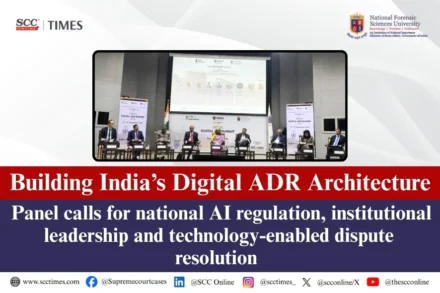
At the India Digital ADR Summit 2026, Justice M R Shah, Justice Rajesh Bindal, Justice Soniaben Gokani and leading arbitration professionals discussed the need for a coordinated digital ADR framework, safeguards for human judgment, common cybersecurity standards, institutional control over technology and India’s potential to contribute to international rule-making.
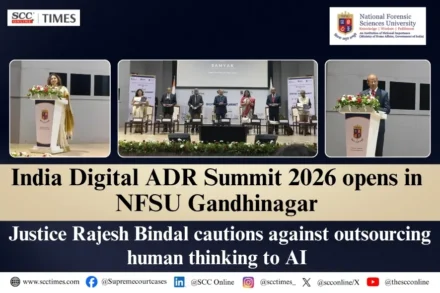
At the summit’s inaugural ceremony, marked by the ceremonial lighting of the lamp and the unveiling of SAMYAK, IDDRC’s new ODR platform, Prof. Purvi Pokhariyal outlined NFSU’s plans to digitise dispute resolution from filing to award.
The two-day summit will explore Artificial Intelligence, Online Dispute Resolution arbitration, mediation and cross-border dispute resolution, with a focus on building an innovative, secure and technology-enabled ADR ecosystem in India and beyond.
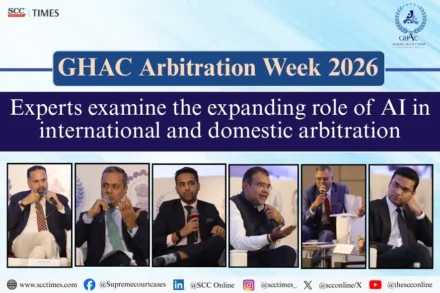
Experts at GHAC Arbitration Week 2026 examined how artificial intelligence is reshaping international and domestic arbitration, including its use in legal research, document review, cross-examination and drafting.
Amazon had sued Perplexity AI alleging that its agentic AI-based shopping tool has been accessing Amazon’s servers without authorisation. The District Court had granted injunction in favour of Amazon holding that it had proved its claims under Computer Fraud and Abuse Act and Comprehensive Computer Data Access and Fraud Act.
Supreme Court cautioned that AI may assist adjudication but can never be substituted for adjudication, setting aside a ₹425.27 crore Customs penalty after reliance on dubious AI-generated case laws.
While finding that “A Recent Entrance to Paradise” satisfies the limited threshold of “originality” under Section 13, the Copyright Office held that DABUS cannot be entered as an author under Section 2(d)(vi).
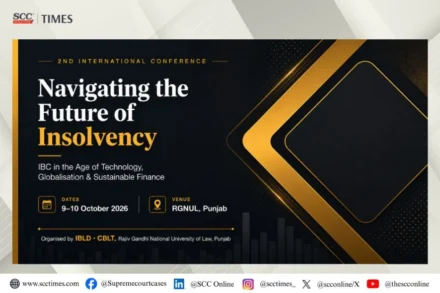
The Insolvency and Bankruptcy Law Division (IBLD), operating under the Centre for Business Laws and Taxation (CBLT) at Rajiv Gandhi National University of Law (RGNUL), Patiala, Punjab, is hosting the 2nd International Conference on “Navigating the Future of Insolvency: IBC in the Age of Technology, Globalization and Sustainable Finance” on 9—10 October 2026.
From a fake AI-generated precedent that voided an insolvency order to a stray bull attack that reshaped animal-welfare law, July 2026 was one of the Supreme Court’s most consequential months. Explore 30+ rulings spanning constitutional law, criminal justice, technology, and human rights, plus the appointments, transfers, and numbers behind the month’s docket.
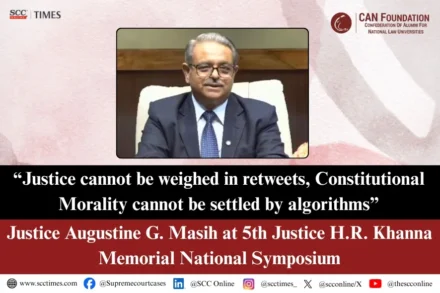
Speaking at the 5th Justice H.R. Khanna Memorial National Symposium organised by the CAN Foundation, Justice Augustine G. Masih reflected on Justice H.R. Khanna’s enduring constitutional legacy and examined how judicial independence is being tested in an era shaped by social media, artificial intelligence and unprecedented digital visibility.
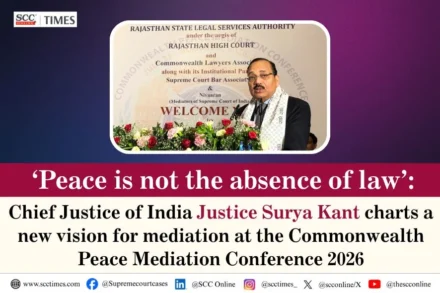
From ancient village panchayats and the Mahabharata to the Mediation Act, 2023 and modern commercial disputes, Chief Justice of India Justice Surya Kant outlined why mediation must become a central pillar of India’s justice delivery system and the Rule of Law.
This is India’s first judicial ruling to consider the application of copyright law and the fair dealing exception under the Copyright Act 1957, in context of the training and operation of artificial intelligence systems, including large language models (LLMs).
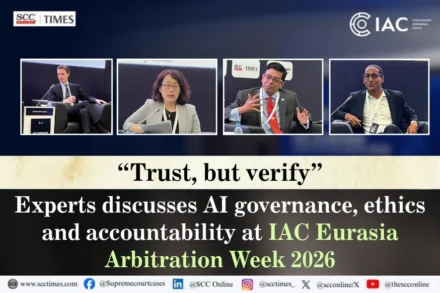
The panel examined the evolving role of artificial intelligence in arbitration, discussing its practical applications, ethical boundaries and the principles that should guide its responsible use.
Explore Supreme Court judgments from June 2026 covering defining decisions on recognition of a homemaker’s unpaid work, fundamental right to walk, EWS reservation in private colleges etc., and legal developments on appointment of judges, draft AI Regulations and many more stories.
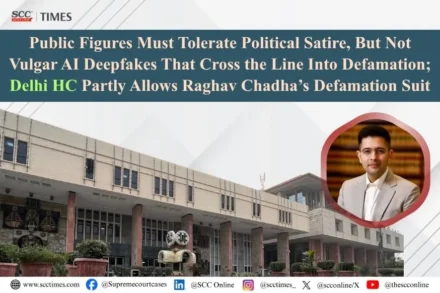
The Court reiterated that “a public figure should not be so thin-skinned so as to complain about any criticism of his decisions and such criticism ought to be viewed with humility”.
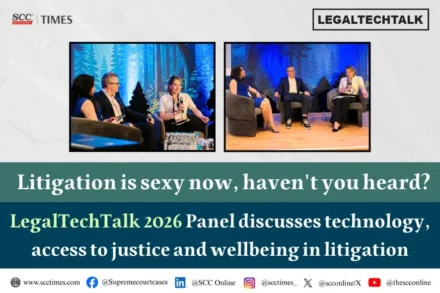
Litigation Is sexy now, haven’t you heard?: LegalTechTalk 2026 Panel discusses technology, access to justice and wellbeing in litigation
The panel brought together perspectives from social impact litigation, litigation support services and legal leadership to discuss contemporary developments in litigation. The speakers reflected on technology’s growing role in litigation practice, questions of accessibility and inequality in the use of AI tools, and the importance of wellbeing, leadership and organisational culture within legal teams.
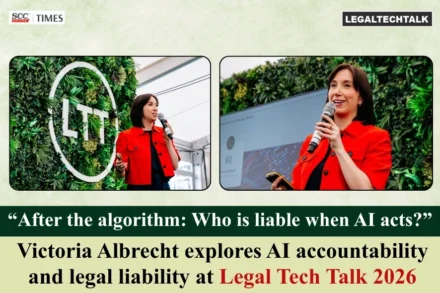
“After the algorithm: Who is liable when AI acts?”: Victoria Albrecht explores AI accountability and legal liability at Legal Tech Talk 2026
At Legal Tech Talk 2026, Ms. Victoria Albrecht examined the accountability challenges arising from autonomous AI systems, discussing questions of personhood, liability, governance, human oversight, attribution frameworks, and AI literacy in legal practice.
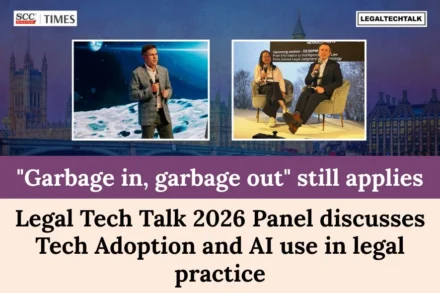
At Legal Tech Talk 2026, Christel Aguila and Dan Hauck discussed practical approaches to technology adoption and AI in legal practice, focusing on solving client problems, selecting appropriate technology, and the role of structured information in supporting AI tools.