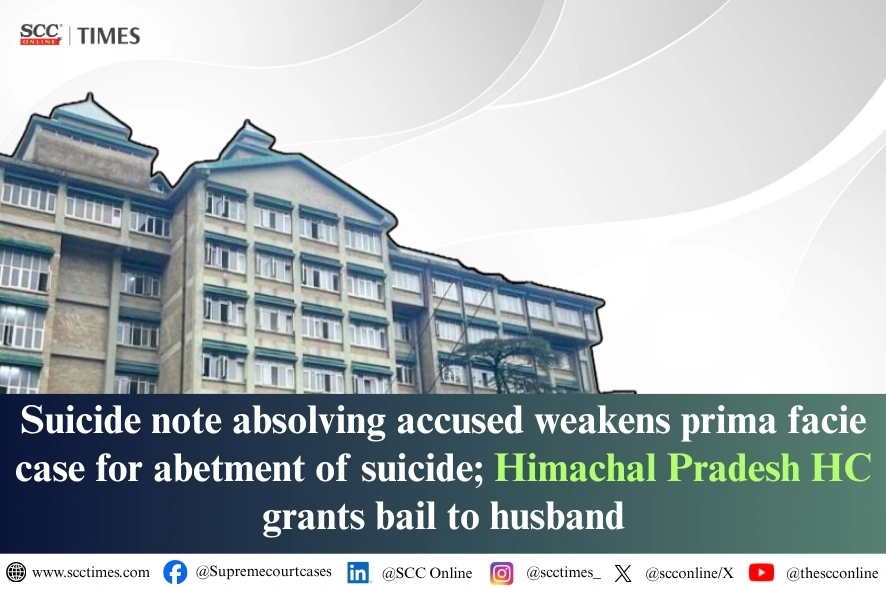
Himachal Pradesh High Court: While considering a petition seeking regular bail in an FIR registered for the offence of abetment of suicide under Section 108 read with Section 3(5), Nyaya Sanhita, 2023 (BNS), a Single Judge Bench of Rakesh Kainthla, J., held that a suicide note absolving the accused weakens prima facie case for abetment of suicide. The Court observed that the suicide note stating that the deceased was committing suicide on her own and that no person should be harassed, carried greater prima facie value than earlier diary entries and letters alleging matrimonial harassment. Accordingly, the Court granted regular bail to the petitioner (husband) subject to stringent conditions.
Also Watch: Anger or Abetment of Suicide? Understanding Section 306 IPC
Background
The prosecution case originated from the suicide of a married woman who was found hanging in her residence on 2 June 2026. The informant stated that after marriage, the deceased and her husband used to quarrel frequently. They had a child who studied in Class XI. It was alleged that the husband and his mother asked the deceased to live separately in one room. The deceased had filed a maintenance petition and the maintenance awarded in her favour was not regularly paid, and that she was prevented from freely meeting her son. The informant further stated that on the morning of the incident the deceased called her and expressed that she was fed up with the behaviour of her husband and his mother and intended to do something. When the informant reached the residence, the deceased was found hanging.
During investigation, the police recovered a suicide note dated 2 June 2026 mentioning that she was committing suicide on her own, that she had no complaint against any person and that no one should be harassed on account of her death. The informant also produced 2 letters dated 6 September 2025 and the deceased’s diary entries recorded in 2014, wherein she had referred to harassment and strained marital relations. The investigation culminated in presentation of the charge-sheet before the competent court, and the husband’s mother was released on bail on 6 July 2026.
The husband contended that the allegations were generalised statement of matrimonial discord and did not disclose any specific proximity, intention or overt act sufficient to attract Section 108 BNS. It was submitted that the suicide note clearly stated that the deceased was committing suicide on her own and nobody should be harassed, that the diary entries and letters relied upon by the prosecution were not proximate in time, that the deceased had been residing separately, and that the investigation already stood completed. It was also pointed out that the co-accused had been granted bail. On the other hand, the State opposed the bail application and argued that the accused and his mother had continuously harassed the deceased, leaving her with no option except to end her life. According to the prosecution, the material collected during investigation was sufficient, at least prima facie, to satisfy the ingredients of Section 108 BNS.
Analysis
The Court referred to Pinki v. State of U.P., (2025) 7 SCC 314, wherein the Supreme Court reiterated that while granting the bail, the court has to keep in mind the nature of accusations, the nature of evidence in support thereof, the severity of the punishment which conviction will entail, the character, behaviour, means and standing of the accused, circumstances which are peculiar to the accused, reasonable possibility of securing the presence of the accused at the trial, reasonable apprehension of the witnesses being tampered with, the larger interests of the public or State and similar other considerations.
The Court also relied upon State of Rajasthan v. Balchand, (1977) 4 SCC 308, wherein it was observed that the normal rule is bail and not jail, except where the gravity of the crime or the heinousness of the offence suggests otherwise.
Examining the material on record, the Court noted that although the deceased had made diary entries in 2014 and had written letters in September 2025 alleging harassment, she had subsequently written a suicide note on the date of the incident specifically stating that she was committing suicide on her own and that no person should be harassed. The Court observed that the suicide note written on the date of occurrence was to be preferred to the diary entries of 2014 or letters of 2025. Consequently, the Court opined that the contents of the suicide note did not, prima facie, connect the husband with the commission of the alleged offence.
The Court further observed that it was undisputed that the deceased was residing separately from her husband and his mother. The status report did not disclose in what manner they could have harassed her despite residing separately. The Court also took note of the fact that no complaint against the husband or his mother was found between 2019 and 2026 and that the deceased had not approached the Protection Officer under the Protection of Women from Domestic Violence Act, 2005 (DV Act). Thus, the Court held that the material relied upon by the prosecution was prima facie insufficient to connect the husband to the commission of the crime.
The Court further noted that the charge-sheet had already been filed and the matter was listed for service of the accused, which indicated that the husband’s custodial interrogation was not required and that no fruitful purpose would be served by detaining him in custody. The Court also observed that since the co-accused had already been enlarged on bail, the husband was also entitled to bail on the principle of parity. The Court further noted that the accused was a permanent resident of Dharamshala and had roots in society, reducing any likelihood of absconding or not facing the trial.
While the State expressed apprehension that witnesses had not yet been examined and could be influenced upon the husband’s release, the Court observed that such apprehension was not sufficient to deny bail to the husband because it could be removed by imposing stringent conditions.
Also Read: Bombay HC quashes abetment of suicide proceedings; lays down test for ascertaining offence
Decision
Consequently, while allowing the petition, the Court directed the husband’s release on bail upon furnishing bail bonds in the sum of ₹1,00,000 with one surety in the like amount. The Court imposed conditions requiring the accused not to intimidate witnesses or tamper with evidence, to attend trial proceedings regularly, not to leave his address for a continuous period of 7 days without prior intimation, to surrender his passport, and to furnish and maintain his mobile and social media contact details with the police and the court. The Court clarified that violation of any condition would entitle the prosecution to seek cancellation of bail.
[Himesh Karki v. State of H.P., 2026 SCC OnLine HP 5784, decided on 9-9-2026]
Advocates who appeared in this case:
For the Petitioner: M/s Sheetal Vyas and Yug Singhal, Advocates.
For the Respondent: Jitender Sharma, Additional Advocate General.