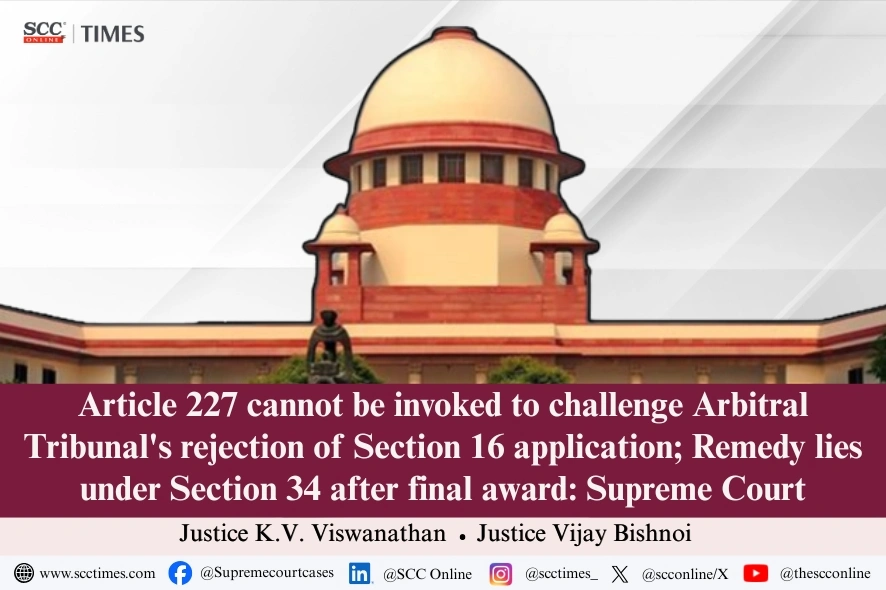
Supreme Court: In a batch of appeals against the interim order and the order passed by the Gauhati High Court , whereby the High Court stayed the notice issued by the Arbitral Tribunal to respondents and rejected the appellant’s preliminary objection regarding the maintainability of a revision petition under Article 227 of the Constitution, the Division Bench of K.V. Viswanathan and Vijay Bishnoi*, JJ., held that the High Court was not justified in entertaining the challenge under Article 227 to an order of the Arbitral Tribunal rejecting jurisdictional objections under Section 16 Arbitration and Conciliation Act, 1996 (1996 Act). The Court set aside the impugned orders, observing that interference under Article 227 is permissible only in exceptional cases involving a patent lack of inherent jurisdiction, and that the appropriate remedy against rejection of a Section 16 application lies under Section 34 of the Act, 1996 after the pronouncement of final arbitral award.
Background
The dispute arose out of a long-standing family partnership engaged in the tea business. The appellant had instituted a civil suit alleging mismanagement, financial irregularities, and seeking rendition of accounts against the partnership firm and related companies. An earlier application under Section 8 of the Act, 1996 seeking reference of the dispute to arbitration, had been rejected by the Trial Court and the High Court. However, in a subsequent appeal, the Supreme Court, with the consent of the parties, referred the disputes to arbitration and appointed a sole arbitrator. During the arbitral proceedings, certain respondent companies, which were non-signatories to the partnership deed containing the arbitration clause, challenged the tribunal’s jurisdiction by seeking deletion of their names from the proceedings.
Treating the applications as objections under Section 16 of the 1996 Act, the arbitral tribunal rejected them and held that the issue of maintainability against non-signatories would be decided during arbitration. The respondents thereafter invoked Article 227 of the Constitution before the Gauhati High Court, which stayed the notices issued to them and held that the revision petition was maintainable. Aggrieved, the appellant approached the Supreme Court.
Issue
Whether the High Court was justified in exercising its supervisory jurisdiction under Article 227 of the Constitution to entertain a challenge against an arbitral tribunal’s order rejecting jurisdictional objections under Section 16 Arbitration and Conciliation Act, 1996.
Analysis and Decision
The Court reiterated that the Arbitration and Conciliation Act, 1996, is a self-contained code intended to ensure expeditious dispute resolution with minimal judicial interference.
Referring to SBP & Co. v. Patel Engineering Ltd., (2005) 8 SCC 618 , Deep Industries Ltd. v. ONGC, (2020) 15 SCC 706, Punjab State Power Corporation Ltd. v. Emta Coal Ltd., (2020) 17 SCC 93 the Court held that although the constitutional power under Article 227 cannot be ousted, it must be exercised with extreme restraint in arbitral matters. Interference is permissible only where the arbitral tribunal’s order suffers from a patent lack of inherent jurisdiction that is apparent on the face of the record.
The Court found that the High Court had neither recorded any prima facie finding of such jurisdictional defect nor established any perversity in the tribunal’s order. It further observed that the question whether non-signatories are “veritable parties” to an arbitration agreement involves a detailed factual and legal inquiry which, in light of the Constitution Bench decision in Cox and Kings Ltd. v. SAP India Pvt. Ltd., (2024) 4 SCC 1, falls within the arbitral tribunal’s jurisdiction under Section 16.
The Court held that the High Court was not justified in entertaining the challenge under Article 227 of the Constitution against the Arbitral Tribunal’s order or in staying the arbitral proceedings. It reiterated that an order rejecting a jurisdictional objection under Section 16 of the Arbitration and Conciliation Act, 1996, is challengeable only under Section 34 after the final arbitral award is passed. Accordingly, set aside the High Court’s orders, dismissed the revision petition, and directed the arbitral tribunal to independently determine the respondents’ status as non-signatories while proceeding with the arbitration expeditiously.
[Manash Kamal Bezboruah v. Bokahola Tea Company Private Limited, 2026 SCC OnLine SC 1330 decided on 14-7-2026]
*Judgment Authored by: Justice Vijay Bishnoi
Advocates who appeared in this case:
For Appellant(s): M/S. Kmnp Law Aor, AOR Mr. Abir Phukan, Adv. Mr. V. Shyamohan, Adv. Mr. Prashant Bezboruah, Adv. Ms. Rishika Radhakrishnan, Adv. Mr. Shamik Sanyal, Adv.
For Respondent(s): Mrs. Madhavi Diwan, Sr. Adv. Ms. Priyanka Das, Adv. Ms. Megha Karnwal, AOR Ms. Nishat Nafisa Ahmed, Adv. Ms. Aishani Narain, Adv. Mr. Prashant Rawat, AOR Mr. Shaveer Ahmed, AOR Mr. Sharad Kamal Bezboruah, Adv.
Buy Arbitration and Conciliation Act, 1996 HERE
Buy Constitution of India HERE