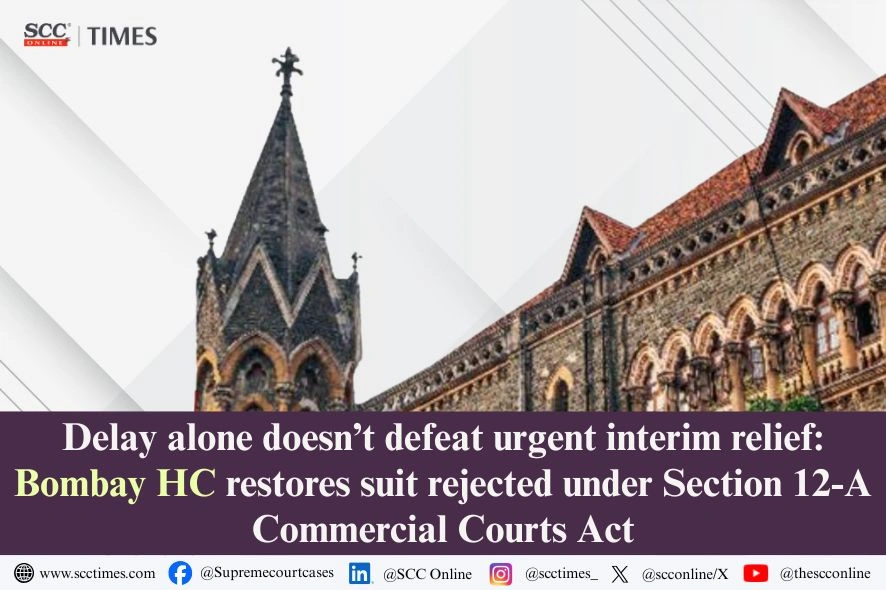
Bombay High Court: In a commercial first appeal challenging an order rejecting the plaint under Order 7 Rule 11(d), Civil Procedure Code, 1908 (CPC), for non-compliance with Section 12-A(1), Commercial Courts Act, 2015 (Commercial Courts Act), the Division Bench of R.I. Chagla and Farhan P. Dubash*, JJ., held that the trial court had adopted an unduly restrictive approach in determining whether the suit genuinely contemplated urgent interim relief. The Court held that while pre-institution mediation under Section 12-A, Commercial Courts Act is mandatory, a suit which genuinely contemplates urgent interim relief falls within the statutory exception. The Court accordingly set aside the order rejecting the plaint and restored the commercial suit.
Background
The appellant, a US-based delivery company, and the respondent, an Indian company engaged in collecting, processing and manufacturing colostrum powder, entered into an exclusive distribution agreement (EDA) on 26 June 2023, under which the appellant was appointed as the exclusive distributor of the product in the North American market for a 3-year term effective until June 2026. The EDA was governed by the laws of the State of Colorado, USA.
The EDA contained an “exclusivity exception” permitting the respondent to continue supplying the product to its existing customer, Pantheryx, subject to the terms specified in the agreement. The appellant subsequently placed a purchase order for 4200 kg of the product and contended that the respondent failed to supply the product within the stipulated period. The appellant further contended that during the subsistence of the EDA, the respondent was supplying the product to Glanbia Nutritionals despite the contractual exclusivity.
The respondent thereafter issued a legal notice dated 23 October 2024 stating that the EDA would stand terminated with effect from 23 November 2024, alleging that the appellant’s communication to Glanbia had damaged its reputation and caused loss of business. The appellant denied the allegations and contended that the respondent had failed to fulfil its obligations under the EDA.
The appellant subsequently instituted a suit seeking, inter alia, specific performance of the EDA, a declaration that its termination was non est, void ab initio and bad in law, damages and compensation for losses, and injunction restraining the respondent from breaching the EDA and entering into arrangements with third parties for supply of the product in North America. The respondent filed an application under Order 7 Rule 11(d) CPC seeking rejection of the plaint.
The plaint and interim application were e-filed on 13 April 2025, nearly six months after the termination notice, and the suit was registered on 18 April 2025. The appellant attributed the intervening period to the time required to obtain an expert affidavit on Colorado law (which governed the EDA), prepare and revise the pleadings, and have them executed and notarised in the USA before transmitting them to its advocates in Mumbai via the United States Postal Service.
The trial court allowed the application, holding that Section 12-A, Commercial Courts Act was mandatory, that no genuine urgency justifying exemption from pre-institution mediation had been established and that the prayers for interim injunction and preservation of exclusivity were merely a camouflage to bypass the statutory requirement.
Analysis
The Court noted that Section 12-A(1), Commercial Courts Act, engrafts a mandatory pre-condition to the institution of a commercial suit and that, save and except in cases falling within the statutory exception relating to urgent interim relief, compliance with the provision was mandatory. The Court further observed that the statutory exception was where the suit genuinely contemplated urgent interim relief and that the question whether a suit contemplated such relief was not determined solely by the plaintiff’s drafting or subjective assertion. The Commercial Court was the ultimate arbiter and was required to independently scrutinise whether the plea of urgency was genuine or merely a device to evade the statutory mandate.
The Court traced the mandatory character of Section 12-A(1) to the Supreme Court’s decision in Patil Automation (P) Ltd. v. Rakheja Engineers (P) Ltd., (2022) 10 SCC 1, which had authoritatively held that, save for suits genuinely contemplating urgent interim relief, compliance with Section 12-A is mandatory and a plaint filed in breach of it is liable to be rejected under Order VII Rule 11.
The Court referred to Supreme Court’s judgment in Yamini Manohar v. T.K.D. Keerthi, (2024) 5 SCC 815, Dhanbad Fuels (P) Ltd. v. Union of India, (2025) 9 SCC 424, Novenco Building & Industry A/S v. Xero Energy Engg. Solutions (P) Ltd., (2026) 4 SCC 815 and its own findings in Buildcon Sethia Construction v. Dipti Coop. Housing Society Ltd., 2025 SCC OnLine Bom 4958, Gundecha Estates (P) Ltd. v. IIFL Finance Ltd.1, IIFL Home Finance Ltd. v. Paramvir Developers (P) Ltd., 2026 SCC OnLine Bom 3858 and Image Developer v. Kamla Landmarc Real Estate Holding (P) Ltd., 2025 SCC OnLine Bom 3284 and observed a cumulative legal position that the exercise had to be undertaken objectively upon a holistic consideration of the plaint and the surrounding circumstances. It was highlighted that the court may examine the plaint as a whole, the documents annexed thereto, the nature of the dispute, the cause of action, the reliefs claimed and the attendant facts and circumstances existing on the date of institution of the suit. Further, the burden lay upon the plaintiff to establish a bona fide factual foundation for claiming exemption and that mere formal pleadings, bald assertions of urgency or a mechanical prayer for interim relief were insufficient.
Applying these principles, the Court observed that it was unable to concur with the trial court’s conclusion that the appellant had sought to invoke the exception merely by incorporating a routine prayer for interim relief. The Court noted that a meaningful reading of the plaint as a whole disclosed that the dispute arose out of the EDA under which the appellant claimed an exclusive right to distribute the respondent’s products in the North American market until June 2026. The plaint further proceeded on the basis that the respondent continued to supply the product directly to Glanbia in breach of the exclusivity covenant, purported to terminate the agreement and thereafter persisted in denying its contractual obligations. The Court held that, for the limited purpose of the enquiry under Section 12-A(1), Commercial Courts Act, these allegations constituted the factual foundation upon which the appellant asserted the necessity for immediate protective relief.
The Court further observed that the approach adopted by the trial court travelled beyond the limited enquiry contemplated under Section 12-A(1), Commercial Courts Act. The trial court had proceeded to examine whether the appellant would ultimately be entitled to an injunction and whether damages would constitute an adequate remedy. The Court held that such considerations were germane while adjudicating the interim application on its own merits and did not arise while considering an application under Order 7 Rule 11(d) CPC founded upon alleged non-compliance with Section 12-A(1), Commercial Courts Act. The enquiry at that stage was jurisdictional and not adjudicatory.
On the monetary claims, the Court observed that it was unable to agree with the trial court that their presence necessarily negatived the existence of urgency. The Court noted that the appellant had sought damages for the losses alleged to have been suffered, but the substantive reliefs were not confined to compensation alone. The plaint also sought specific performance of the EDA, a declaration that the purported termination was illegal, a perpetual injunction restraining further breaches of the exclusivity covenant and disclosure of the sales allegedly effected in violation of the agreement.
The Court emphasised that the exclusivity covenant constituted the very substratum of the commercial arrangement between the parties. According to the appellant, every sale effected by the respondent directly in the North American market otherwise than through the appellant constituted a continuing infraction of that covenant and progressively eroded the exclusivity for which the parties had expressly contracted. The Court held that these averments, if assumed to be correct for the limited purpose of the enquiry, disclosed an allegation of continuing invasion of the appellant’s contractual rights and not merely a completed breach giving rise to a claim for damages.
On the interval between the termination notice and institution of the suit, the Court highlighted that the chronology of events constituted a relevant circumstance while examining the genuineness of the plea of urgency, but could not, by itself, be regarded as conclusive. The Court held that these circumstances did not necessarily render the plea of urgency illusory and could not, by themselves, justify rejection of the plaint under Order 7 Rule 11(d) CPC.
The Court was also unable to agree with the trial court that the prayers for interim relief constituted a mere camouflage to circumvent pre-institution mediation. The Court emphasised that the plaint proceeded on the basis that the respondent continued to act in breach of the exclusivity covenant, that the agreement was wrongfully terminated, that the respondent persisted in denying its contractual obligations and that every continuing sale in the North American market outside the contractual arrangement further impaired the appellant’s contractual rights.
The Court held that these averments could not, at that stage, be characterised as inherently sham or devoid of factual foundation so as to warrant the conclusion that the appellant invoked the statutory exception merely as a device to bypass Section 12-A(1), Commercial Courts Act. The Court further observed that the trial court had attached undue significance to the form of the pleadings relating to urgency instead of examining their substance. Consequently, the Court noted that the statutory exception contained in Section 12-A(1), Commercial Courts Act stood sufficiently invoked and the trial court was not justified in rejecting the plaint at the threshold.
The Court held that the impugned order also disclosed a conflation of 2 distinct enquiries. The first enquiry under Section 12-A(1), Commercial Courts Act was jurisdictional and confined to determining whether the suit genuinely contemplated urgent interim relief. The second concerned the grant or refusal of interim relief on merits. The Court highlighted that the trial court, while considering the application under Order 7 Rule 11(d) CPC, had entered upon matters falling within the latter enquiry and thereby effectively prejudged issues which properly arose for consideration while deciding the interim application.
Considering the cumulative effect of the pleadings, the documents annexed thereto and the attendant circumstances existing on the date of institution of the suit, the Court was satisfied that the plaint disclosed a bona fide factual foundation for the appellant’s assertion that immediate judicial intervention was necessary to preserve the contractual rights claimed under the EDA pending adjudication of the suit. The Court held that the suit could not be characterised as one in which the plea of urgency was illusory or merely colourable and that the statutory exception contained in Section 12-A(1), Commercial Courts Act stood sufficiently invoked.
Decision
The Court accordingly held that although the trial court had correctly appreciated the mandatory nature of Section 12-A(1), Commercial Courts Act, it had fallen into error in applying the settled principles governing the statutory exception relating to urgent interim relief. The Court observed that the impugned order proceeded upon an unduly restrictive reading of the plaint, accorded determinative weight to considerations germane to the merits of the interim application and thereby travelled beyond the limited jurisdiction exercisable under Order 7 Rule 11(d) CPC.
Consequently, the Court allowed the commercial first appeal and set aside the trial court’s order dated 9 December 2025 rejecting the plaint under Order 7 Rule 11(d) CPC. The Court restored the Commercial Suit No. 2 of 2025 to the file of the trial court, to proceed from the stage immediately preceding the impugned order and futher directed the trial court to consider and decide the appellant’s interim application on its own merits, uninfluenced by the observations in either the impugned order or the present judgment.
The Court also kept open all contentions of the parties on the merits of the suit and the interim application and disposed of the commercial first appeal with no order as to costs.
[High Point Supply Company LLC v. Agati Healthcare (P) Ltd., 2026 SCC OnLine Bom 9115, decided on 5-8-2026]
*Judgment authored by: Justice Farhan P. Dubash
Advocates who appeared in this case:
For the Appellant: Simil Purohit, Senior Counsel with Ameya Gokhale, Kriti Kalyani, Chintan Gandhi and Abhishek Mookherjee i/b Shardul Amarchand Mangaldas & Co.
For the Respondent: Shanay Shah a/w Vivek Sharma and A.A. Kapadia i/b Sujit Lahoti and Associates
1. Order dated 17 July 2025 passed in Interim Application (L) No. 16800 of 2025 in Commercial Suit (L) No. 8617 of 2025