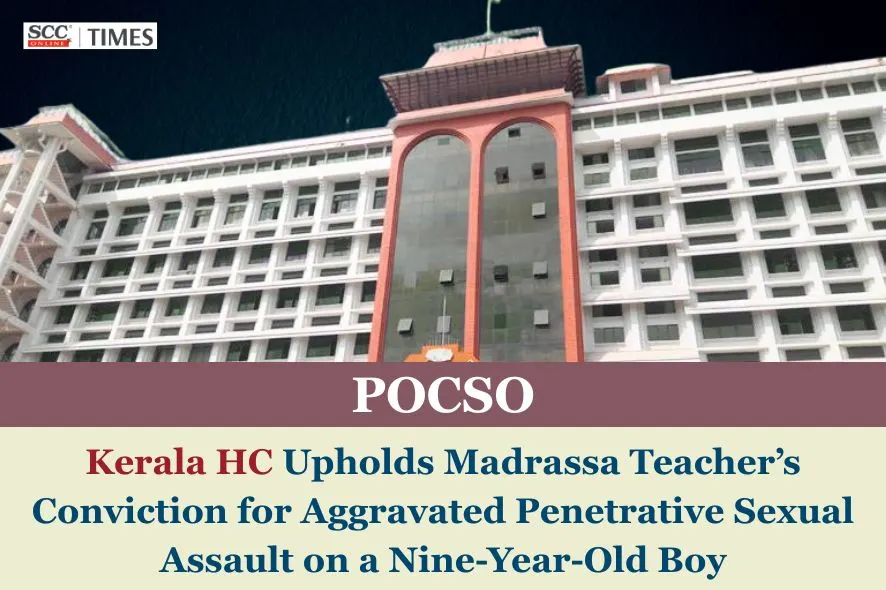
Kerala High Court: In a criminal appeal filed by the accused against the judgment passed by Special Court under the Protection of Children from Sexual Offences (POCSO) Act, 2012, a Single Judge Bench of A. Badharudeen, J. upheld the conviction and sentence imposed on the accused for offences punishable under Section 377, Penal Code, Section 5(f) and (m) read with Section 6, Section 9(m) and (o) read with Section 10, Protection of Children from Sexual Offences Act, 2012 (POCSO Act), and Section 75, Juvenile Justice (Care and Protection of Children) Act, 2015 (JJ Act).
The Court held that the testimony of a child victim, if found to be credible, trustworthy, and free from material contradictions, can form the sole basis for conviction even in the absence of direct corroborative evidence. Upon reappreciating the evidence on record, the Court found the testimony of the survivor (PW 1) to be wholly reliable and sufficiently supported by the surrounding circumstances and the evidence of other prosecution witnesses. The Court further observed that vague allegations of false implication based on sectarian differences, unsupported by cogent evidence, cannot displace an otherwise proved prosecution case.
Facts
The accused was serving as an Usthad (teacher) at Noorul Hidaya Madrassa, Mullassery, and was residing in a building owned by Sidhiquel Akbar Juma Masjid adjacent to the Madrassa. According to the prosecution, on 25 August 2020, a nine-year-old student of the Madrassa visited the accused’s room to seek clarification regarding an online examination. During this visit, the accused allegedly subjected the child to acts amounting to sexual assault.
Based on the complaint and subsequent investigation, the accused was charged with offences punishable under Section 377, Penal Code, 1860, Section 4(2) read with Sections 3(d), 6(1) read with Sections 5(f) and (m) and 8 read with Section 7, and Section 10 read with Section 9(o) and (m), POCSO Act, as well as Section 75, JJ Act.
Issues for Consideration
-
Whether the Special Court erred in holding the accused guilty of the offence punishable under Section 377, Penal Code, 1860?
-
Whether the Special Court erred in convicting the accused for the offence punishable under Section 5(f) read with Section 6(1), POCSO Act?
-
Whether the Special Court erred in convicting the accused for the offence punishable under Section 5(m) read with Section 6(1), POCSO Act?
-
Whether the Special Court erred in finding the accused guilty of the offence punishable under Section 9(m) read with Section 10, POCSO Act?
-
Whether the Special Court erred in finding the accused guilty of the offence punishable under Section 9(o) read with Section 10, POCSO Act?
-
Whether the Special Court erred in convicting the accused for the offence punishable under Section 75, Juvenile Justice (Care and Protection of Children) Act, 2015?
-
Whether the impugned judgment of conviction and sentence warranted interference by the High Court?
Analysis and Decision
The Court said that, upon a reappreciation of the evidence on record, no material contradictions were found in the testimony of the child survivor (PW 1) or the other prosecution witnesses that would justify disbelieving their version of events. The Court found the evidence of PW 1 to be wholly reliable and sufficiently corroborated by the surrounding circumstances and other evidence adduced during trial.
The Court rejected the accused’s contention that PW 1 was not a credible or “sterling” witness, observing that nothing emerged during cross-examination to undermine the reliability of his testimony. The Court further found no merit in the defence argument that the prosecution was motivated by sectarian differences within the Muslim community, noting that no convincing evidence had been produced in support of such a claim.
Accordingly, the Court concluded that the prosecution had proved beyond reasonable doubt that the accused committed the offences punishable under Section 377, Penal Code, Section 5(f) and (m) read with Section 6(1), and Section 9(m) and (o) read with Section 10 POCSO, as well as Section 75, JJ Act. The findings of conviction recorded by the Special Court were therefore affirmed.
The High Court further observed that the Special Court had imposed only the statutory minimum sentence prescribed under Section 6(1), POCSO Act for offences under Section 5(f) and (m), namely, rigorous imprisonment for 20 years. Since the sentence awarded was the minimum punishment mandated by law, no reduction was warranted.
The criminal appeal was dismissed, and the conviction as well as the sentence imposed by the Special Court were confirmed.
[Rasheed v. State of Kerala, 2026 SCC OnLine Ker 5660, decided on 12-6-2026]
Advocates who appeared in this case:
For Appellant: C.P. Udayabhanu,Navaneeth N. Nath,Rassal Janardhanan A.,Abhishek M. Kunnathu, Boban Palat,P.U. Pratheesh Kumar,P.R. Ajay,K.U. Swapnil,Pranav Ushakar,Swetha Bijumon
For Respondent: Vipin Narayan.A, Sr.Public Prosecutor
Buy Protection of Children from Sexual Offences Act, 2012 HERE
Buy Penal Code, 1860 HERE
Buy Juvenile Justice (Care and Protection of Children) Act, 2015 HERE