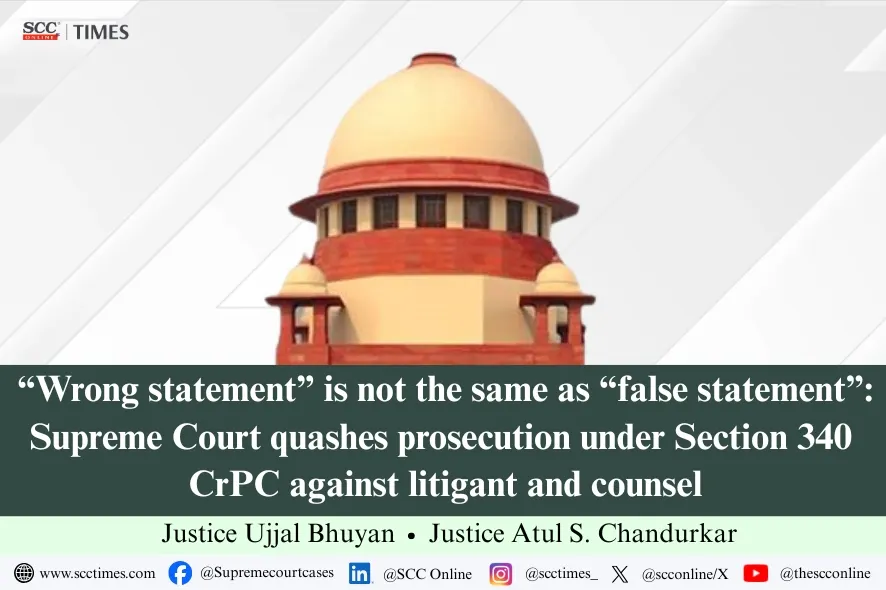
Supreme Court: While deciding an appeal concerning the initiation of criminal proceedings under Section 340, Criminal Procedure Code, 1973 (CrPC), against a litigant and his counsel for allegedly making false statements in pleadings, a Division Bench of Ujjal Bhuyan and Atul S. Chandurkar*, JJ., held that a mere prima facie finding of “wrong statements” is insufficient to direct prosecution for offences under Sections 193, 199 and 200, Penal Code, 1860 (IPC). The Court observed that before invoking Section 340 CrPC, the Court must record its satisfaction not only that a prima facie case of making a “false statement” is made out, but also that it is “expedient in the interests of justice” to hold such an inquiry. Holding that inadvertent or typographical errors cannot, by themselves, be equated with deliberate falsehood, and finding that the statutory requirements under Section 340 CrPC had not been satisfied, the Court quashed the orders directing prosecution and allowed the appeal.
Background
The dispute arose out of a civil suit instituted by the second respondent seeking a permanent injunction against the predecessors-in-title of the first appellant to restrain them from interfering with the plaintiffs’ possession and enjoyment of the suit property. During the pendency of the suit, the trial court granted a temporary injunction in favour of the plaintiffs. Subsequently, the first appellant purchased the suit property and was impleaded as a defendant. Alleging violation of the injunction order, the plaintiffs-initiated proceedings under Order 39 Rule 2-A, Civil Procedure Code, 1908, upon which the trial court directed restoration of the earlier position and issued a show-cause notice to the defendant. Aggrieved thereby, the defendant preferred a miscellaneous appeal before the appellate court, which stayed the operation of the trial court’s order.
The plaintiffs thereafter alleged that the defendant and his counsel had made false statements in the memorandum of appeal and the accompanying stay application, on the basis of which the appellate court had granted the interim stay. Although the Bombay High Court declined to entertain the plaintiffs’ criminal contempt petition, it granted them liberty to initiate proceedings under Section 340 CrPC. Acting on such liberty, the plaintiffs filed an application before the appellate court, which held that a prima facie case was made out for prosecuting the defendant and his counsel for offences punishable under Sections 193, 199 and 200 IPC, and directed filing of a complaint. The High Court affirmed the said order in appeal under Section 341 CrPC. Challenging these orders, the appellants approached the Supreme Court, contending that the alleged false statements were merely typographical errors that had been sought to be corrected prior to the filing of the Section 340 application, and that there was no deliberate intention to mislead the Court so as to justify initiation of criminal proceedings.
Analysis
The Court held that the courts below erred in directing initiation of proceedings under Section 340 CrPC merely on the basis of a prima facie finding that “wrong statements” had been made in the memorandum of appeal and the stay application drafted by the defendant’s counsel. Reiterating the settled position in Iqbal Singh Marwah v. Meenakshi Marwah, (2005) 4 SCC 370 the Court observed that before exercising powers under Section 340 CrPC, the Court must not only be satisfied that a prima facie case exists regarding an offence referred to in Section 195(1)(b) CrPC but must also form an opinion that it is “expedient in the interests of justice” to hold such an inquiry. The appellate court failed to record any such satisfaction. The Court further drew a clear distinction between a “wrong statement” and a “false statement”, holding that while inadvertent or erroneous statements may amount to wrong statements, a false statement necessarily denotes a deliberate intention to deceive and is the threshold required for offences under Sections 193, 199 and 200 IPC. Since the order under Section 340 CrPC recorded only that “wrong statements” had been made, it failed to satisfy the statutory requirement for directing prosecution.
The Court also noted that the alleged errors had already been sought to be corrected by the appellants through an application pointing out typographical mistakes, filed much before the application under Section 340 CrPC. It held that the High Court, while hearing the appeal under Section 341 CrPC, impermissibly improved upon the trial court’s order by recording findings that the appellants had made “false statements” and that initiation of prosecution was expedient in the interests of justice, although no such findings had been returned by the Court of first instance. Observing that proceedings under Section 340 CrPC should not ordinarily be initiated during the pendency of substantive proceedings, as cautioned by the Constitution Bench in Iqbal Singh Marwah, the Supreme Court concluded that no case whatsoever had been made out for directing criminal prosecution.
Decision
Accordingly, it quashed the orders of the appellate court and the High Court, dismissed the application under Section 340 CrPC, and allowed the appeal.
[Prabhakar Yeshwant Masram v. Sou Tula Namdeorao Jaipurkar, 2026 SCC OnLine SC 1367, decided on 21-7-2026]
*Judgement authored by: Justice Atul S. Chandurkar
Buy Code of Criminal Procedure, 1973 HERE