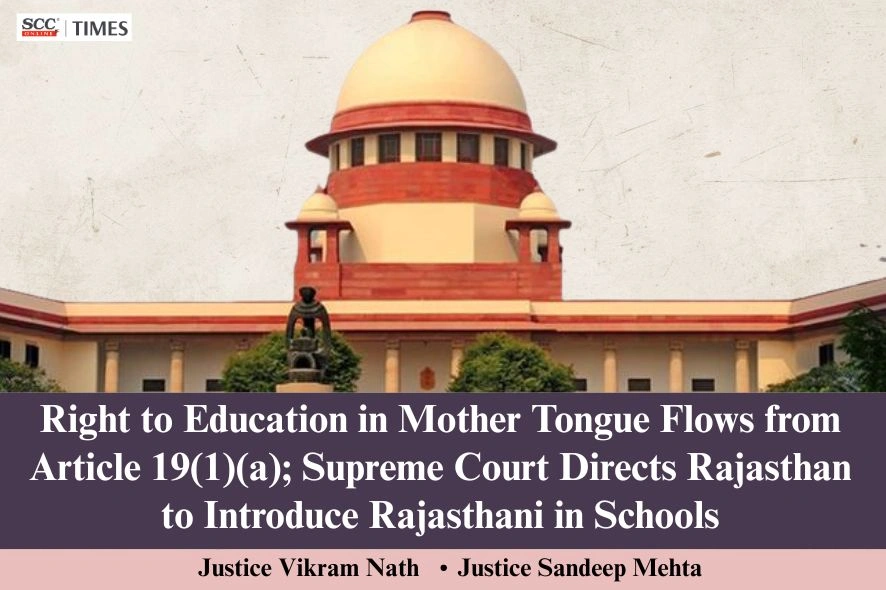
Supreme Court: In a significant judgment concerning linguistic rights and the constitutional promise of meaningful education, the Division Bench of Vikram Nath and Sandeep Mehta*, JJ., held that the right to receive education in one’s mother tongue found its normative basis in Article 19(1)(a) of the Constitution and that “true value of this freedom lies not merely in the ability to communicate, but in the ability to understand, internalise, and process information so as to make informed choices”.
The Court set aside the impugned judgment of the Rajasthan High Court and issued following directions to the State of Rajasthan:
-
Formulate an appropriate and comprehensive policy for implementation of mother tongue-based education in line with the National Education Policy, 2020 (NEP 2020).
-
Recognise and accord due status to the Rajasthani language as a local/regional language for educational purposes.
-
Progressively facilitate its adoption as a medium of instruction at foundational and preparatory stages and subsequently at higher levels.
-
Introduce Rajasthani as a subject in all schools, government and private, in a phased and progressive manner.
Factual Matrix
The appellants approached the Rajasthan High Court through a public interest litigation (PIL) seeking two principal reliefs, 1. inclusion of Rajasthani language in the examination syllabus for recruitment to the posts of Teacher Grade-III Level-I and Level-II under the Rajasthan Eligibility Examination for Teachers, 2021 (REET-2021); and 2. a direction to the State authorities to impart education to children in the Rajasthani language or relevant local language.
The High Court dismissed the writ petition on the ground that issuance of a writ of mandamus required the establishment of an enforceable legal right coupled with a corresponding statutory duty on the State, which had not been demonstrated.
Aggrieved by the dismissal, the appellants approached the Supreme Court by way of special leave under Article 136 of the Constitution.
Appellants’ Contentions
The appellants contended that the Rajasthani-speaking population constitutes a “linguistic minority” within Rajasthan because Hindi is the principal official language of the State. It was argued that Rajasthani possesses a distinct linguistic identity and cultural heritage and therefore falls within the protection of Article 350-A of the Constitution.
The appellants further argued that the right to receive education in one’s mother tongue is implicit in Article 19(1)(a), since freedom of speech and expression includes the right to meaningfully receive and comprehend information. It was stated that Article 19(1)(a) read with Article 21-A, imposes an obligation upon the State to provide intelligible and effective education.
It was also submitted that the State had discriminated against Rajasthani by permitting languages such as Gujarati, Punjabi and Sindhi in school curricular while excluding Rajasthani despite its widespread usage and cultural significance and such exclusion violated Article 14 of the Constitution.
Reliance was also placed upon the NEP 2020, which recognised that children understand concepts more effectively when taught in their home language or mother tongue.
Respondents’ Contentions
The respondents contended that education and teacher recruitment were presently undertaken only in respect of languages recognised in the Eighth Schedule to the Constitution. Since Rajasthani had not been included in the Eighth Schedule, there existed no policy or administrative framework for adopting it as a medium of instruction or compulsory subject.
The State further argued that Article 350-A is merely directory and does not create enforceable rights capable of being implemented through a writ of mandamus. It was also urged that Rajasthani speakers do not constitute a linguistic minority within Rajasthan.
The respondents also argued that the NEP 2020 is merely an executive policy statement without statutory force and therefore creates no enforceable rights or obligations.
Analysis
Before entering into the controversy, the Supreme Court undertook an elaborate discussion on the historical, constitutional and pedagogical significance of language, particularly mother tongue-based education, placing the issue in a broader constitutional framework.
Historical and Constitutional Background
The Court traced the historical importance of language as the medium through which knowledge, culture, and values are transmitted across generations. It observed that the Constituent Assembly was acutely conscious of “the unifying potential of language and its capacity to bind together the diverse cultural fabric of India, particularly in the context of education and nation building”.
The Court discussed Part XVII (Articles 343 to 351) of the Constitution dealing with languages and noted that the Constitution originally recognised 14 languages in the Eighth Schedule, which now stands expanded to 22 languages through constitutional amendments. It emphasised that the framers of the Constitution recognised the importance of the mother tongue in education and university instruction.
“In the deliberations of the Constituent Assembly of India, the question of language was not confined to matters of official usage, but extended to concerns of far-reaching import, including the use of the mother tongue at the primary stage of education, an issue of enduring relevance in every multilingual society characterised by substantial linguistic diversity, as well as the determination of the medium of instruction in universities and other institutions of higher learning.”
The Court referred to the insertion of Article 350-A by the 7th Constitutional Amendment, intended to ensure that States shall provide adequate facilities for instruction in the mother tongue at the primary stage for children belonging to linguistic minority groups.
The Court also examined the recommendations of the D.S. Kothari Commission (1964—66), which advocated for 3-language formula and stressed that regional language should ordinarily be the medium of instruction. These recommendations were later adopted in the National Policies on Education of 1968, 1986 and 1992.
The Court thereafter referred to the Right of Children to Free and Compulsory Education Act, 2009 (Right to Education Act), particularly Section 29(2)(f), which provides that the medium of instruction shall, “as far as practicable”, be in the child’s mother tongue, thereby recognising the foundational role of the mother tongue in facilitating meaningful learning.
Discussing the NEP 2020, the Court noted that NEP 2020 emphasised on the use of home language, local language or regional language as the medium of instruction up to at least Grade V and preferably till Grade VIII. It further recognised the role of technology in overcoming linguistic barriers and facilitating comprehension in the child’s home language.
Also Read: National Education Policy 2020 approved; Mother tongue as medium of instruction till Class 5
Relief Regarding REET-2021
The Court observed that the principal relief concerning inclusion of Rajasthani language in REET-2021 had become infructuous because the recruitment process had already concluded and attained finality and therefore, any direction at that stage would unsettle a completed recruitment exercise.
However, the Court clarified that the issues raised in the present matter extended beyond the specific examination and involved broader constitutional concerns relating to language, education and public employment.
“Question of language in education transcends the confines of administrative convenience or pedagogical preference; it strikes at the very core of inclusivity, identity, and meaningful access to the learning process.”
Importance of Education and Language
The Court described education as a transformative force capable of lifting individuals from adverse social and economic conditions. It emphasised that education is not merely acquisition of knowledge and communication but a tool of empowerment, “enabling individuals to overcome systemic disadvantages, break cycles of poverty, and contribute meaningfully to the society”.
The Court observed that Articles 21, 21-A, 41, 45, 51-A(k), and 350-A collectively establish education as a constitutional entitlement coupled with a corresponding public duty on the State.
The Court stressed that quality education is inseparable from the medium through which it is imparted. Education delivered in a language not understood by the child cannot meaningfully qualify as quality education. The Constitution mandates the State to adopt measures that facilitate effective learning using child’s chosen language, or mother tongue, thereby delivering education that is truly substantive, inclusive, and empowering.
“Instruction that cannot be adequately grasped by the students due to language barriers or unfamiliar mediums of instruction cannot, in any meaningful sense, be regarded as quality education, for the very purpose of education is to equip the learner with knowledge, understanding, and skills.”
The Court referred to State of U.P. v. Anand Kumar Yadav, (2018) 13 SCC 560, where it was observed that the right to education necessarily means the right to quality education and Devesh Sharma v. Union of India, (2023) 18 SCC 339, wherein the transformative purpose of the Right to Education Act and the significance of quality elementary education were highlighted. The Court also emphasised that the Right to Education Act was not enacted merely to fulfil the formality of free education but to ensure meaningful and equitable quality education.
The Court explained that Section 29(2)(f), Right to Education Act embodies the pedagogical principle that instruction in the child’s mother tongue improves comprehension and prevents alienation and fear in the learning process. “By mandating that curricular design and evaluation frameworks duly account for the medium of instruction, Section 29(2)(f) reinforces the principle that quality education must be intelligible, inclusive, and conducive to the holistic development of the child.” It further observed that NEP 2020 reflects a considered governmental policy that education imparted in a familiar language improves conceptual clarity and long-term learning outcomes. The NEP 2020 reinforces the constitutional vision underlying under Articles 19(1)(a), 21, 21-A, 41, 45, 51-A(k) and 350-A and ensuring “education that is accessible, inclusive, and meaningful”.
Mother Tongue and Article 19(1)(a)
The Court held that the right to receive education in one’s mother language flows from Article 19(1)(a) and the freedom of speech and expression includes not only the right to communicate information but also the right to receive and understand information meaningfully.
“Instruction in the mother language, or a language of choice, fortifies the learner’s conceptual clarity, ensures deeper cognitive engagement, and secures the constitutional promise of meaningful access to knowledge.”
The Court referred to English Medium Students Parents Assn. v. State of Karnataka, (1994) 1 SCC 550, wherein the Court emphasised importance of mother tongue instruction and regional languages and stated that the mother tongue serves not merely as a medium of communication but also as a vital instrument for cognitive growth, cultural continuity and meaningful participation in the educational process and State of Karnataka v. Associated Management of English Medium Primary & Secondary Schools, (2014) 9 SCC 485, where the Court had recognised that Article 19(1)(a) includes the freedom of a child or on his behalf his parent or guardian, to choose the medium of instruction at the primary level.
Criticism on State Inaction
The Court expressed serious concern that despite constitutional provisions, statutory mandates and policy declarations, there had been little effective implementation at the ground level. It observed that the continued failure of States to operationalise mother tongue-based education undermines statutory directives and risks violating fundamental rights.
The Court remarked that rights existing merely on paper without implementation are effectively no rights at all. It criticised the tendency of announcing schemes and frameworks “with much fanfare and panache” without translating them into lived realities for children.
The Court termed the stand taken by the State of Rajasthan as “myopic” and “lackadaisical”. The Court observed that the State’s justification that only Eighth Schedule languages were being taught in schools amounted to an attempt to sidestep constitutional obligations. The absence of policy was wrongly projected as a defence rather than a deficiency requiring rectification.
The Court held that constitutional rights cannot be permitted to remain illusory because of executive inertia and that once the Union had recognised the necessity of imparting education in a language intelligible to the child, corresponding obligations arose upon the States.
Lastly, the Court noted that Rajasthani was already being taught in universities such as Jai Narain Vyas University, Maharaja Ganga Singh University and University of Rajasthan, which demonstrated institutional and pedagogical acceptance of the language.
Decision and Directions
The Court allowed the appeal and set aside the impugned judgment of the Rajasthan High Court.
The Court directed the State of Rajasthan to
-
Formulate an appropriate and comprehensive policy for effective implementation of the constitutional mandate relating to mother tongue-based education, particularly in light of the NEP 2020.
-
Recognise and accord due status to Rajasthani as a local/regional language for educational purposes.
-
Progressively facilitate adoption of Rajasthani as a medium of instruction at foundational and preparatory stages and thereafter at higher levels.
-
Introduce Rajasthani as a subject in all schools, government and private, in a phased and progressive manner.
-
File a compliance affidavit before the Court by 25 September 2026.
-
Listed the matter on 30 September 2026 for consideration of compliance.
[Padam Mehta v. State of Rajasthan, 2026 SCC OnLine SC 849, decided on 12-5-2026]
*Judgment by Justice Sandeep Mehta