Disclaimer: This has been reported after the availability of the order of the Court and not on media reports so as to give an accurate report to our readers.
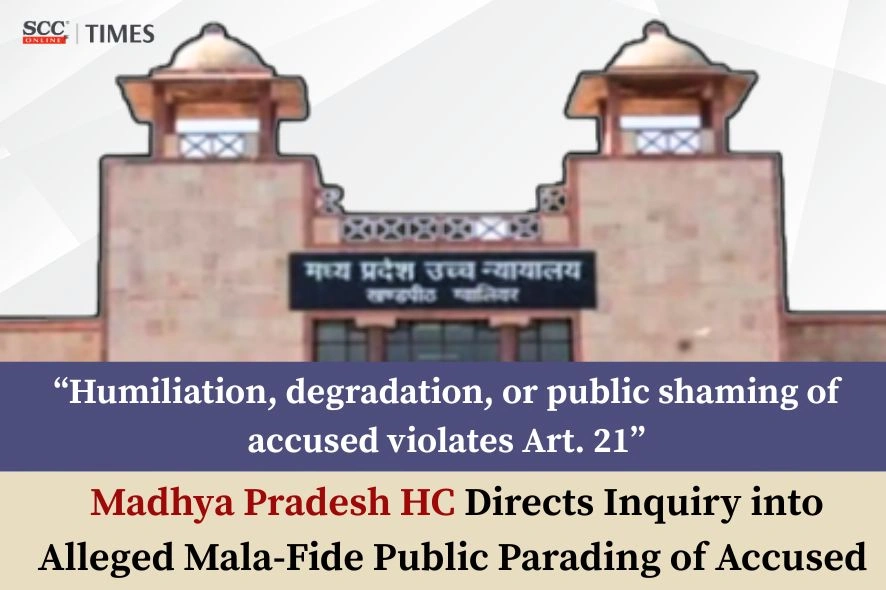
Madhya Pradesh High Court: In a writ petition filed by an accused who was allegedly paraded in public while being taken from the police station to the Court in public and media view, the Single Judge Bench of Himanshu Joshi, J., disposed of the petition, holding that the accused could not establish, by cogent and unimpeachable material, that the act of the police personnel amounted to a deliberate and malicious public parade to infringe his fundamental rights under Article 21 of the Constitution. However, considering the nature of the allegations made and in order to ensure fairness, the Court directed the Superintendent of Police to conduct a preliminary enquiry into the allegations within 60 days.
Background
The accused was an agriculturist aged about 35 years and a resident of Nahar Colony, Bareli, District Raisen. In 2018, his Bolero vehicle accidentally hit the railing of the Rajshree Hotel. Aggrieved, the owner of Rajshree Hotel lodged an FIR under Sections 294, 323, 452, 427, and 506-B, Penal Code, 1860 (IPC).
After the FIR registration, the accused and other co-accused persons voluntarily presented themselves before the police authorities through their family members. However, certain police officials allegedly demanded an illegal gratification of ₹2 lakhs and threatened that if the amount was not paid, the entire family would be falsely implicated in serious criminal cases.
Thereafter, on 17 November 2018, Respondents 3 to 8, police personnel posted at Police Station Bareli, allegedly paraded the accused and other co-accused persons on foot from the police station to the Bareli Court, covering a distance of approximately 2.5 km along a public road/national highway, in full public view and in the presence of media persons. The accused contended that there was no legal necessity or justification for this act, and that it was intended to humiliate and degrade him. Photographs depicting the said incident have been filed, which prima facie indicate that he was exposed to public gaze during the said procession.
He further contended that he had no criminal antecedents and was merely an accused in the aforesaid case, and therefore, such treatment was wholly unwarranted and violative of his fundamental rights. The accused’s brother submitted representations before the competent authorities seeking action against the erring police personnel. However, no action has been taken to date, hence the present petition was filed.
Analysis
After hearing the parties and perusing the material, the Court found that the issue involved in the present case touched upon the fundamental right to dignity of an individual. The Court reiterated that Article 21 of the Constitution not only guarantees protection of life and personal liberty, but also encompasses the right to live with human dignity. “Any action of the State or its instrumentalities which results in humiliation, degradation, or public shaming of an individual, without authority of law, would fall foul of the said constitutional mandate.”
At the same time, the Court stated that it was equally settled that mere transportation of an accused from a police station to the Court for production before the Magistrate, even if done on foot, under unavoidable circumstances, would not ipso facto constitute a violation of fundamental rights, unless it is shown that such an act was done deliberately to humiliate or with mala fide intention.
The Court added that the concept of presumption of innocence is a cornerstone of criminal jurisprudence, and an accused person cannot be subjected to any form of punishment or public humiliation before conviction. The alleged act of parading the accused in public, if established, would amount to treating the accused as a convict without due process of law. Such conduct had been consistently deprecated by constitutional courts as being violative of human rights and constitutional guarantees.
The Court stated that the explanation furnished by the respondents that due to the non-availability of an official vehicle, the accused persons were taken on foot to the Court, could not be brushed aside lightly, particularly when production before the Court within the stipulated time is a statutory requirement.
Furthermore, the Court stated that the representations submitted by the accused indicated that a grievance was raised before the authorities, mere non-action on such representations would not automatically warrant issuance of a writ of mandamus for initiating disciplinary proceedings, unless a prima facie case of misconduct is established.
Considering the aforementioned, the Court held that the accused had not been able to establish, by cogent and unimpeachable material, that the act of the police personnel amounted to a deliberate and malicious public parade to infringe his fundamental rights under Article 21 of the Constitution. However, considering the nature of the allegations made and to ensure fairness, the Court directed the competent authority to examine his grievance in accordance with the law.
Accordingly, the Court disposed of the writ petition with a direction to the Superintendent of Police, Raisen, to consider and decide the representations submitted by the accused by conducting a preliminary enquiry into the allegations within 60 days, if not already conducted. The enquiry shall take into consideration the material placed on record and shall be conducted by an officer not below the rank of Additional Superintendent of Police, who is not connected with the incident in question. If the allegations are substantiated, appropriate departmental and legal action shall be initiated against the erring officials in accordance with the law. The outcome of the enquiry shall be communicated to the accused forthwith.
[Sangram Singh Rajoot v. State of Madhya Pradesh, 2026 SCC OnLine MP 10914, decided on 28-4-2026]
Advocates who appeared in this case:
For the petitioner: Shikha Paliwal
For the respondents: Deepak Sahu and Anmol Rawat
Buy Constitution of India HERE

Buy Penal Code, 1860 HERE