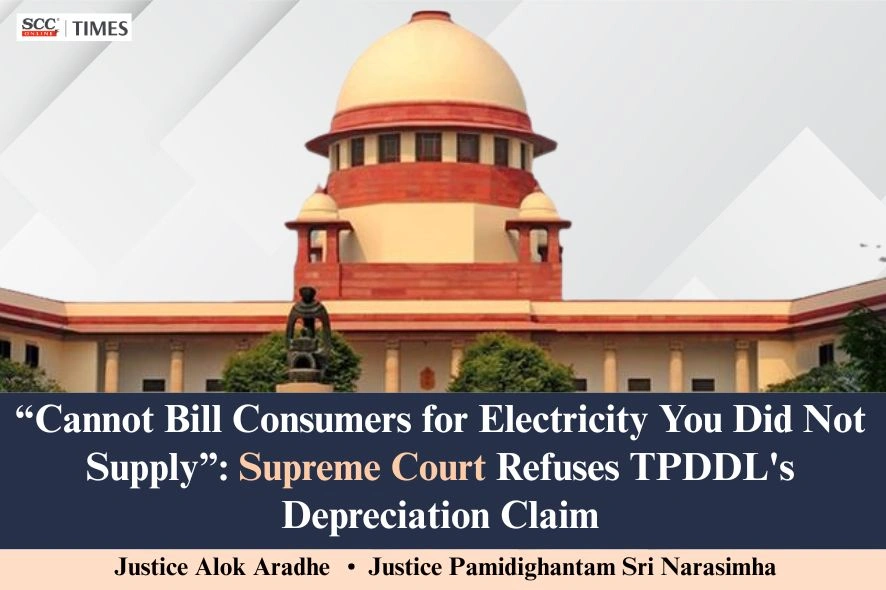
Supreme Court: In an appeal under Section 125, Electricity Act, 2003, the Delhi Electricity Regulatory Commission assailing the Appellate Tribunal for Electricity order, whereby it permitted the respondent to recover the entire capital cost of the Rithala Combined Cycle Power Plant at Delhi (the Plant) through depreciation over a period of 15 years, even though the Plant ceased to supply electricity to the consumers from and after March 2018, the Division Bench of Alok Aradhe* and Pamidighantam Sri Narasimha, JJ., allowed the appeal and held that:
“… Regulation 6.32 of the 2011 Regulations does not, and cannot, override the broader statutory and regulatory framework and the same does not confer an absolute and unconditional right upon the generating utility to recover depreciation from the consumers even for a period when the asset is free to supply electricity.”
The Court further stated that the true-up proceedings are intended to give effect to the tariff framework and not to reopen or reconfigure it. Accordingly, it held that Appellate Tribunal for Electricity (APTEL) erred in disregarding the regulatory framework and the conditions governing approval.
Background
The respondent, Tata Power Delhi Distribution Ltd. (TPDDL), a joint venture entity between the Tata Power Company Ltd. and Delhi Power Company Ltd., had proposed to set up a temporary Power Plant at Rithala with operational tenure expressly limited to 5 to 6 years. The Plant was conceived as a short-term measure to address peak demand in the National Capital Territory of Delhi during the Commonwealth Games 2010.
The appellant, Delhi Electricity Regulatory Commission (DERC), granted approvals and allowed operation of the Plant only till March 2018. The DERC determined the Plant’s capital cost at Rs 197.70 crores after applying appropriate benchmarking and prudence checks, as against the TPDDL’s claimed capital cost of Rs 320.17 crores, which TPDDL did not challenge by an appeal and had attained finality.
Subsequently, TPDDL sought true-up of expenditure for FY 2010-2011 to 2016-2017 and annual requirements for FY 2017-2018. However, the Commission allowed depreciation only up to FY 2017-2018 and denied recovery of the remaining capital cost and carrying cost on the ground that the Plant had ceased supplying electricity after March 2018.
Aggrieved, TPDDL challenged the Commission’s order before the APTEL, which held that since the Commission itself had accepted the useful life of the Plant as 15 years, depreciation could not be restricted to 6 years. APTEL further held that Regulation 6.32, Delhi Electricity Regulatory Commission (Terms and Conditions for Determination of Generation Tariff) Regulations, 2011 (2011 Regulations) mandated depreciation over the useful life and did not admit of any exception. Accordingly, the Commission’s order was set aside, and the matter was remanded with a direction to allow recovery of the entire capital cost through depreciation over 15 years.
Aggrieved thereby, the Commission preferred the present appeal.
Issues
-
Whether the depreciation under the applicable tariff regulations must necessarily be allowed over the entire technical useful life of an asset, irrespective of the period during which the asset is actually utilised for the supply of electricity?
-
Whether Regulation 6.32, 2011 Regulations, confer an absolute right upon the generating utility to recover the entire capital cost over the useful life of the asset, even where the asset ceases to supply electricity to the consumer?
-
Whether the APTEL erred in law in disregarding the regulatory framework and approval conditions which limited the operational and recovery period of the Plant to 6 years?
Analysis
Issue 1: Whether the depreciation should be allowed over the entire technical useful life of an asset, irrespective of the period during which the asset is actually utilised for the supply of electricity?
The Court observed that the DERC, while computing the capital cost of the Plant for the determination of the final generation tariff, found that the useful life of the Plant was 15 years. The Court noted that the DERC approved the power purchase agreement (PPA), which restricted the period of operation and supply up to March 2018, i.e., for 6 years. The Court stated that:
“The tariff determination is not merely a mathematical exercise but a regulatory balancing act. The object of enabling reasonable cost recovery for utilities must be weighed against and calibrated with the paramount obligation to safeguard consumer interest.”
The Court stated that in the present case, since electricity had not been supplied to the consumers after March 2018, the consumers cannot be required to pay for a service which they no longer received.
The Court perused the PPA and noted that the TPDDL had to supply electricity only for a period of 6 years, and that there was no legal impediment to either the sale of the Plant or the sale of electricity as a merchant generator. Accordingly, the Court held that TPDDL cannot be permitted to burden the consumers with tariff charges beyond March 2018.
Issue 2: Whether Regulation 6.32, 2011 Regulations, confer an absolute right upon the generating utility to recover the entire capital cost over the useful life of the asset, even where the asset ceases to supply electricity to the consumer?
The Court noted that Regulation 6.32, 2011 Regulations prescribes the methodology of calculating depreciation over the useful life of the asset. The Court stated that it is a settled position that no provision is to be read in isolation, and thus, Regulation 6.32 must be construed harmoniously with Regulation 4.1, which confines tariff entitlement to the period approved in the PPA. The Court stated that the 2011 Regulations have to be read in conjunction with Section 61(d), Electricity Act, 2003, which places the consumer interest at the centre of tariff Regulation. The Court held that:
“… Regulation 6.32 of the 2011 Regulations does not, and cannot, override the broader statutory and regulatory framework and the same does not confer an absolute and unconditional right upon the generating utility to recover depreciation from the consumers even for a period when the asset is free to supply electricity.”
Accordingly, the second issue was held against the TPDDL.
Issue 3: Whether the APTEL erred in law in disregarding the regulatory framework and approval conditions which limited the operational and recovery period of the Plant to 6 years?
The Court noted that the permission was granted on a temporary basis for a period of 5 to 6 years, and the PPA was approved only for a period of 6 years from the date of commercial operation till March 2018, which TPDDL did not challenge.
The Court stated that APTEL failed to appreciate the distinction between the Plant’s technical useful life of 15 years and the regulatory recovery period of 6 years under the tariff framework. The Court held that the Commission’s order, which had attained finality, clearly limited tariff recovery to 6 years, notwithstanding the accepted technical life of the Plant. The Court further noted that the true-up proceedings are intended to give effect to the tariff framework and not to reopen or reconfigure it. Accordingly, it held that APTEL erred in disregarding the regulatory framework and the conditions governing approval.
Decision
Accordingly, the Court allowed the appeal by answering all the issues in favour of the Commission and against the TPDDL. The Court set aside the APTEL order and restored the order passed by the Commission.
[Delhi Electricity Regulatory Commission v. Tata Power Delhi Distribution Ltd., 2026 SCC OnLine SC 819, decided on 7-5-2026]
Advocates who appeared in this case:
For the appellant: Senior Advocate Jayant K. Mehta and AOR Dhananjay Baijal with Mansvini Jain and Tilak Singh, Advocates
For the respondent: Senior Advocate Kapil Sibal, and AOR Pukhrambam Ramesh Kumar with Amit Kapur, Anupam Varma, Rahul Kinra, Aditya Gupta, Girdhar Gopal Khattar, Yash Srivastava, Karun Shamra, Anupama Ngangom, and Rajkumari Divyasana, Advocates