Supreme Court asks P&H HC to decide PIL petitioner’s locus before examining merits of religious conversion allegations
The Supreme Court declined to interfere with the interim order in the religious conversion PIL.

Bringing you the Best Analytical Legal News


The Supreme Court declined to interfere with the interim order in the religious conversion PIL.
Supreme Court clarifies the selections made after 11 March 2026 are governed by the 1993 OM; no timeline set for equivalence of posts.
The Supreme Court declared a gift of temple inam land to the Tamil Nadu Government void under Section 41, HR&CE Act, 1959, enhanced monthly lease rent to ₹31,000 and directed payment of arrears and costs.
Supreme Court examined the legal effect of the Entitlement Rules 2008, their relationship with the 1982 Rules, the role of Medical Board opinions, and the shift in burden of proof after 15 years in disability pension claims.
Supreme Court issued directions to Tamil Nadu to facilitate transit through territorial waters and timely access pass clearance for purse seine fishing in EEZ
Supreme Court held that the contents of documents already excluded from evidence cannot be introduced through oral testimony, while upholding the Bombay High Court’s redaction and imposing ₹10 lakh costs on RIL.
An Administrative-cum-Finance Officer of MAKAIAS challenged his compulsory retirement, alleging that the disciplinary proceedings were vitiated by bias on the part of the Director who acted as the disciplinary authority.
The Court held that a comprehensive maintenance contractor owes a heightened duty of care and where it is aware of a defect and fails to implement the necessary remedial measures or ensure safe operation, it is guilty of deficiency in service.
The Court called for a shift from occasional seminars to continuous professional learning and proposed a full-time National Legal Academy to strengthen advocates’ skills, ethics, technological competence, and long-term development.
The instant dispute arose from Canara Bank’s allegation that the appellant’s legal opinion wrongly certified the entire mortgaged property as belonging to the guarantor, despite prior sale deeds affecting part of it. The Bank treated the alleged omission in title verification as negligence that exposed it to financial risk.
Supreme Court held that reliance on non-existent, AI-generated or hallucinated judicial precedents vitiates adjudication, rendering the decision void in law and warranting its setting aside.
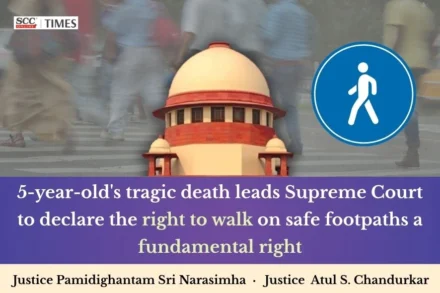
In a judgment arising from a five-year-old child run over by a tanker while walking to school, the Supreme Court declared that Urban Development Authorities, Municipal Corporations and Panchayats bear an enforceable duty to provide pedestrian infrastructure, with remedies independent of the Motor Vehicles Act.
By judgment day, the mall had been running for seventeen years, supporting 8,000 livelihoods and generating ₹100 crores in annual tax revenue. The Supreme Court held that demolition would not vindicate the public interest, it would destroy it.

The Court clarified that limitation under Section 34, Arbitration Act, begins only upon disposal of proceedings formally instituted and entertained under Section 33 by the Arbitral Tribunal.
The Court attached significance to the fact that a married son remained part of the family irrespective of his marital status, whereas a married daughter was excluded merely because she was married.

The Supreme Court regularised MBBS admissions and directed authorities to issue degrees to students affected by the NMC CBME Corrigendum dispute while keeping the larger legal issue open.

The Court denied the electricity distribution company the depreciation cost for the Plant’s technical useful life, instead of the regulatory recovery period under the tariff framework.
“The present case does not involve a straightforward financial debt-fault scenario warranting initiation of CIRP. The facts disclose a dispute which is predominantly contractual in nature and is subject matter of the proceedings before the DRT-the appropriate forum for recovery.”

At the hearing, it was contended that the said clause was permissive in nature and does not constitute a binding arbitration agreement within the meaning of Section 7.

Person may be treated as a “member” entitled to file petitions under Sections 397 and 398, Companies Act, 1956 even if their name is not entered in the register of members, provided the Company’s conduct and records establish recognition of proprietary interest.