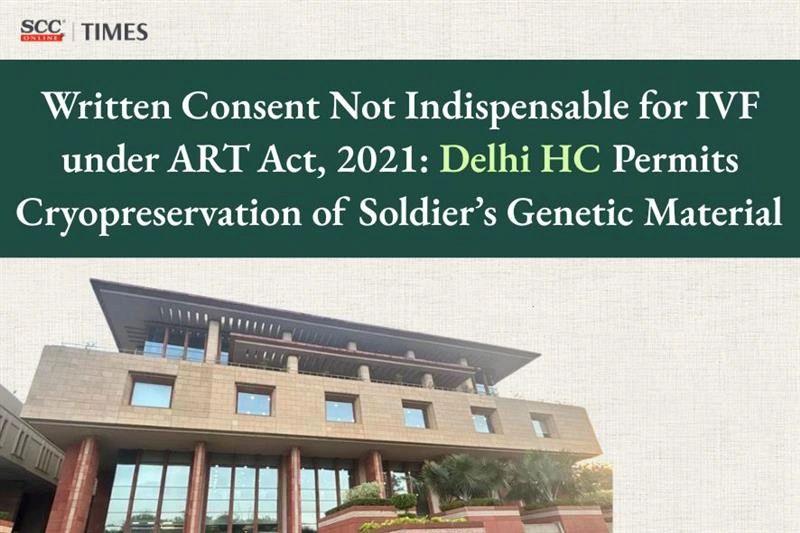
Delhi High Court: In a petition seeking extraction and cryopreservation of genetic material of the petitioner’s husband, who is in a persistent vegetative state, a Single Judge Bench of Purushaindra Kumar Kaurav, J., disposed of the petition with directions to the respondents to undertake the necessary procedure required to take the IVF treatment to its logical conclusion after holding that written consent is not indispensable for IVF under the Assisted Reproductive Technology (Regulation) Act, 2021 (ART Act). The Court held that, in the facts and circumstances of the case, the consent of the petitioner’s husband in opting for IVF treatment would constitute sufficient compliance with Section 22, ART Act and the petitioner cannot be disentitled on the sole ground of absence of explicit written consent.
Observing that the ART Act is intended to address issues of reproductive health and that procedure is the handmaiden of justice, the Court held that non-compliance with the bare, strict text of a procedural provision ought not to defeat the substantive intent of the legislation or derogate from the fundamental right to reproductive autonomy under Article 21.
Background
The petitioner, wife of Mr XX Kumar, a Lance Naik in the Indian Army, has filed the present petition seeking extraction and cryopreservation of her husband’s genetic material, relying upon the provisions of the ART Act as well as the constitutional guarantees under Article 21, including the right to motherhood, dignity and reproductive autonomy. Mr Kumar, who joined the Army in 2014 and has an unblemished service record, married the petitioner on 4 March 2017. The couple, with the intention of expanding their family, opted for conception through IVF in June 2023.
On 7 July 2025, while posted at Dhoodhganga, Jammu & Kashmir, Mr Kumar sustained a severe traumatic brain injury after falling from a considerable height during patrolling in an operational area. Despite undergoing surgeries, he is presently in a persistent vegetative state with no foreseeable likelihood of neurological recovery. It is stated that the authority concerned granted permission on 17 February 2026 to continue IVF treatment. However, the same was subsequently discontinued. Aggrieved thereby, the petitioner approached the Court, and upon preliminary consideration on 6 April 2026, notice came to be issued in the matter.
Also Read: Ker HC permits wife to extract brain-dead husband’s gametes
Analysis
The Court noted that the respondents had placed on record the proceedings of the Board of Officers of the Army Hospital (R&R), Delhi Cantt., which indicated that although surgical retrieval of sperm of the petitioner’s husband is technically feasible, the chances of retrieval of viable sperm are meagre. The respondents further contended, placing reliance on Section 22(1)(a), ART Act, that there is no explicit written consent of the petitioner’s husband. However, the Court noted that both the petitioner and her husband had voluntarily opted for IVF treatment and had already undertaken procedures in furtherance thereof, from which consent could be safely inferred, there being no material to the contrary. The Court observed that the unfortunate incident leading to the husband’s condition could not have been foreseen, and strict insistence on express consent in the present facts would defeat the very purpose of the IVF treatment and render the earlier consent otiose.
Emphasising that the ART Act is intended to address issues of reproductive health and that procedural requirements must serve, and not defeat, substantive rights, the Court held that the right to reproductive autonomy is a fundamental right and the statute must be interpreted to further the same. The contention regarding low probability of viable sperm retrieval was held not to be determinative, the Court observed that the question of parenthood ultimately lies beyond human control. Placing reliance on Simi Rajan v. Union of India1, the Court held that the husband’s consent to undergo IVF treatment would constitute sufficient compliance with Section 22, ART Act.
Decision
Accordingly, it directed the respondents to undertake necessary steps to carry the IVF treatment to its logical conclusion, treating the petitioner’s consent as valid for required procedures, and not to deny the relief solely on the ground of absence of written consent of the husband, subject to other statutory compliances and the medical condition of the husband. The petition was, thus, disposed of with the aforesaid directions.
[X v. Union of India, 2026 SCC OnLine Del 1606, decided on 13-4-2026]
Advocates who appeared in this case:
For the Petitioner: Arjeet Gaur, Atul Yadav, Jasbir Singh Balhara, Sidarth Yadav, Prince Sharma, Subhan Singh Sejwal, Saurabh Bharti, Mayank Dev, Pawan Yadav, Kiran, Himanshi, Himanshu Dutt, Deepshikha, Advocates
For the Respondent: Ayush Gaur, SPC with Riddhi Kapoor, Advocate and Harshit Joshi Government Pleader
1. W. P. (C) No. 9271 of 2026, order dated 9-3-2026.