Supreme Court Issues Directions for Speedy Trials in Dowry & Cruelty Cases
The Supreme Court has issued detailed directions to tackle delays in dowry and cruelty cases. From framing charges within 60–90 days and

Bringing you the Best Analytical Legal News


The Supreme Court has issued detailed directions to tackle delays in dowry and cruelty cases. From framing charges within 60–90 days and
A quick roundup to cover all the important legal developments and cases this week.
The Court noted that the presence of the appellant at the time of occurrence at the scene of crime has not been proved beyond reasonable doubt and no active role has been assigned to him and the chain of the evidence is not consistent only with the hypothesis of the guilt of the accused.
The Court noted that as per the post-mortem report, the death was due to ante-mortem hanging by ligature, but 6 other ante-mortem injuries were found on the body of the deceased, which were not caused by taking the body out of the ligature or carrying it out to the hospital.
Supreme Court upheld the conviction of the husband under Sections 302 and 498-A IPC in a dowry death case, rejecting the claim of suicide. The Court held that medical evidence showed a case of homicidal hanging, supported by ante-mortem injuries and absence of typical ligature marks not suicide.
The Court also urged the media to avoid recording statements of the persons who are likely to be potential witnesses or accused, as it may unnecessarily prejudge the outcome on certain issues, which are yet to be investigated.
The Court also took note of the State’s contention that the anticipatory bail was granted in a very hurried manner, as the death occurred on 12 May at night, the post-mortem was conducted on 14 May, the anticipatory bail application was filed on 14 May, and the same was allowed on 15 May.
The Court emphasised that dowry death cases carry statutory presumptions under Section 118, Sakshya Adhiniyam, 2023 which cannot be ignored.
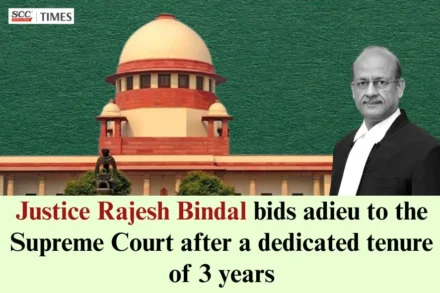
Prior to being elevated to the Supreme Court in 2023, Justice Rajesh Bindal served as the Chief Justice of Allahabad High Court.
“The trial court failed to note that only when the prosecution proves the foundational facts and there is evidence to show that cruelty was meted out to the deceased in respect of demand of dowry soon before death, the presumption under Section 113-B of the Evidence Act would arise.”
It is quite understandable that being the deceased’s father, he would have been highly traumatized due to untimely death of his daughter. However, it is quite evident from his first statement that no details of the alleged harassment of the daughter were mentioned.
“Every dispute, quarrel or altercation arising from the matrimonial life are not criminal offence. It will take colour of Criminal law only when there are no alternatives for the wife but to put an end to her life, because of the harassment.”
“To prove the offence of dowry death, it must be shown that there was cruelty and harassment within 7 years of marriage and that it was meted out for or in connection with, demand for dowry”.
It was not the prosecution’s case that any demand for dowry or any valuable security or other property was made by the accused. Rather, it was an admitted case that the only demand was to arrange Rs 50,000 to meet the legal expenses for applying bail of the husband and her father-in-law, who were in judicial custody.
“Scope of interference in the acquittal order passed by the Trial Court is very limited, and if the impugned judgment of the Trial Court demonstrates a legally plausible view, mere possibility of a contrary view shall not justify the reversal of acquittal.”
The Court opined that impugned provisions do not warrant judicial interference, because it is well-settled law that courts refrain from intervening in matters of legislative policy or mandate
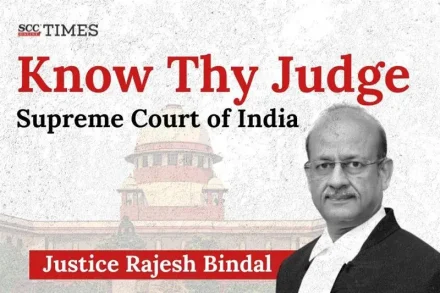
Prior to being elevated to the Supreme Court in 2023, Justice Rajesh Bindal was serving as the Chief Justice of Allahabad High Court.
The expression “soon before her death” in Section 304-B of Penal Code, 1860 must be read as an expression of continuity of time and not an expression of mere length of time. The legislature in its wisdom had used the phrase as “soon before” and not “immediately before”.

Top criminal cases on quashing of proceedings, arrest, bail, acquittal, and more.

A quick legal roundup to cover important stories from all High Courts this week.