
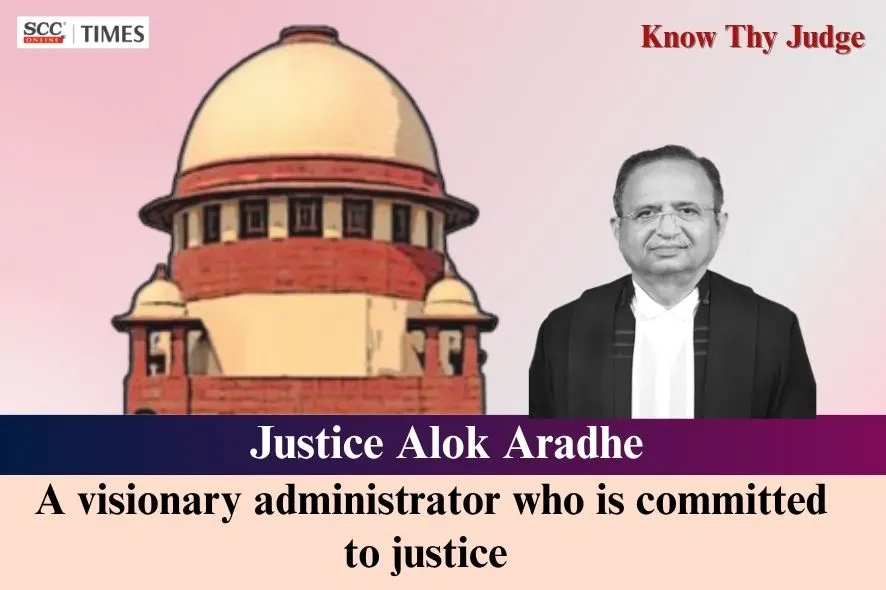
Justice Alok Aradhe, who was appointed as Supreme Court Judge in August 2025, began his legal journey in the late 1980s and gained expansive wisdom as a counsel, as a trainer of newly appointed judicial officers and a Judge.
Early Life and Career as an Advocate1
Justice Alok Aradhe was born on 13 April 1964 in Raipur, Chhattisgarh. He earned a degree in Bachelor of Science (BSc) and LLB and got enrolled as an advocate on 12 July 1988.
Justice Aradhe was designated as Senior Advocate in April 2007 and majorly practiced in Civil, Constitutional, Arbitration and Company Matters in the Madhya Pradesh High Court at Jabalpur.
He also had the privilege of serving as a Visiting Faculty in JudicialTraining & Research Institute to address judicial officers on various issues.
Career as a Judge2
Justice Alok Aradhe was appointed as Additional Judge of the Madhya Pradesh High Court on 29 December 2009 and was made Permanent Judge on 15 February 2011.
Justice Aradhe was transferred to the Jammu and Kashmir High Court and took oath of office on 20 September 2016. Justice Aradhe also performed the duties of Acting Chief Justice of Jammu and Kashmir High Court from 11 May 2018 to 10 August 2018. He was nominated as Chairman of Jammu and Kashmir State Judicial Academy on 7 June 2017 and on 4 September 2018, he was also nominated as Executive Chairman of Jammu and Kashmir State Legal Services Authority.
Upon being transferred to Karnataka High Court, Justice Aradhe took oath as Judge on 17 November 2018. He further assumed charge as the Acting Chief Justice of Karnataka High Court from 3 July 2022 to 14 October 2022. During his tenure as Judge of Karnataka High Court, Justice Aradhe also served as the President of Bangalore Mediation Centre, Arbitration and Conciliation Centre and President of Karnataka Judicial Academy.3
Another feather on his cap was attained when he was recommended by the Supreme Court Collegium for the prestigious position of Chief Justice of Telangana High Court. The Supreme Court Collegium Resolution dated 5 July 20234 recommended Justice Aradhe as the highest authority in Telangana High Court and stated that:
“Justice Alok Aradhe is now a senior puisne Judge in his parent High Court. He has been functioning, on transfer since November 2018 as a Judge of the Karnataka High Court and has acquired experience of more than 13 years in dispensing justice in two large High Courts.
Having regard to all relevant factors, the Collegium is of the considered view that Justice Alok Aradhe is fit and suitable in all respects to be appointed as Chief Justice of the High Court for the State of Telangana.”
The aforestated recommendation being accepted by the Law Ministry, consequently the President of India on 19 July 2023, appointed Justice Alok Aradhe as Chief Justice of Telangana High Court; and on 23 July 2023, Justice Aradhe took oath of office the High Court’s 6th Chief Justice.5
-
Did You Know? During his tenure as Chief Justice of Telangana High Court, Justice Alok Aradhe took initiative of live streaming of all 29 Benches and the facility to appear before any Bench via virtual mode.6
Thereafter, Justice Alok Aradhe was transferred as Chief Justice of Bombay High Court.
On 25 August 2025, the Supreme Court Collegium led by then CJI B.R. Gavai in its meeting, recommended elevation of Justice Aradhe as Judge of Supreme Court. His appointment was swiftly confirmed by the President on 27 August 2025 and he took oath of office on 29 August 2025.
-
Did You Know? As Chief Justice of Telangana High Court, Justice Alok Aradhe launched “National Service and Tracking of Electronic Processes (NSTEP)” to fast-track Criminal Justice System and made Telangana the 3rd State to implement this system in the criminal cases sector.7
Notable Decisions by Justice Alok Aradhe8
In an appeal arising from a challenge to the validity of Notifications dated 1 April 2000 and 4 April 2001 issued under Section
[State of Maharashtra v. Reliance Industries Ltd., 2026 SCC OnLine SC 477]
Did Kahaani 2 Really Copy ‘Sabak’? The Supreme Court’s Verdict, Simplified
While deliberating over this appeal filed by Director and Screenwriter Sujoy Ghosh (appellant) revolving around his alleged wrongful copying and use of complainant’s script titled “Sabak” to produce the film “Kahaani 2” which led to institution of proceedings against him; the Division Bench of P.S. Narasimha and Alok Aradhe*, JJ., allowed the appeal finding that the appellant’s work had preceded the complainant’s script hence the question of copyright infringement does not arise as the complainant’s script was not even in existence when the appellant registered his screenplay for “Kahaani 2”.
[Sujoy Ghosh v. State of Jharkhand, 2026 SCC OnLine SC 454]
In an appeal arising from Gujarat High Court’s judgment directing re-evaluation of technical bids by the consultant which was originally awarded to the appellant based on higher technical score, a Division Bench of P.S. Narasimha and Alok Aradhe, JJ., upheld the Letter of Award dated 9 June 2025 and the contract dated 1 July 2025 in favour of the appellant and set aside the High Court’s judgment, holding that the High Court had exceeded the principle of judicial restraint in contractual matters. The Court held that courts cannot interfere in contractual matters merely because another view is possible or because a competing bidder has a marginally higher score, unless the decision-making process is vitiated by mala fides, arbitrariness, or perversity, the choice of the tendering authority and the owner must prevail.
[Steag Energy Services (India) (P) Ltd. v. GSPC Pipavav Power Co. Ltd., 2026 SCC OnLine SC 478]
In a batch of civil appeal raising an important question concerning the legal status of Sugarcane Growers Cooperative Societies at Bajpur and Gadarpur following the bifurcation of the State of Uttar Pradesh and creation of the State of Uttarakhand in terms of between the
[Registrar, Cane Coop. Societies v. Gurdeep Singh Narval, 2026 SCC OnLine SC 346]
In a batch of civil appeals filed by appellants, belonging to reserved categories, challenging the merit list of the Teachers Aptitude and Intelligence Test (TAIT-2022), the controversy before the Court was whether candidates belonging to reserved categories, who had availed relaxation in a qualifying examination for eligibility, could migrate to the open category on the basis of merit secured in the main selection examination. The Division Bench of Pamidighantam Sri Narasimha and Alok Aradhe*, JJ., held that reserved category candidates who secured higher marks than the last selected candidate in the open category were entitled to be considered for the open category, even if they had availed relaxation in the Teacher Eligibility Test (TET) qualifying marks. Such relaxation affects only the eligibility criteria and not the merit, and in the absence of an express prohibition in the recruitment rules, migration to the open category is permissible.
[Chaya v. State of Maharashtra, 2026 SCC OnLine SC 457]
AI-made fake precedents surface in trial court order; Supreme Court issues notice
In a matter raising an important issue concerning the integrity of the judicial decision-making process in the era of artificial intelligence (AI), a Division Bench of Pamidighantam Sri Narasimha and Alok Aradhe, JJ., took cognizance of the matter and issued notice to the Attorney General for India, the Solicitor General of India, and the Bar Council of India in order to examine the systemic implications of reliance on AI-generated non-existing, fake or synthetic alleged precedents.
[Gummadi Usha Rani v. Sure Mallikarjuna Rao, 2026 SCC OnLine SC 341]
In a significant ruling on forged arbitration agreements, the Supreme Court held that a dispute cannot be referred to arbitration when the very document containing the arbitration clause is alleged to be fabricated. The Court held that where the arbitration clause is embedded in a document alleged to be forged, the controversy “strikes at the very root of arbitral jurisdiction” and falls squarely within the category of non-arbitrable disputes. The present case resolved around the conflict between arbitral jurisdiction and allegations of forgery of the very document containing the arbitration clause. The appeals arose from inconsistent orders of the High Court, which on the same factual matrix declined appointment of an arbitrator under Section
[Rajia Begum v. Barnali Mukherjee, 2026 SCC OnLine SC 135]
In an appeal arising from the Madhya Pradesh High Court’s interim order dated 2 December 2025 where in the Court declared the mandate of the existing arbitrator in the ongoing arbitration proceedings between the parties to be terminated and directed the parties to propose the name of a new arbitrator for appointment, a Division Bench of Sanjay Kumar and Alok Aradhe, JJ., set aside the impugned order and held that Section
[Viva Highways Ltd. v. M.P. Road Development Corpn. Ltd., 2026 SCC OnLine SC 195]
The batch of civil appeals under Section
[Union of India v. SGT Girish Kumar, 2026 SCC OnLine SC 194]
Armed Forces Tribunal has power to substitute finding of Court Martial & pass sentence afresh: SC
While considering the instant appeal challenging the judgment and order of Armed Forces Tribunal (the Tribunal) whereby the appellant’s conviction in respect of charge for alleged possession of ammunition was substituted and instead held him guilty of an act prejudicial to good order and discipline; the Division Bench of J.B. Pardiwala and Alok Aradhe*, JJ., the Court found the Tribunal under Section
[S.K. Jain v. Union of India, 2025 SCC OnLine SC 2201]
In the present case, a 15-year-old juvenile accused under Sections 376 and 506, Penal Code, 1860 and Section
[X v. State of U.P., 2025 SCC OnLine SC 2200]
While considering this appeal against dismissal of challenge against certain tender conditions contained in 3 tender notices which were issued for supply of sports kits to the students at Government Primary School, Government Upper Primary Schools and Government High and Higher Secondary Schools in the State of Chhattisgarh; the Division Bench of Sanjay Kumar and Alok Aradhe*, JJ., quashed the impugned tender notices holding that the impugned tender condition of past supply of sports kit within Chhattisgarh, had the effect of excluding bidders who have no experience of supply of sports goods to the State Government agencies of Chhattisgarh in past 3 years. The State by linking the eligibility criteria with past local supplies, thus created an artificial barrier, against the suppliers who had no past dealing with the State of Chhattisgarh, thereby curtailing the fundamental rights of the bidders, who have been ineligible to participate in the tenders.
[Vinishma Technologies (P) Ltd. v. State of Chhattisgarh, 2025 SCC OnLine SC 2119]
Supreme Court deprecates State Inaction; Orders immediate restoration of suspended Rajasthan Pradhan
In a writ petition filed under Article
[Himanshu v. State of Rajasthan, 2025 SCC OnLine SC 1920]
While dismissing a PIL seeking removal of illegally erected telecommunication (mobile) towers with multiple antennas at the petitioners’ premises and other densely populated areas, alleging health hazards from electromagnetic radiation; the Division Bench of Alok Aradhe, CJ., and Sandeep V. Marne*, J., noted that the issues raised in the PIL were squarely covered by several judgments of various High Courts, including of Bombay High Court, which had repeatedly repelled apprehensions about health hazards due to electromagnetic radiations from mobile phone towers. The Court pointed out that the petitioners did not place any independent conclusive material to prove the health hazards and, further taking note of the new regulatory framework under the
[Jagruk Nagrik Sanghatana v. State of Maharashtra, 2025 SCC OnLine Bom 3006]
In the present case, an appeal was filed by the assessee challenging the order of Income Tax Appellate Tribunal (ITAT) which stated that the interest paid by the assessee to the bank for the funds borrowed, could not be set off against interest received by it, by lending part of the said borrowed funds to its sister concerns. The Division Bench of Alok Aradhe, CJ., and Sandeep V. Marne*, J., held that the ITAT could not be permitted to treat the income earned for the Assessment Year 1992-1993 as “other sources” while treating the similar income in the succeeding Assessment Year 1993-1994 under the head “business”. The Court opined that the order for Assessment Year 1992-1993 needed to be brought in tune with its orders passed for subsequent years, which had attained finality, else it would defeat the ends of justice. Thus, the Court set aside the order of ITAT.
[Modi Business Centre (P) Ltd. v. CIT, 2025 SCC OnLine Bom 2968]
The present appeal was filed by the assessee challenging the Income Tax Appellate Tribunal’s (ITAT) decision treating profit from the sale of a vintage car as taxable capital gains rather than exempt as a “personal effect”. The assessee argued that the car was his personal asset and should not attract capital gains tax. The Division Bench of Alok Aradhe*, CJ., and Sandeep V. Marne, J., held that for an article to qualify as a “personal effect”, there must be evidence of personal use. Since, the assessee failed to adduce any evidence with regard to the vintage car being put to personal use, therefore, the Court upheld ITAT’s order and rule that pride of possession did not constitute personal use under Section
[Narendra I. Bhuva v. Assistant Commissioner of Income Tax, 2025 SCC OnLine Bom 2936]
The present public interest litigation (PIL) was filed by the petitioner and five other advocates against the global fashion giant, PRADA. The petitioners sought judicial intervention to restrain PRADA from commercialising and using “toe ring sandals” alleged to be deceptively similar to geographical indication (GI) tagged product “Kolhapuri Chappal” without securing authorisation from the registered proprietor or authorised users. The Division Bench of Alok Aradhe, CJ., and Sandeep V. Marne*, J., dismissed the PIL, holding that such statutory and proprietary rights under the
[Ganesh S. Hingmire v. PRADA Group, 2025 SCC OnLine Bom 2681]
Advocates are not Bar Council employees, hence outside the ambit of POSH Act: Bombay High Court
The UNS Women Legal Association filed the instant public interest litigation (PIL) seeking formation of permanent internal grievance committee of women advocates in all State Bar Council offices and all Bar Associations of Maharashtra. The Division Bench of Alok Aradhe, CJ., and Sandeep V. Marne, J., while disposing of the PIL, observed that the provisions of the
[UNS Women Legal Assn. v. BCI, 2025 SCC OnLine Bom 2647]
The Division Bench of Alok Aradhe*, CJ., and M.S. Karnik, J., directed the State Advisory Board on disability to consider the prayers made in relation to implementing Accessibility Guidelines for Bus Stops and Bus Terminals, 2021 and the Harmonised Guidelines and Space Standards for Barrier Free Built Environment, 2016 and to take action for redressal of the grievances of the differently abled persons.
[High Court of Bombay v. Municipal Corpn., Greater Mumbai, 2025 SCC OnLine Bom 1194]
In the present case, the petitioner challenged the validity of Rules 2(iv)(a), 2(xii)(B) and the Proviso appended thereto, Rules 14, 16(2), 18(2), 19(ii), 19(iii) and 26(a) of the Rules of Legal Education, 2008 (the 2008 Rules) on the ground that the same were void and ultra vires the power conferred under Section 49(1)(d) read with Section
[Nathibai Damodar Thackersey Women’s University Law School v. State of Maharashtra, 2025 SCC OnLine Bom 874]
In the present case, intra court appeals were filed against Single Judge’s common order dated 9 September 2024 passed in Padi Kaushik Reddy v. State of Telangana, 2025 SCC OnLine SC 1576, wherein the Secretary, Telangana Legislative Assembly, was directed to place the disqualification petitions before the Speaker, Telangana Legislative Assembly, for fixing a schedule of hearing these petitions. The Division Bench of Alok Aradhe, CJ., and J. Sreenivas Rao, J., granted liberty to appellant to approach this Court in case any precipitative action was taken against appellant on or before 24 October 2024. A batch of writ petitions were filed challenging the inaction of the Speaker of Telangana Legislative Assembly in adjudicating the petitions dated 18 March 2024, 1 July 2024, 2 July 2024 and 8 July 2024 seeking disqualification of Danam Nagender, Venkat Rao Tellam, and Kadiyam Srihari, Members of Legislative Assembly.
[Telangana Legislative Assembly v. Alleti Maheshwar Reddy, 2024 SCC OnLine TS 2064]
Petitioners, were journalists, employed by various small newspapers, which were published from various places in the State of Telangana, assailed the validity of Schedule E of G.O.Ms. No. 239 (Gen. Administration (I&PR) Department) dated 15 July 2016, insofar as it categorises small newspapers in the State of Telangana into A, B, C, and D categories for the purposes of issue of accreditation cards. Schedule E was challenged on the ground that it was violative of Articles
[Thatikonda Krishna v. State of Telangana, 2024 SCC OnLine TS 1788]
Petitioner assailed the validity of G.O.Ms. No. 9, Energy (Power. II) Department, dated 14 March 2024 issued by the State Government by which a Commission was appointed to conduct an inquiry into the correctness and propriety of the decision taken by the erstwhile Government of Telangana on procurement of power from the distribution companies (DISCOMS) of the State of Chhattisgarh and to inquire into correctness and the propriety of the decision taken by the erstwhile State Government of Telangana to establish Bhadradri Thermal Power Station (BTPS) at Manuguru and Yadadri Thermal Power Station (YTPS) at Damaracherla. The Division Bench of Alok Aradhe, CJ., and Anil Kumar Jukanti, J., opined that the allegation of bias against Respondent 3 was solely based on the statement made in the press conference and no other material had been produced to show that the proceeding before Respondent 3 was vitiated on account of personal bias. The Court further opined that the allegation of bias could not be inferred but had to be established and thus, held that petitioner failed to prove the plea of bias against Respondent 3.
[Kalvakuntla Chandrashekar Rao v. State of Telangana, 2024 SCC OnLine TS 1480]
In a case wherein petitioner assailed the validity of Section
[Pareekshith Reddy Pesarikayala v. Union of India, 2024 SCC OnLine TS 92]
Appellant had challenged an order dated 13 March 2023 wherein a Single Judge Bench of this Court (the Single Judge) had quashed provisional order of attachment and show-cause notice issued by the adjudicating authority formed under provisions of
[Enforcement Directorate v. Karvy India Realty Ltd., 2024 SCC OnLine TS 18]
A batch of writ petitions were filed by practicing advocates and Additional Public Prosecutors seeking quashment of order which rejected their applications seeking recruitment to the post of District Judge in the State of Telangana. Petitioners also sought a declaration to struck down Rule 5(1)(a) of Telangana State Judicial (Service and Cadre) Rules, 2023 (Rules 2023) as arbitrary and discriminatory and a consequential direction to respondents to permit petitioners to appear in written examination of District Judge. The Division Bench of Alok Aradhe*, CJ., and T. Vinod Kumar, J., dismissed the writ petitions and held that the advocates practicing in other States were ineligible for the post of District Judge in Telangana.
[Bodugula Brahmaiah v. State of Telangana, 2023 SCC OnLine TS 4105]
In a PIL assailing the award of contract for construction of flats to homeless persons by Greater Hyderabad Municipal Corporation (GHMC) to DEC Infrastructure Projects India Pvt. Ltd. (DEC), the Division Bench of Alok Aradhe*, CJ., and T. Vinod Kumar, J., dismissed the PIL and held that the grant of construction project to the DEC was fair, just and reasonable.
[Gonewar Chandu v. State of Telangana, 2023 SCC OnLine TS 2981]
While deciding the instant appeal wherein a husband had challenged the dismissal of his petition seeking dissolution of his marriage on the ground that he was allegedly being humiliated by his wife due to being dark-skinned; the Division Bench of Alok Aradhe and Anant Ramanath Hegde*, JJ., set aside the impugned judgment of the Family Court dismissing the husband’s petition and held that the evidence presented by the husband sufficiently established the wife used to insult him on the premise that he is dark-complexioned; and for the same reason she moved away from the company of the husband without any cause, and to cover up this aspect, had levelled false allegations of illicit relationships against the husband. The Court was of the view that these facts certainly constituted cruelty.
[K. Murthy v. V. Kalaivani, 2023 SCC OnLine Kar 48]
While deciding the instant petition seeking transference of physical custody of the minor son to the petitioner (father) and the child’s repatriation to his habitual place of residence—Germany, the Division Bench of Alok Aradhe and Vijaykumar A. Patil, JJ., pointed out that the principle of comity of courts is salutary in nature, yet it cannot override the consideration of best interest and welfare of the child. The principle must yield to paramount consideration i.e., interest and welfare of the child, which must be examined in the facts of each case. The Court further held that the remedy of writ of habeas corpus cannot be used for enforcement of an ex parte order passed by the German Court, which was not in existence at the time when the son left Germany.
[Sankar Viswanathan v. State of Karnataka, 2023 SCC OnLine Kar 9]
A Division Bench of Alok Aradhe CJ., and S. Viswajith Shetty, J., held that azan or the contents of azan does not violate fundamental rights of petitioner of any person from a different faith. The use of loudspeakers, however, must be ensured to be within permissible limits from 10.00 p.m. to 6.00 a.m. in accordance with law.
[Chandrashekar R. v. State of Karnataka, 2022 SCC OnLine Kar 1482]
In a case filed by a social activist seeking direction to the State to provide minimum wages to the women workers employed under the Mid-Day Meal Scheme and to provide other benefits like Maternity Leave and other leaves including medical benefits and insurance benefits, a Division Bench of Alok Aradhe ACJ and S. Vishwajith Shetty, J., held that no writ of mandamus can be issued to the respondent State to provide minimum wages to the head cooks and cooks employed under the scheme as the provisions of
[Nowhera Shaik v. State of Karnataka, 2022 SCC OnLine Kar 1479]
The Division Bench of Alok Aradhe and J.M. Khazi, JJ., dismissed an appeal filed by a husband seeking permanent alimony from his divorced wife as she is employed as an Assistant Manager in a Co-operative Society. The Court held that the husband, being an able-bodied person, has the ability to earn and the salary of the wife must go in taking care of the son born out of wedlock and thus, is not entitled to seek permanent alimony from his divorced wife.
[T. Sadananda Pai v. Sujatha S. Pai, 2022 SCC OnLine Kar 1194]
A petition was filed raising the question, whether the service provided by the petitioner, i.e., leasing of residential premises as hostel to students and working professionals is covered under Entry 13 of Notification No. 9/2017 namely “service by way of renting of residential dwelling for use as residence” issued under
[Taghar Vasudeva Ambrish v. Appellate Authority for Advance Ruling, Karnataka, 2022 SCC OnLine Kar 88]
Two appeals were filed one by the claimant’s seeking enhancement of the amount of compensation, and the other by the Karnataka State Road Transport Corporation under Section
[Gowri S. Patil v. NWKSRTC, 2021 SCC OnLine Kar 447]
A Division Bench of Alok Aradhe and H.T. Narendra Prasad, JJ., set aside the decision of the Income Tax Appellate Tribunal in favour of the assessee. The present appeal was filed under Section
[CIT v. Mind Tree Consulting Ltd., 2020 SCC OnLine Kar 1328]
Jammu and Kashmir High Court dismisses PIL seeking quashing of decision of Shri Mata Vaishno Devi Board charging money for special Aarti by devotees
A PIL was filed by the petitioner seeking quashing of order, dated 11 March 2008 as well as 31 May 2008 by which, in the 43rd Board Meeting of Shri Mata Vaishno Devi Board (for short, “the Shrine Board”), the decision has been taken to charge a sum of Rs 16,000 for Aarti for one adult and on certain auspicious occasions which have been mentioned therein, a sum of Rs 21,000 is sought to be charged for performing Shradha Vishesh Pooja Darshan, as well as a sum of Rs 1,000 for participating in the Attka Aarti performed at the temple of Shri Mata Vaishno Devi, respectively. A Division Bench of Alok Aradhe and Sanjeev Kumar, JJ., dismissed the PIL as the writ petition does not disclose any element of public interest or does it even raise an issue where the public in general is involved.
The Court noted “Darshan is open to every visitor who visits the temple of Shri Mata Vaishno Devi. Only provision for payment has been made at the time of Arti in Sanctum Sanctorum only to the extent of 30 per cent in respect of Attka Arti. The Shrine Board in its 43rd Board Meeting noticed that there were many people who wanted to attend the Arti and noticed that in several instances, they even tried to influence the staff of the Shrine Board in an undue manner to ensure their entry in the Sanctum Sanctorum at the time of entry. Therefore, it was decided that the hurdle price marginally in routine for A, B, C and D categories be prescribed. The aforesaid decision, in our considered opinion, is a well-informed decision and in the larger public interest for the benefit of the pilgrims, taken by the Shrine Board with which we do not find any ground to interfere. Therefore, there is no element of public interest involved in the writ petition.”
[Sumit Nayyar v. Mata Vaishno Devi Shrine Board, 2017 SCC OnLine J&K 969]
A petition was filed under Section
The Court held that severe injustice had been done to the petitioner by clubbing both the proceedings and recording the evidence. The petitioner should have been allowed to lead evidence in the main proceeding, which was initiated by the respondent and hence, suffered from an error apparent on the face of the record.
[Harjeet Singh v. Taranjeet Kour, 2017 SCC OnLine J&K 746]
Madhya Pradesh High Court | No prior notice required for withdrawal of powers if criminal charge is registered and arrest has been made against a Panchayat Karmi
An appeal was filed to examine whether a criminal case is registered against a Panchayat Karmi and he has been arrested in the said offence, whether he is still required to be served a show-cause notice or an opportunity of hearing before withdrawing the powers of Secretary. A Full Bench of A.M. Khanwilkar, CJ., S.K. Gangele and Alok Aradhe, JJ., held that no prior notice or opportunity of hearing before suspension of the Gram Panchayat Secretary or for that matter withdrawal (de-notified) of such charge given to the Panchayat Karmi, is required to be given by the competent authority to the concerned employee much less who is facing serious criminal case.
[Chandrapal Yadav v. State of M.P., 2016 SCC OnLine MP 1144]
Madhya Pradesh High Court | New Excise Policy is a valid policy not being in contravention with Rule 8(1) of M.P. Foreign Liquor Rules, 1996
A petition was filed seeking clarification on whether in the language of Rule 8(1)(a), M.P. Foreign Liquor Rules, 1996 and Rule 9, M.P. Country Spirit Rules, 1995 the Government has power to renew the licence or it has to invite applications for each and every shop, every year and whether 2010-2011 Liquor Policy which relates to renewal is a valid policy and whether such policy is likely to create monopoly in favour of all such persons who are ready and willing to give 20 per cent extra on the existing basic licence fee and licence fee and such persons are providing 80 per cent of the revenue. A Full Bench of S.R. Alam, CJ., Arun Mishra and Alok Aradhe, JJ., held that under Rule 8(1)(a), M.P. Foreign Liquor Rules, 1996 and Rule 9, M.P. Country Spirit Rules, 1995, it is open to the State Government to renew the licence of existing licensee on such condition, which it may prescribe or invite applications for grant of licence, or deal with grant of licence in such other manner as it may determine. The Court further held that the new liquor policy which provides for renewal of existing licence with further condition that renewal will take place only when the said renewal will generate more than 80 per cent of the estimated revenue for the year 2010-2011 at the district level is a valid policy and does not create any monopoly.
The Court noted that The entire policy is aimed at generation of more revenue in lieu of parting with the privilege to deal in the business of liquor. The new policy cannot be said to be arbitrary and irrational. The new policy also does not contravene either the provisions of the Constitution or any statutory provisions, since, elimination and exclusion from business is held to be inherent in liquor business. Therefore, the policy cannot be assailed on the grounds that it is discriminatory.
[Chingalal Yadav v. State of M.P., 2010 SCC OnLine MP 110]
* Judge who has authored the Judgment
3. Justice Alok Aradhe, Telangana High Court.
4. Supreme Court Collegium Resolutions.
5. Justice Alok Aradhe, Telangana High Court
6. “Telangana HC CJ Alok Aradhe Lauded for His Services”, The Hindu, 20-1-2025, available at <https://www.thehindu.com/news/national/telangana/telangana-hc-cj-alok-aradhe-lauded-for-his-services/article69118971.ece>.
7. “Telangana High Court Launches NSTEP to Fast Track Criminal Justice System”, Economic Times Government, 24-11-2024, available at <https://government.economictimes.indiatimes.com/news/governance/telangana-high-court-launches-nstep-to-fast-track-criminal-justice-system/115621468#:~:text=Summons%20and%20warrants%20will%20be,easier%20through%20this%20online%20system>.