








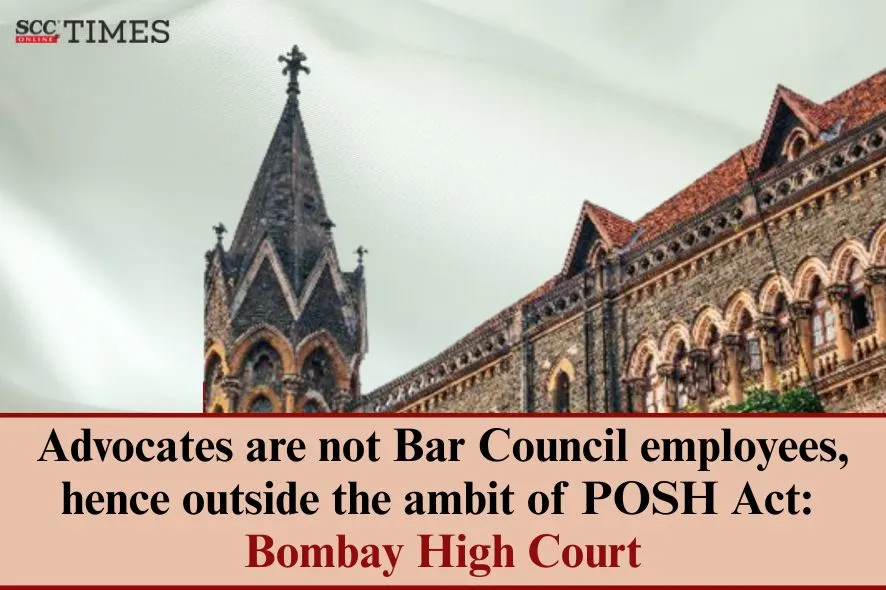
Bombay High Court: The UNS Women Legal Association filed the instant Public Interest Litigation (PIL) seeking formation of permanent internal grievance committee of women advocates in all State Bar Council offices and all Bar Associations of Maharashtra. The Division Bench of Alok Aradhe, C.J. and Sandeep V. Marne, J., while disposing of the PIL, observed that the provisions of the Sexual Harassment of Women at Workplace (Prevention, Prohibition and Redressal) Act, 2013 (‘POSH Act’) does not apply to advocates as the POSH Act requires an employer-employee relationship, which does not exist between advocates and the Bar Council of Maharashtra & Goa (‘BCMG’).
The petitioner association, a registered society under the Societies Registration Act, 1860, sought direction from the Bar Council of India (‘BCI’) as well as BCMG to form a Permanent Internal Grievance Committee of women advocates in all State Bar Council offices and all Bar Associations of Maharashtra. The petitioner relied on the Supreme Court’s directives in Medha Kotwal Lele v. Union of India, (2013) 1 SCC 297 and the provisions of the POSH Act for the constitution of Internal Complaints Committee.
The Court referred to Vishaka v. State of Rajasthan, (1997) 6 SCC 241, wherein the Supreme Court recognized the right of working women against sexual harassment at workplace. The Court also referred to Megha Kotwal Lele (supra), in which the Supreme Court issued specific guidelines for the formation and effective implementation of women’s committees at all State Bar Councils and the Bar Council of India, and subsequent to this, the POSH Act was enacted, which prevented sexual harassment of women at the workplace, as it violated women’s right to equality, life, and liberty.
The Court also analysed Sections 2(f), 2(g), 4, and 6 of the POSH Act and observed that these provisions applied where the relationship of employer and employee existed. Since neither the Bar Council of India nor the Bar Council of Maharashtra & Goa could be said to be the employer of advocates, the provisions of the POSH Act did not apply insofar as they pertained to advocates. The Court, however, clarified that the provisions of the POSH Act would apply to employees of the BCI and BCMG.
The Court pointed out that the Advocates Act already provided a redressal mechanism for grievances raised by women advocates, specifically, under Section 35 of the Advocates Act, wherein the Bar Council has been empowered to take disciplinary action against advocates not only for professional misconduct but also for other forms of misconduct. The Court, therefore disposed of the present PIL without passing any further orders.
[UNS Women Legal Association v. Bar Council of India, 2025 SCC OnLine Bom 2647, decided on 7-7-2025]
Advocates who appeared in this case :
For the Respondents: Shekhar Jagtap with Sairuchita Chowdhary – Respondent 1 – Bar Council of India
Milind Sathe, Senior Advocate with Meghna Gowalani i/by Mr. Yogendra Rajgor – Respondent 2-Bar Council of Maharashtra & Goa
Jyoti Chavan, Addl. Govt. Pleader with Fatima Lakadawala, AGP – Respondent 4 – State.





This order inconsistent with supreme Court guidlines and review on it is required. otherwise sports institute will say students and coach has no employer employee relation school colleges will say they have no employer employee relation and many other places . POSH Act gives wide definition of aggrieved women and work place that need to be considered and ICC need to be established at all state Bar council.