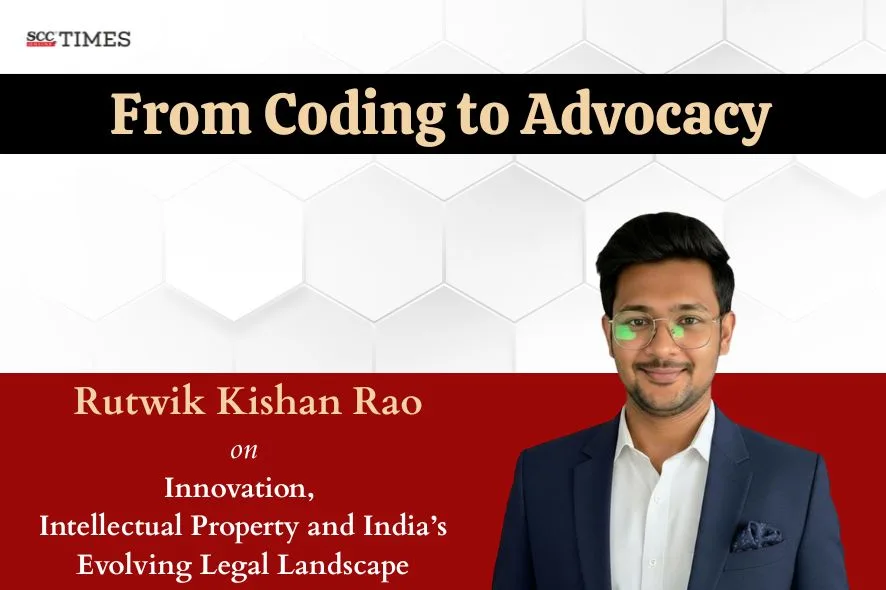
Rutwik Kishan Rao is an engineer-turned-lawyer and currently an IPR professional practising before the Bombay High Court. As an engineering graduate, he secured the second position in the Baja SAE (Society of Automotive Engineers) competition at the national level. During his law studies, he also achieved second place in the Oxford University India Moot Court Competition (2013-2014). He is the Founder and Partner at Exponent Law, a Mumbai-based law firm with an office in Hyderabad, and has represented reputed corporates and investors, including Intex Mobile, Sayaji Hotels, Total TV, HTC, EaseMyTrip, and others.
1. Kindly describe your professional trajectory, beginning with your academic foundation in Engineering, followed by your pursuit of Law at IIT Kharagpur, and culminating in your practice before the Bombay High Court.
The story of how I became an Advocate is a matter of fate. As an incurably curious person obsessed with problem-solving, I have always been drawn to Science and Technology. As a young impressionable child, I was convinced that deliverance from human suffering could only come from Science and Technology and at the core of this was my world view that all human problems are for a want of a technological solution. Growing up, I saw my mother routinely burn the midnight oil preparing for matters, poring over files, books and judgments. It was the sheer volume of paperwork that lawyers had to go through on a daily basis that had me convinced not to pursue the practice of law. So, I set out to study science and technology.
I was rather good at Science, Technology, Engineering and Mathematics (STEM) and thoroughly enjoyed Physics and Chemistry. My predilection for machines and an innate desire to work with my hands led me to choose Mechanical Engineering. Even as an engineering student, I had the good fortune to work on Research and Development (R&D) as a part of the Team competing in Baja Society of Automotive Engineers, where we designed, fabricated and raced all-terrain vehicles in the name of science. This gave me a first-hand experience of the creative process in engineering. Encouraged by our success at SAE Baja 2011, I was determined to pursue research abroad. The turning point was my internship at Skoda’s manufacturing plant in Aurangabad (now Chhatrapati Sambhajinagar). The plant was Skoda only in name; its most valuable output was the Audi’s it put out. They assembled the A series and Q series of the Audi lineup for India. The operations were massive, with parts flown in from every part of the world, mostly from the Czech Republic and Germany. I reported to Mr Ninad Watkar (Assistant General Manager, as he then was) of Logistics Planning. The plant operated on a just-in-time production principle, where the parts had to all fly in just in time for when they were needed to be put into the cars on the production line. That is a massively complicated feat of human planning and management. This was when I realised management was a much larger part of the value creation than pure engineering innovation. The more I interacted with organisations, the clearer it became to me that both life’s great problem and its solution are human being and the systems it creates. Science and technology are mere tools a human wields. This experience helped reshape my worldview, and I became greatly interested in social technologies such as religion, economics and politics.
I still wanted to retain access and reason to track and interact with technology whilst learning and engaging with law, religion, economics and politics. It was divine intervention acting through my mother that I was introduced to intellectual property rights as a field of law that required me to engage equally with both technology and the law. It was through my mother’s guidance that I discovered IIT Kharagpur. The LLB (Honours in IPR) program offered at IIT Kharagpur is open only to graduates in Science and Technology. It was just the right fit for me, so I leapt at the opportunity and took the national entrance exam. I was pleased to be offered a seat at the law school, and there began my journey into the study and practice of law.
Looking back in retrospect, I often quote Master Oogway from Kung Fu Panda, to describe my foray into legal practice — “One often meets his destiny on the road he takes to avoid it.”
2. How do you reflect on your success in the Oxford University India Moot Court Competition on Constitutional Law (2013-2014)? How did this experience influence your understanding of international legal principles and law?
The study of the Constitution of India3, and more generally the constitutional documents of any organisation, is endlessly fascinating, for it goes into the very root of the organisation’s values, ethos, hope and aspirations. These features are then encapsulated and reflected in the form of a framework within which the organisation seeks to govern itself. The Constitution of India and its genesis story, as recorded in vivid detail in the Constituent Assembly Debates, make for an enlightening reading. It was Prof. Dr Uday Shankar of IIT Kharagpur who had sown the seed of interest and appreciation of the Constitution of India in my mind as a student. This led me to opt to compete in the Oxford University India Moot Court Competition as the moot proposition related to the challenge to a constitutional amendment to provide for the appointment of Judges to the higher judiciary by the legislators through a mechanism referred to as the National Judicial Appointments Commission (NJAC).
My research for the moot led me to read deeply about the evolution of the Constitution of India, more specifically, the evolution of the basic structure doctrine. It makes for fascinating reading. Trivia that is truly remarkable is that the jurisprudence of the basic structure doctrine in the Indian subcontinent actually started with the Pakistan Supreme Court’s decision in Fazlul Quader Chowdhry v. Mohd Abdul Haque4 (1963), which was relied upon by J.R. Mudholkar, J. in Sajjan Singh v. State of Rajasthan5 (1965). I had the occasion to read the landmark Kesavananda Bharati Sripadagalvaru v. State of Kerala6 in preparation for the moot. That then led me into the rabbit hole of reading the works of the great Nani Palkhiwala. In many ways, that Moot Court competition was my crash course into research, drafting and advocacy. I benefited immensely from it, as it introduced me to the life and work of intellectual stalwarts and legal luminaries such as Sir Benegal Narsing Rau and Mr Nani Palkhiwala, and helped lay strong jurisprudential foundations on which I would eventually build my litigation practice.
3. As the Founder and Partner of Exponent Law, you have built a reputation representing major corporates like Intex Mobile, Sayaji Hotels, and HTC. What was your vision when establishing this boutique firm, and how do you make your firm stand out in Mumbai’s competitive legal market?
Right from the outset, I was clear about playing to my strengths. As an Engineer turned Lawyer, I was able to read the changing landscape of business and commercial law. All aspects of life and commerce were being disrupted by technology, and I saw that it was only a matter of time before technology became the foundation and fundamental to doing most business, both domestically and internationally. Convinced of the growth potential of the Tech startup wave India was to encounter, I narrowed my core focus and competence to laws governing technology and media, positioned to cater to the swelling number of tech companies. The founders and management need lawyers who understand technology and speak the same language as they do, and understand the technical and commercial challenges they face in building the next generation of businesses. So, I positioned myself and the firm as tech lawyers.
4. Many startups treat IP as an afterthought. How do you convince a founder or investor that IP strategy should be an early boardroom conversation? What are some practical steps that you recommend at the seed stage?
My experience in the matter has been diametrically opposite. Startups I cater to start with a tech product, and so IPR is the first consideration for them to make. Right after incorporation, even before they commence operations, they need their branding secured, so they need an IPR expert to set up their internal IP policy and have their trade marks filed and protected. I step in in my capacity as a registered Trade Mark Attorney. Next up is bringing on board the tech founder or Chief Technology Officer (CTO), that needs IPR considerations on the employment agreement front. Eventually, the startup will either licence technology or invent its own, in both cases, I am able to advise them in my capacity as a registered patent agent. Increasingly, investors are backing early-stage startups. These are typically pre-revenue and practically at this seed stage, I am able to help founders significantly in setting up a lean and robust legal system and framework, and securing a reasonable valuation based primarily on their IPR.
5. You have a comprehensive view of IPR protection as both a patent agent and a trade mark attorney. Given the current backlog in patent and trade mark processing in India, what advice do you give clients about timing and strategic filing?
Whilst it is true that there are backlogs in processing applications before the Patent & Trademark Office, and before the judiciary, there are provisions within the system that allow you to expedite the processing to a significant extent. I was recently able to obtain a patent registration for one of my clients in a record time of less than 12 months. This was made possible by formulating smart strategies using existing provisions to expedite the examination process. Registering under the Startup India scheme has been indispensable in getting matters expedited. Registration under the Ministry of Micro, Small & Medium Enterprises (MSME) and Startup India schemes is a low-hanging fruit that I advise to all my clients to bite into.
6. India faces significant challenges in IPR enforcement, including counterfeiting, piracy, and lengthy litigation processes. Based on your practice before the Bombay High Court, what are the most pressing IPR challenges you have encountered? How do you address them for your clients?
Well, the first challenge with all enforcement is that the courts are overburdened with litigation. We need more courts and more Judges. Our Judges are thoroughly overworked. A challenge specific to the Bombay High Court is that there is no Intellectual Property Rights Division (IPD) established within it yet. Before the matters stood assigned to the High Courts, we had a system under which all IPR appeals and oppositions were before the Intellectual Property Appellate Board (IPAB). With its abolition, all those matters are now before the High Courts, having the necessary jurisdiction. The High Courts of Delhi, Calcutta and Madras have all created an IPD within their Commercial Court structures and dedicated registry and benches hearing IPR matters. This arrangement is pending in the Bombay High Court and needs to be addressed as soon as possible. I was invited to be a part of deliberations held by IPR practitioners of the Bombay High Court, and we are doing our best to sensitise the Bombay High Court to take the requisite measures, and hopefully, there will be an IPD notified soon. With a dedicated Registry and Bench hearing IP matters regularly, concerns around pendency and ease of enforcement will certainly be addressed.
Secondly, there are abundant provisions under the Civil Procedure Code7 which allow for interim protection pending a trial and its outcome. In fact, courts are proactive in granting interim relief in matters on their merits. Court Commissioners are routinely appointed to conduct raids and searches. Under orders of the courts, the Court Commissioners are accompanied by police to ensure there is no obstruction of justice. If the plaintiff is able to make good their case on the merits, relief will not be illusory in most cases.
7. Looking ahead, what future trends do you see in intellectual property law, both globally and in India?
As more and more businesses come to be built on or enabled by technology, IPR and allied legislative frameworks such as the DPDP Act8, etc., will continue to take centre stage in most legal discussions, be it inside the boardroom or the courtroom. From healthcare to entertainment, mobility to education, and farm to fork, technology has become indispensable for building a business. Ignoring IPR is a luxury most businesses cannot afford. As the Government continues to push businesses up the value chain, we will continue to see more and more businesses invest in in-house product design, research and development.
As businesses grow in India, they will want to expand globally. The differentiator and moat for such Indian businesses will have to be design and technological innovation.
Equally, we are witnessing a major inflow of Global Capability Centres (GCCs) where foreign MNCs are relocating their Research and Development centres to India in order to benefit from India’s rich talent pool and cost advantages. So, both domestic and international innovation are going to gain steam in India.
Be it manufacturing, software development or consultancy, IPR is the legal framework within which all this will operate. As a signatory to the TRIPS Agreement9, Indian IP assets can equally be protected across more than 158 contracting States, including in significant markets such as the USA, Europe, China, Japan, the Middle East and Africa. Traditionally, foreign companies have sought to protect their IPR in India, but over the past decade, I have witnessed a steady rise in Indian applicants filing IP applications overseas, and this trend will only intensify in times to come.
8. Could you please share a memorable court hearing? What did it teach you about courtroom advocacy, client management, or judicial expectations?
I had the opportunity to represent the CEO of a well-known business house in a matter before the City Civil Court, Mumbai, where a peculiar situation had arisen whereby my client had been impleaded as a party to a suit for specific performance by the plaintiff. The plaintiff had named my client as a defendant in his alleged capacity as the Director of a company. What stands out is the fact that the company, of which my client was alleged to the Director, simply did not exist. On that ground, I argued an Order 1 Rule 10 application seeking deletion of my client from the list of parties, and the Judge insisted that, as the applicant, the burden to prove that the company did not exist was to be discharged by me. I spent a good 15 minutes arguing that it was not possible for me to prove a negative and sought to shift the burden on the plaintiff to prove that the company indeed exists. The arguments lead to quite a few light-hearted exchanges in the court. Whilst I had fact and law on my side, the Judge was adamant on procedural aspects, and the trial dragged on. I remembered the wise words of an old senior who exclaimed that each brief, much like the advocate carrying it, has its own destiny. Sometimes you win a weak matter and sometimes you lose a strong one.
9. For young lawyers aspiring to specialise in IPR and technology law, what advice would you offer based on your journey from engineering to legal practice?
My advice to aspiring IPR lawyers is to invest in studying science and technology. If you are really serious about IPR, having a strong foundation in science and technology is non-negotiable. Be it transactions or litigation, domain knowledge in science and technology has to complement a strong foundation in Law, specifically the IPR legislations. Avenues indeed are limited in IPR for those without a tech background. Play on your strength and try not to get caught up in IPR just because it sounds cool and trendy. I come across too many students and junior lawyers wanting to specialise in IPR without fully grasping the nature of the beast.
Those with a technical background in science or technology should first make it a point to remain up to date with the cutting-edge research and innovation in their respective streams or trades. The second is to identify and seek mentorship from seniors who have the requisite credentials and have built their practice, especially on the patent side of things.
10. You have been teaching and mentoring students for a long time now. You have taught extensively at Siddharth Law College, Mumbai, Government Law College, Mumbai and K.J. Somaiya Institute of Management, Mumbai. What are your views on pursuing higher education abroad after LLB?
I note a great deal of interest in students wishing to pursue an LLM or its equivalent abroad, predominantly in the USA, UK or Singapore. They view a foreign LLM as beneficial to their CV building exercise. My view on the matter is slightly more nuanced and perhaps controversial. To me, it matters why one wishes to pursue an LLM. It matters equally who is paying for it. It is no secret that the true cost of a foreign LLM is anywhere between Rs 40 lakhs to Rs 90 lakhs. Scholarships and waivers may reduce the burden significantly, but those have become increasingly difficult to secure for an average candidate. A simple assessment of the cost-benefit analysis would go a long way in making the right decision in the matter. I will proceed merely to list out the pros and cons of a foreign LLM and leave it to the readers.
Reasons to pursue an LLM:
(i) A CV building exercise: But this works only if you secure an admission in a highly reputed law school.
(ii) If you are looking for “an experience”: You are young, your family is more than happy to support you financially, and you have an itch for travelling and experiencing new places and cultures, consider pursuing an LLM abroad. Pick a specialisation that you are already good at, so you do not have to slog through your time at law school. That way, you will have more bandwidth to explore the local places, food and culture.
(iii) You have secured or are certain about securing a fully paid scholarship to any law school.
(iv) If you wish to migrate to another country: Pursuing a master’s in your target country will help you get a foot in the door and make you more appealing to the local recruiters.
(v) If you wish to pursue a position in academia/policymaking: The international academic exposure and the CV brownie points will certainly be of benefit.
(vi) If you are smart at networking, you may be able to recover your money’s worth in business leads.
Reasons not to pursue an LLM
(i) If you are going to debt finance your LLM: Practising the law is an intensely challenging endeavour, especially financially. You do not want to start your journey with a student loan.
(ii) If you think that a “foreign LLM” is going to give you an edge over your peers in India: If you intend to pursue litigation in India, your CV and foreign degree are of no consequence to your prospective client.
(iii) If you think your foreign degree is going to give you an edge in the job market in India, you will want/need to demand a premium in terms of your salary expectations as compared to your peers. You will, after all, need to recover your investment in the LLM. What benefit, if any, your employer may have from your foreign degree is extremely subjective. Barring exceptional cases, one might end up pricing him/herself out of the market and struggle to find a job that meets their salary expectations.
(iv) If your LLM specialisation has no market in India: Unless you seek to pursue your LLM in international laws, bear in mind that you are being taught a law that does not exist in your homeland. You having a “mastery” over such a law is entirely pointless to most of your prospective employers in India.
1. Engineer-turned-Lawyer (IIT Kharagpur). Currently an IPR professional practising before the Bombay High Court.
2. EBC SCC OnLine Student Ambassador, ILS Law College, Pune.
4. 1963 PLD 486.
7. Civil Procedure Code, 1908.