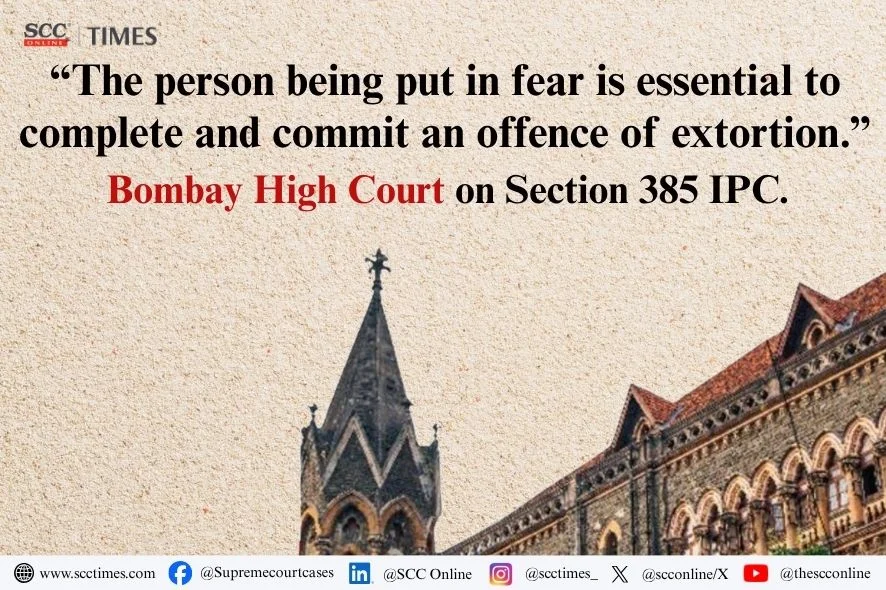
Bombay High Court: In an application under Section 482, Criminal Procedure Code, 1973 (CrPC), now Section 528, Nagarik Suraksha Sanhita, 2023 (BNSS), seeking quashing of an FIR and the resultant charge-sheet alleging that flat purchasers had demanded ₹25 lakhs each from a builder while threatening to cause trouble and obstruct construction unless the demand was met, a Single Judge Bench of Ranjitsinha Raja Bhonsale, J., held that the transcripts of the meetings prima facie reflected settlement talks and negotiations and did not indicate that the complainant was threatened or put in fear of any injury. The Court observed that a general and bare threat with nothing more could not amount to extortion and that merely demanding an exorbitant or disproportionate amount would not attract Section 385 IPC. The Court further held that pursuing pending litigation in accordance with law as an alternative to settlement could not be perceived as an act of extortion.
Background
The application was filed under Section 482 CrPC, now Section 528 BNSS, seeking quashing of an FIR registered with Vasai Police Station and the resultant criminal proceedings pending before the Judicial Magistrate First Class, Vasai, for offences punishable under Sections 385 and 34, Penal Code, 1860 (IPC).
The applicants were flat purchasers and Respondent 2 was the builder/developer. According to Respondent 2, the building consisted of 5 wings, of which 4 wings were ready while construction of “A” Wing was in progress.
The applicants, who were occupants of “B” Wing, had raised issues concerning the construction of “A” Wing and certain amenities and facilities in the building. Various complaints and legal proceedings had been initiated between the flat purchasers and Respondent 2, including proceedings before the State Consumer Disputes Redressal Commission (SCDRC). Respondent 2 had also filed a civil suit seeking damages and a criminal complaint under Section 500 IPC had been filed against the applicants.
Against this background, meetings were held between the parties to explore the possibility of an amicable settlement. According to Respondent 2, during the meetings held on 9 May 2017 and 12 June 2017, the applicants demanded ₹25 lakhs each for settling the disputes and allegedly threatened that, if the demand was not met, he would face further trouble and obstacles in completing the construction of “A” Wing.
The applicants sought quashing of the FIR contending that the meetings were settlement talks and that there was no threat or coercion. They relied upon the transcripts of the meetings and submitted that the criminal proceedings were a counterblast to the consumer proceedings and amounted to an arm-twisting tactic to pressurise them into withdrawing their legal proceedings.
However, Respondent 2 opposed the application and submitted that the FIR and transcripts disclosed a demand for money accompanied by threats and that a prima facie case under Section 385 read with Section 34 IPC was made out.
Analysis
The Court explained that extortion in normal parlance, meant an act of getting something, in most cases money, from a person by using force, intimidation or threats. Referring to Section 383 IPC, the Court observed that the essential ingredients of extortion were intentionally putting a person in fear of injury to himself or another and dishonestly inducing the person so put in fear to deliver property or valuable security.
The Court held that to invoke the offence of extortion, the act had to be intentional and the person had to be put in fear of injury.
“The act of threat or the threat is required to be intentional and of such gravity or intensity that it mentally throws off balance and unsettles, the person so threatened and tends to take away from his act and actions the element of free voluntary action which would constitute consent.”
The Court specifically noted that a general and bare threat with nothing more cannot amount to extortion and moreover it is also necessary to make note of the fact that both the sections do not quantify any amount nor is the offence of extortion dependent on the quantum of money.
The Court also noted that the FIR referred only to the 9 May 2017 meeting and that the 12 June 2017 meeting was mentioned only in a supplementary statement. It also noted that, prima facie, the supplementary statement and Respondent 2’s later affidavit were at material variance on whether the recording was complete.
The Court also considered the transcripts of the conversations produced on record. On a prima facie reading, the transcripts did not indicate any threat or act of extortion. The Court observed that the parties had mutually agreed to meet for settlement talks and to explore the possibility of an amicable settlement. The Court highlighted that the entire tone and tenor of the conversation, as prima facie evident from the transcript, was that of a discussion, negotiation and an attempt to settle the issues. The applicants appeared to have demanded compensation which they considered appropriate for the trouble and stress allegedly undergone by them and their families. They had also proposed to sell their flats and move out and had requested Respondent 2 to purchase the flats or suggest a broker through whom they could sell them. The applicants had also shown willingness to withdraw the consumer complaint and the pending proceedings, and to file undertakings and affidavits.
The Court further held that the contention that the total amount demanded by the seven applicants, i.e. ₹1.75 crores, was highly disproportionate and therefore amounted to extortion could not be accepted in the peculiar facts of the case. The Court emphasised that only demanding an exorbitant or disproportionate amount by itself did not attract Section 385 IPC or make out an offence of extortion.
The Court further observed that a general and bald statement that pending litigation would be pursued in accordance with law and that consequential adverse orders, if any, might cause hindrance or obstacles could not be termed extortion or threat. Pursuing litigation in accordance with law as an alternative to a settlement could not be perceived as an act of extortion.
The Court also referred to Anand Kumar Mohatta v. State (NCT of Delhi), (2019) 11 SCC 706, wherein the Supreme Court observed that only because the charge-sheet has been filed the powers and jurisdiction of the High Court under Section 482 CrPC does not get restricted as the ambit, scope and principles of invoking the inherent jurisdiction under Section 482 CrPC still remain the same and unaltered.
The Court further referred to Mohd. Wajid v. State of U.P., (2023) 20 SCC 219, wherein the Supreme Court had reiterated the parameters laid down in State of Haryana v. Bhajan Lal, 1992 Supp (1) SCC 335 for quashing criminal proceedings. In the said case, the Supreme Court had further observed in frivolous or vexatious proceedings, the Court owes a duty to look into many other attending circumstances emerging from the record of the case over and above the averments and, if need be, with due care and circumspection try to read in between the lines.
Decision
The Court was of the considered opinion that the applicants had made out a case for exercise of its inherent powers under Section 482 CrPC to quash the FIR and resultant charge-sheet so as to meet the ends of justice and prevent abuse of the process of law. The Court found that the present case fell within Categories 1 and 7 of the principles laid down in Bhajan Lal.
Accordingly, the application was allowed.
[Pawan Subhash Sarkale v. State of Maharashtra, 2026 SCC OnLine Bom 13174, decided on 29-9-2026]
Advocates who appeared in this case:
For the Applicants: Amit Ghag
For the Respondents: Tanveer Khan, APP, A. R. Gole