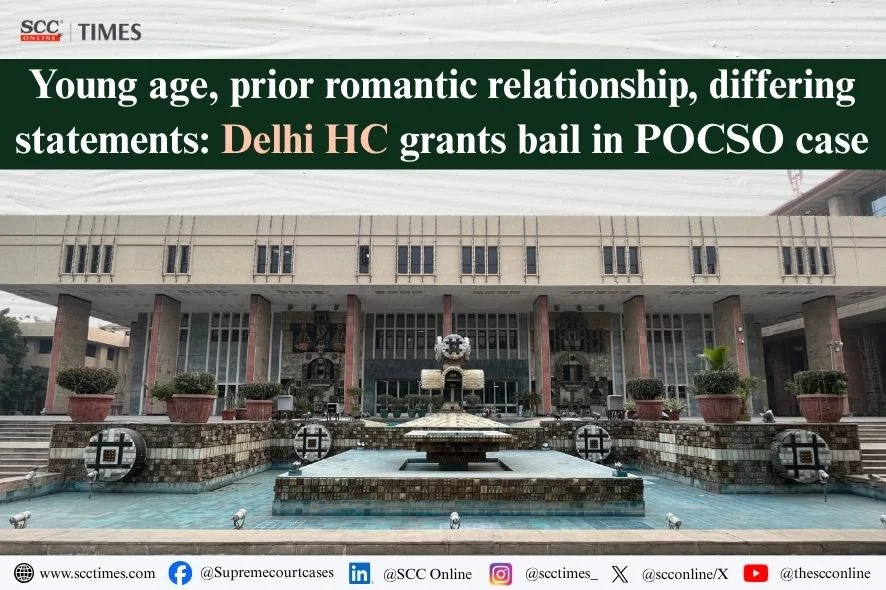
Delhi High Court: While considering a regular bail application for offence punishable under the Protection of Children from Sexual Offences Act, 2012 (POCSO Act), a Single Judge Bench of Mini Pushkarna*, J., granted bail to the applicant, who had been in custody for about 3 years, observing that the prosecutrix’s contradictory statements, the documented romantic relationship between the applicant and the prosecutrix, their young ages, the applicant’s prolonged incarceration, absence of criminal antecedents and the fact that the trial was likely to take time constituted mitigating circumstances tilting the balance in favour of bail.
Also Read: Rajasthan High Court grants bail to accused in POCSO case where victim allegedly eloped willingly
Brief Facts
In the instant matter, the applicant was facing prosecution arising out of FIR, registered at PS Aman Vihar, Delhi, under Sections 363, 368, 376, 328 and 34, Penal Code, 1860 (IPC) and Sections 6 and 21, POCSO Act. The FIR was initially registered pursuant to a missing complaint lodged by the prosecutrix’s father. The prosecutrix was traced on 30 July 2023 and, in her initial statement under Section 161, Criminal Procedure Code, 1973 (CrPC), stated that she had left home in anger and had no complaint against anyone. She subsequently alleged that the applicant had kept her against her will and sexually assaulted her.
The prosecutrix’s date of birth was verified as 12 November 2008, making her 14 years and 8 months old at the time of the incident, while the applicant was 20 years and 4 months old. The applicant had been in custody since August 2023 and had undergone approximately 3 years and 2 months of incarceration by the time of the present application.
Parties’ Contentions
The applicant contended that the parties had been in a relationship for 8 to 9 months before the incident and that their relationship was publicly reflected through social-media photographs. It was further urged that the applicant had no previous criminal antecedents, was a permanent resident of Delhi and was not a flight risk. Reliance was also placed on the medical examination, which did not detect any drug or intoxicant in the prosecutrix’s blood.
The complainant opposed bail, emphasising the gravity of the allegations and the severe punishment prescribed under the IPC and POCSO Act. The State submitted that “consent is irrelevant” in cases under the POCSO Act and that the complainant supported the prosecution case.
The prosecution’s Status Report recorded that the DNA profiles of both the applicant and the prosecutrix were found in the mixed DNA profile from the blanket recovered from the spot, though no male DNA could be generated from the cervical swabs and smears. The complainant submitted that the prosecutrix was made to smell something, so nothing would be found in her blood.
Analysis
At the outset, the Court noted that the prosecutrix had given different versions at different stages. Her initial statement recorded on 30 July 2023 stated that she had left home on her own accord and had no complaint against anyone, whereas she subsequently alleged sexual assault by the applicant.
The Court also took note of the documents showing an intimate and romantic relationship between the applicant and the prosecutrix, including Instagram posts containing their photographs. At the time of the incident, the applicant was 20 years old and the prosecutrix was 14 years old. The applicant had already spent more than 3 years in judicial custody.
The Court referred to Praduman v. State (NCT of Delhi), 2021 SCC OnLine Del 4620, where the age of the parties, photographs indicating a relationship and discrepancies in the statements had been considered as mitigating circumstances while deciding bail. The Court also referred to Dharmander Singh v. State (NCT of Delhi), 2020 SCC OnLine Del 1267, wherein it laid down parameters that are to be followed when considering bail of a person accused under the POCSO Act, including, the age of the prosecutrix and accused, their comparative ages, the presence of threat or violence, the accused’s conduct, possibility of access to the prosecutrix, social standing and other real-life considerations. The Court noted that these factors are far from exhaustive and that grant or refusal of bail ultimately remains within the subjective satisfaction of the Court.
Quoting Praduman, the Court noted that consent given by a minor cannot be said to be valid consent in the eyes of law. It nevertheless held that “these facts cannot be disregarded and serve as mitigating factors which tilts the balance towards grant of bail to the applicant”.
Further, the Court noted that only 2 of the 19 prosecution witnesses had been examined and, therefore, the trial was likely to take time. The applicant had no criminal antecedents and the applicant and prosecutrix were residing in different parts of Delhi.
Considering the surrounding circumstances cumulatively in the present case, the Court held that the applicant’s case warranted grant of bail.
Decision
The Court allowed the bail application and directed the applicant to furnish a personal bond of ₹30,000 with one surety of the like amount to the satisfaction of the Trial Court/Duty Magistrate, subject to conditions including appearance before the trial court on every date, furnishing residential and mobile details, reporting to the jurisdictional police station every Monday at 9.00 a.m., non-interference with witnesses or evidence, and refraining from committing any offence during release.
The Court expressly clarified that the observations in the order were “solely for the purpose of deciding the present bail application” and would neither influence the trial nor constitute an expression of opinion on the merits of the case.
[Vicky v. State (NCT of Delhi), (2023) 2 HCC (Del) 525, decided on 6-10-2026]
*Judgment Authored by Justice Mini Pushkarna
Advocates who appeared in this case:
For the Applicant: Mr. Utsav Kumar, Ms. Medhavi Tyagi, Mr. Devender Kumar, Mr. Bikram Vishal Kumar, Ms. Laveena Tak, Mr. Akshay Sahay and Mr. Yash Gupta, Advs.
For the Respondent 1: Mr. Sunil Kumar Gautam, APP
For the Respondent 2: Ms. Anushkaa Arora, Standing Counsel, Delhi High Court Legal Services Committee
SI Koma, PS Aman Vihar, Delhi
Buy Protection of Children from Sexual Offences Act, 2012 HERE