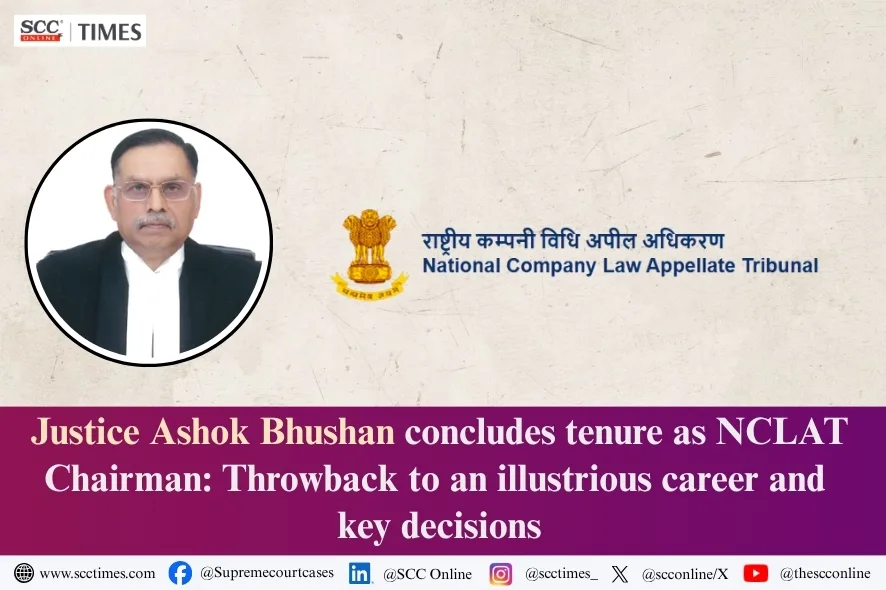
On 4 July 2026, Justice Ashok Bhushan, former Judge of Supreme Court of India, retired from the Chairmanship of National Company Law Appellate Tribunal (NCLAT) after attaining the statutorily mandated age of 70 years. Justice Bhushan was appointed to this role in 2021 and was reappointed in 20251 therefore, demitting office after a tenure of nearly 5 years.
Section 413(4)(a) of the Companies Act, 2013 provides term limit for holding the office of NCLAT’s Chairperson to be 70 years.
Justice Ashok Bhushan’s Career: From Advocacy to Supreme Court Judgeship
Born on 5 July 1956 in Jaunpur, Justice Ashok Bhushan obtained law degree in 1st Division from the Allahabad University in 1979. He enrolled as an Advocate with the Bar Council of Uttar Pradesh on 6 April 1979 and started practice in the Civil and Original side at Allahabad High Court till the elevation to the Bench.
Justice Ashok Bhushan also served as the Standing Counsel of Allahabad University, State Mineral Development Corporation Limited and several Municipal Boards, Banks & Education Institutions. he was also elected as Senior Vice-President of the Allahabad High Court Bar Association.
After gaining considerable experience as an advocate, Justice Alsok Bhushan was appointed as Permanent Judge of the Allahabad High Court on 24 April 2001. During his judgeship at the High Court, Justice Bhushan also served as Chairman of the Higher Judicial Service Committee and headed several other committees.
Thereafter, Justice Bhushan was transferred to Kerala High Court where he was sworn in as a Judge on 10 July 2014 and thereafter took charge as the Acting Chief Justice on 1 August 2014. Justice Bhushan was subsequently sworn in as Chief Justice of Kerala High Court on 26 March 2015.
Owing to his considerable experience and expertise, Justice Ashok Bhushan was elevated as Judge of the Supreme Court of India on 13 May 2016. During this period, Justice Bhushan was appointed as Chairman of Ravi Bias River Tribunal. He retired as Judge of the Supreme Court of India on 4 July 2021.
During his time in the Supreme Court Justice Bhushan was also instrumental in issuing prompt orders during Covid-19 pandemic ensuring compensation for families of persons who died in the pandemic, ensure the welfare of the migrant labourers who have been severely affected due to the outbreak of the COVID-19 pandemic, proper treatment of Covid-19 patients and dignified handling of the dead bodies.
Justice Ashok Bhushan retired from Supreme Court judgeship on 4 July 20212.
Also Read: Messiah of the sufferers: Bidding adieu to Justice Ashok Bhushan
Justice Ashok Bhushan’s Tenure at NCLAT
Post retirement from the Supreme Court, Justice Ashok Bhushan was appointed as the Chairperson of the NCLAT on 8 November 2021, succeeding Justice S.J. Mukhopadhaya who retired in March 202034.
On 7 November 2025, Justice Ashok Bhushan was reappointed as Chairman of NCLAT by the Appointments Committee of the Cabinet (ACC) till the attainment of age of 70 years5.
During his Chairmanship at the NCLAT, Justice Bhushan worked consistently to discipline the virtual hearing formats and narrow the delays between NCLT and NCLAT proceedings6.
Notable NCLAT Decisions
In Provident Fund Commr. v. Mamta Binani, 2026 SCC OnLine NCLAT 619, a company appeal was filed by the Regional Provident Fund Commissioner-II (Appellant), challenging the impugned order passed by National Company Law Tribunal (Adjudicating Authority). The appeal was accompanied by an application seeking condonation of delay in filing of the appeal, which was taken up for consideration. The Bench of Ashok Bhushan, J. (Chairperson) and Barun Mitra (Technical Member), dismissed the delay condonation application and the memo of appeal stating that the Appellate Tribunal had not been vested with any discretionary power to admit an appeal after the expiry of extended 15 days period. The Appellate Tribunal held that the appeal was filed on the 46th day from the date of the impugned order, fell beyond the statutory outer limit of 45 days under Section 61(2), Insolvency and Bankruptcy Code, 2016 (IBC) and was not maintainable.
In SREI Equipment Finance Ltd. v. R.S. Kamthe Infrastructure Developers (P) Ltd., 2026 SCC OnLine NCLAT 156, filed against order of National Company Law Tribunal, Mumbai wherein, CIRP application under Section 7 of the Insolvency and Bankruptcy Code, 2016 (IBC) was rejected holding it barred by Section 10-A of the IBC, the Division Bench of Ashok Bhushan, J., (Chairperson) and Barun Mitra (Technical member) clarified that application under Section 7 had to confine to the default committed subsequent to the period of Section 10-A of the IBC. Thus, the Tribunal allowed the appeal and held that application under Section 7 of the IBC was not barred by Section 10-A of the IBC and directed the matter to be placed before adjudicating authority for afresh consideration.
In Pankaj Mahajan v. Edelweiss Asset Reconstruction Asset Co., (2026) 265 Comp Cas 507, essentially questioning NCLT’s rejection of the sale of non-core assets of the Corporate Debtor, which was approved by the Committee of Creditors (“CoC”) as a sale of assets outside the course of business, aimed at maximization of value, the bench of Ashok Bhushan, J., (Chairperson) and Arun Baroka* (Technical Member) held that Regulation 29 of the Insolvency and Bankruptcy Board of India (Corporate Insolvency Resolution Process) Regulations, 2016 (CIRP Regulations) does not prohibit a CoC sanctioned sale of encumbered assets where secured creditors had given consent. The NCLAT set aside NCLT’s directions requiring PRAs of NCR Rail and ANFL to bid for the subject parcels of land and restored the CoC-approved two-part sale under CIRP Regulation 29.
The Manish Jaju v. Committee of Creditors of Rajesh Landmark Projects (P) Ltd., (2026) 265 Comp Cas 669, was filed by the Resolution professional (‘appellant’) of Rajesh Landmark Projects (P) Ltd. (‘Corporate Debtor’), challenging the impugned order passed by the National Company Law Tribunal, Court V, Mumbai Bench (‘Adjudicating Authority’), which had allowed an interim application filed by the appellant seeking liquidation of the corporate debtor. However, instead of appointing the appellant as liquidator, it appointed Respondent 2, relying on the Insolvency and Bankruptcy Board of India (‘IBBI’) circular dated 18 July 2023 (‘Circular’). The Bench of Ashok Bhushan, J. (Chairperson) and Barun Mitra (Technical Member), stated that the legislative scheme of Section 34(1) of the IBC clearly intended the Resolution professional to be appointed as liquidator, with replacement being a discretionary act of the adjudicating authority based on the grounds specified in Section 34(4) of the IBC. Thus, the Tribunal allowed the appeal, stating that the impugned order insofar as it appointed Respondent 2 as liquidator could not be sustained. Since there were no grounds available under Section 34(4) of the IBC for replacing the appellant, the appellant was required to be appointed as liquidator.
In Regional P.F. Commissioner, Employees’ Provident Fund Organization v. Alok Kailash Saksena, 2025 SCC OnLine NCLAT 1370, a company appeal was filed by the Regional P.F. Commissioner, Employees Provident Fund Organization (‘Appellant’), challenging the impugned order passed by the National Company Law Tribunal, Ahmedabad (‘Adjudicating Authority’), which had rejected an interim application seeking directions to release the payment of Provident Fund dues in light of Section 36(4)(a)(iii) of the Insolvency and Bankruptcy Code, 2016 (‘IBC’) read with Section 11 and 17B of the Employees Provident Funds and [Miscellaneous Provisions] Act, 1952 (‘EPF Act’). The Bench of Ashok Bhushan, J. (Chairperson) and Barun Mitra (Technical Member), dismissed the appeal, stating that as per Regulation 16(2) of the IBBI (Liquidation Process) Regulations, 2016 (‘2016 Regulations’), a stakeholder claim could be filed as on the liquidation commencement date. In present case, the claim had been filed based on the assessment order by the Appellant subsequent to the liquidation commencement date, thus inadmissible.
In Rajesh Vilasrao Patil v. Savannah Lifestyle (P) Ltd., 2025 SCC OnLine NCLAT 1297, Company appeals were filed by the suspended director of Shaila Clubs and Resorts (P) Ltd.-Corporate Debtor and Vasantdada Shetkari Sahakari Bank-the Cooperative Bank challenging the order passed by National Company Law Tribunal, Mumbai Bench (‘Adjudicating authority’) which admitted Section 7 of Insolvency and Bankruptcy Code, 2016 (‘IBC’) application filed by Savannah Lifestyle (P) Ltd. (Respondent 1). The Bench of Ashok Bhushan, J. (Chairperson) and Barun Mitra (Technical Member), set aside the impugned order stating that the admission of application under Section 7 IBC was based on the debt assignment as recorded in minutes of settlement. The claim of debt assignment having been held to be unlawful, there was no right in Respondent 1 claim to be Financial Creditor of the Corporate Debtor.
In IDBI Bank Ltd. v. Hemangi Patel, 2025 SCC OnLine NCLAT 1263, filed by the IDBI Bank, challenging the two identical orders passed on 5-5-2025 by the National Company Law Tribunal (‘NCLT’), Indore Special Bench, Court — I, whereby IDBI’s Section 95 application under Insolvency and Bankruptcy Code, 2016 (‘IBC’) against the personal guarantor (‘respondent’) was rejected, the Bench of Ashok Bhushan J. and Barun Mitra Member (Technical), upheld the decision of adjudicating authority that the Section 95 application filed by IDBI Bank was filed after expiry of three years period of limitation. Thus, the Tribunal found no merit in the appeals and accordingly, dismissed them.
In Ramprasad Vishvanath Gupta v. Dinesh Kumar Deora, 2025 SCC OnLine NCLAT 959, challenging the rejection of application under Section 43 of the Insolvency and Bankruptcy Code, 2016 (IBC), rejection of objections to the Resolution Plan and the approval of the Resolution Plan itself, a 3-member bench of Ashok Bhushan,* J., (Chairperson), Mr. Barun Mitra (Technical Member) and Mr. Arun Baroka (Technical Member), upheld the NCLT’s order and the Resolution Plan. The NCLAT reaffirmed the legal position that homebuyers form a class of financial creditors and are represented by an Authorised Representative. The NCLAT asserted that individual homebuyers do not have independent locus standi to challenge the resolution plan once approved by the majority of the CoC. The NCLAT noted that the Adjudicating authority held that “individual homebuyers may have divergent views but ultimately they vote as a class and individual homebuyers cannot claim to be ‘dissenting homebuyers’.” The NCLT further stated that “the Applicants being disgruntled homebuyers in a minority position have no option but to ‘sail along’ or ‘drag along’ with overwhelming majority which has accepted the resolution plan.”
In Maharashtra State Electricity Distribution Co. Ltd. v. Ravi Sethia, 2025 SCC OnLine NCLAT 382, challenging the Adjudicating Authority’s order directing the appellant, Maharashtra State Electricity Distribution Company Ltd., to restore Corporate Debtor’s electricity without insisting on payment during CIRP, a 3-member bench of Ashok Bhushan, J., Barun Mitra (Technical Member) and Arun Baroka (Technical Member), upheld the Adjudicating Authority’s order and held that Electricity is an essential service under Section 14(2) of the Insolvency and Bankruptcy Code, 2016 (IBC) and cannot be disconnected even if dues remain unpaid during CIRP.
In Sandeep Jain v. IDBI Trusteeship Services Ltd., 2025 SCC OnLine NCLAT 286 filed by the suspended director of the corporate debtor challenging the Adjudicating Authority’s order dated 08-01-2025 admitting an application under Section 7 of the Insolvency and Bankruptcy Code, 2016 (IBC), a 3-member bench of Ashok Bhushan, J. (Chairperson), Barun Mitra (Technical Member) and Arun Baroka (Technical Member), upheld the Adjudicating Authority’s order. The NCLAT held that, the default in repayment of the obligation by obligors cannot in any manner be put on the financial creditor nor constitution of PMC in any manner affect the obligation or absolve the corporate debtor from its default for repayment of the debt.
In Atul Dev v. Union of India, 2024 SCC OnLine NCLAT 1193 challenging the NCLT order dated 01-04-2022 allowed the Union of India’s takeover of the prestigious Delhi Gymkhana Club and the directed to nominate 15 persons as Directors to manage the affairs of the Delhi Gymkhana Club, a Division Bench of Ashok Bhushan,* J., (Chairperson) and Arun Baroka (Technical Member), upheld the Central government’s takeover of the Delhi Gymkhana Club. The NCLAT held that,
-
The proceedings initiated under Sections 241 and 242 is valid and the NCLT properly exercised its jurisdiction.
-
The existing Committee is mandated to expedite remedial actions, ensuring a resolution of the complaints within a specified timeframe.
-
Elections must be conducted within three months after the completion of the remedial actions, culminating in the installation of a duly elected General Council.
In Rahul Gyanchandani v. Parsvnath Landmark Developers (P) Ltd., (2024) 246 Comp Cas 55, against the Adjudicating Authority’s order rejecting the application under Section 7 of the Insolvency and Bankruptcy Code, 2016 (IBC), a 3-member bench comprising of Ashok Bhushan, J., (Chairperson), Mr. Barun Mitra (Technical Member) and Mr. Arun Baroka (Technical Member), allowed the appeal and set aside the order rejecting the Section 7 IBC application. The NCLAT upheld the appellant’s classification as Financial Creditors and rejected the respondent’s arguments based on RERA orders. NCLAT emphasised on the inclusive nature of the IBC’s provisions and the importance of uniform interpretation across enactments.
In Ashdan Properties (P) Ltd. v. Mamta Binani, 2024 SCC OnLine NCLAT 386 challenging the order of Adjudicating Authority which allowed the Committee of Creditors (CoCs) to consider the Resolution Plan of the applicant subject to certain conditions, a 3-member bench comprising of Ashok Bhushan, J., Mr. Barun Mitra, (Technical Member) and Arun Baroka (Technical Member), held that that Resolution Plans from applicants which are not included in the list of Prospective Resolution Applicants (PRAs) cannot be considered by the CoCs. “When no fresh Form G has been issued, it is not open for any new applicant to submit application before the Adjudicating Authority for being permitted to participate in the CIRP and submit Resolution Plan.”
In Fervent Synergies Ltd. v. Manish Jaju, 2023 SCC OnLine NCLAT 2154, against the rejection of application objecting to the Resolution Plan categorizing homebuyers into affected and unaffected groups based on NOC possession submitted by the respondent, a 3-member bench comprising of Ashok Bhushan, J., Barun Mitra (Technical Member) and Arun Baroka (Technical Member), affirmed the validity of the Resolution Plan approved by the CoC and rejected the appellant’s objections based on discrimination and promissory estoppel.
In ICICI Bank Ltd. v. BKM Industries Ltd., (2024) 243 Comp Cas 817, involving a dispute over the distribution of the amount offered for secured creditors under the Resolution Plan, a 3-member bench comprising of Ashok Bhushan, J.*, Mr. Barun Mitra (Technical Member) and Mr. Arun Baroka (Technical Member), while dismissing the appeal, held that the Committee of Creditors (CoC)’s decision to distribute proceeds based on the proportion of admitted claims was in accordance with the IBC and reiterated that the dissenting financial creditor’s entitlement is to receive the minimum amount specified in Section 53(1) and not distribution based on security interest.
In Dheeraj Raikhy v. Raheja Developers Ltd., 2023 SCC OnLine NCLAT 1404, filed against the rejection of application under Section 7 of the Insolvency and Bankruptcy Code, 2016 (IBC), a Division bench comprising of Ashok Bhushan, J., and Barun Mitra (Technical Member), held that in the light of the law laid down by the Supreme Court in Vishal Chelani v. Debashis Nanda, 2023 SCC OnLine SC 1324, it is established that the status of the party, i.e., the allottee, does not change, and therefore, the Adjudicating Authority correctly concluded that the threshold requirement had not been met by a single allottee to trigger insolvency.
While deciding an Express Resorts & Hotels Ltd. v. Amit Jain, 2023 SCC OnLine NCLAT 97 related to ending back the Resolution Plan for re-consideration after the approval of CoC, a Division bench comprising of Ashok Bhushan, J., and Mr. Barun Mitra (Technical Member) held that the approved Plan is not violative of S. 30 (2) and there no breach of procedure or manifest error in the approval of the Resolution Plan, therefore the Resolution Plan cannot be send back for re-consideration.
1. India Reappoints Justice Ashok Bhushan to Lead NCLAT Until July 2026
2. https://www.sci.gov.in/judge/justice-ashok-bhushan/
3. https://legal.economictimes.indiatimes.com/news/law-policy/india-reappoints-justice-ashok-bhushan-to-lead-nclat-until-july-2026/125155015
4. https://nclat.nic.in/about-NCLAT/former-chairperson
5. India Reappoints Justice Ashok Bhushan to Lead NCLAT Until July 2026
6. https://legal.economictimes.indiatimes.com/news/law-policy/india-reappoints-justice-ashok-bhushan-to-lead-nclat-until-july-2026/125155015