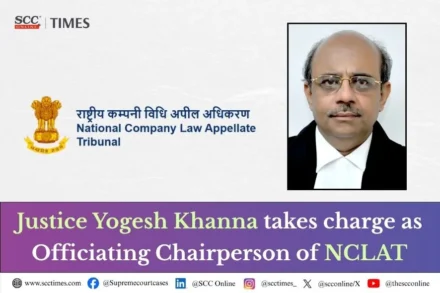
Justice Yogesh Khanna takes charge as Officiating Chairperson of NCLAT
Justice Yogesh Khanna’s appointment was made w.e.f 5 July 2026 after the conclusion of former Chairman, Justice Ashok Bhushan’s tenure on 4 July 2026.
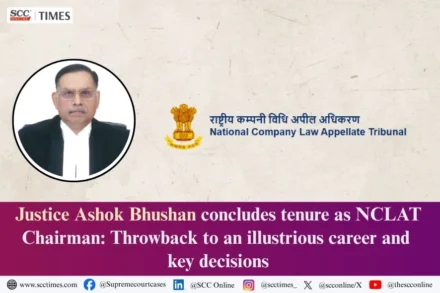
After an extensive career as an advocate and an equally extensive judicial career including the Supreme Court of India, Justice Ashok Bhushan took over as Chairman of NCLAT in 2021.
Supreme Court held that reliance on non-existent, AI-generated or hallucinated judicial precedents vitiates adjudication, rendering the decision void in law and warranting its setting aside.
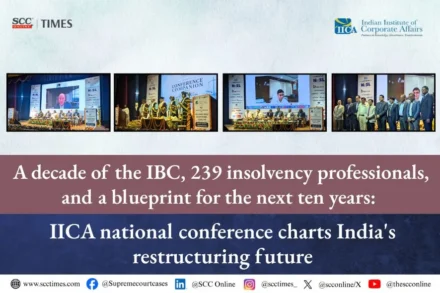
Commemorating a decade of the Insolvency and Bankruptcy Code, the Indian Institute of Corporate Affairs hosted a national conference on India’s restructuring ecosystem alongside the PGIP 6th Batch Convocation. The event featured discussions on cross-border insolvency, distressed assets, early-stage resolution, and the future of India’s insolvency framework.
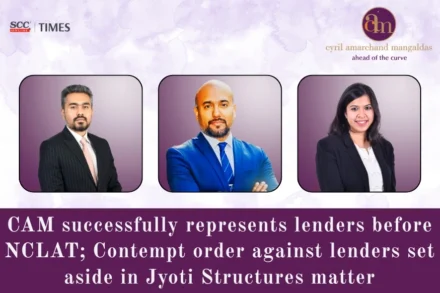
The NCLAT held that the NCLT had failed to comply with the mandatory procedural safeguards applicable to contempt proceedings and, therefore, the impugned order could not be sustained. While setting aside the contempt order, the NCLAT also granted certain fact-specific directions in the matter.
“When the Section 7 of Insolvency and Bankruptcy Code, 2016 (IBC) application is based on default committed subsequent to Section 10-A of the IBC period and the amount claimed subsequent to Section 10-A of the IBC period is well beyond threshold, application cannot be rejected on the ground.”
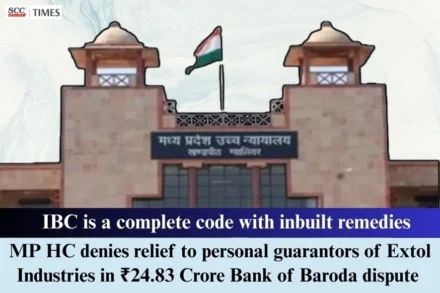
The Court noted that despite filing an appeal before the NCLAT, the petitioners filed the present writ petition challenging the demand notice issued by the Bank.
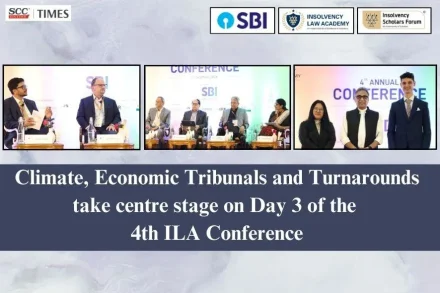
On Day 3 of the 4th Insolvency Law Academy Annual Conference, discussions centred on climate change and insolvency, institutional challenges facing economic law tribunals, the evolving turnaround framework, and contemporary insolvency scholarship.
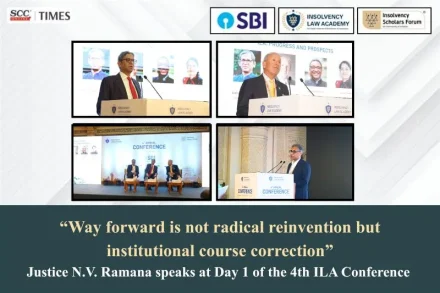
Day 1 of the much-awaited 4th ILA Conference featured erudite addresses and insights from leading insolvency experts and distinguished dignitaries on insolvency law and policy, global trends in restructuring, the changing geopolitical landscape, and cinema as a lens and mirror for the economy.
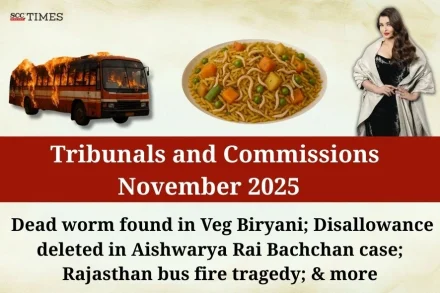
Explore the key legal developments of November 2025, featuring CCI’s power to examine patented product disputes, dead worm found in Veg Biryani, deletion of disallowance against Aishwarya Rai Bachchan, grieving father bribing ambulance, woman’s death at Jammu-based Super Specialty Hospital and Rajasthan bus fire tragedy.
Commercial wisdom of the CoC in choosing the mode and counter-party of sale of assets, whether core or non-core, encumbered or unencumbered, is non-justiciable, barring jurisdictional or regulatory violations.
The appeal challenges the NCLAT’s order upholding a purported lay-off by Resolution Professional, which the appellant claims was a disguised and unlawful retrenchment. The Court is set to examine whether IBC overrides ID Act provisions and whether such retrenchments can legally occur under the garb of lay-offs during insolvency proceedings.
The judgment reaffirmed the principle that entries in a corporate debtor’s balance sheet can constitute an acknowledgment of liability under Section 18 of the Limitation Act, provided they indicate a subsisting jural relationship between the parties, even if the financial creditor is not named explicitly. The Court emphasised that such entries must be interpreted liberally and in context, considering the overall tenor of the balance sheet and the surrounding circumstances.
Reiterating that the commercial wisdom of the CoC is to be given paramount importance for approval/rejection of the Resolution Plan, the NCLT held that the Resolution Plans in the present case met the requirements of the IBC and the IBBI Regulations, and thus, had to be approved.
“Investigation has also revealed no other independent player apart from DNEG has attempted to enter the market over the last few years, which shows the enforcement of appellants model has been a significant barrier for independent players to venture into cloning and delivery of content by the appellants.”
“The impugned order is exclusively interlocutory in nature which is yet to be considered on merits and yet to be given a final shape till the conduct of the final hearing when the interim reliefs prayed for, are heard and decided by the Tribunal.”
The Resolution Plan has been approved by 83.46% voting share of the CoC, therefore, at the instance of Appellant, approval of Resolution Plan cannot be allowed to be questioned.”
“There shall be liberty to the appellant to file a fresh Section 7 application for any default on the part of the corporate debtor subsequent to 10A period.”
“There is a clear distinction between the Avoidance Applications that may be filed by the Resolution Professional in view of Section 25(2)(j), for avoidance of transactions in accordance with Chapter III of the IBC, and the applications that may be filed in respect of the fraudulent trading or wrongful trading under Section 66, which falls under Chapter VI of the IBC.”