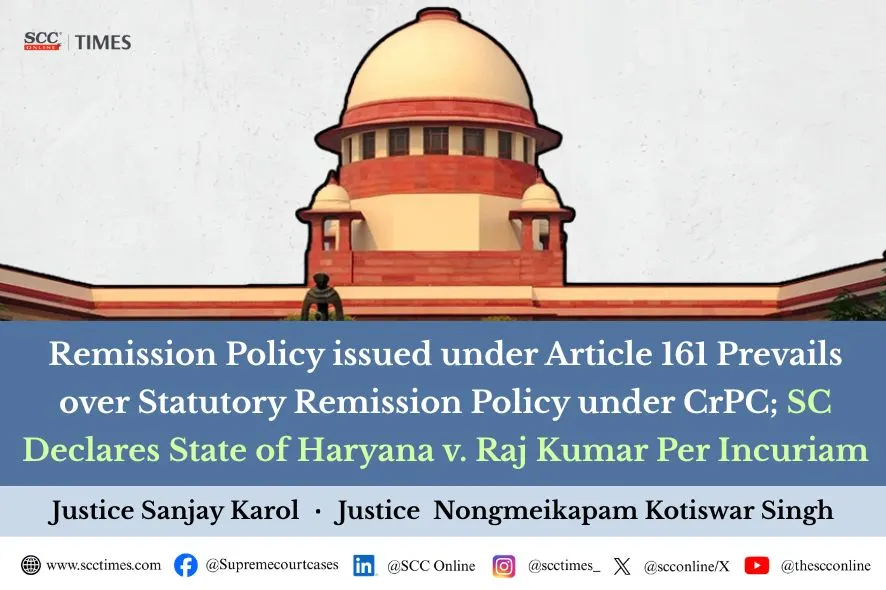
Supreme Court: While determining an important question in an appeal, whether the appellant’s application for grant of remission to the State of Haryana would be governed by the “Policy Regarding Release of Life Convicts 2002” (2002 Policy) dated 12 April 2002 or the subsequent Policy, “Premature Release of Life Convicts 2008” (2008 Policy) dated 13 August 2008 notified by the Jails and Judicial Department, Government of Haryana, the Division Bench of Sanjay Karol* and Nongmeikapam Kotiswar Singh, JJ., held that the appellant’s remission claim must be considered under the 2002 Policy, not under the later 2008 Policy. The Court held that a remission policy that is substantively framed for the exercise of the Governor’s power under Article 161 of the Constitution retains its constitutional character even if issued in the form of a government memorandum. A later remission policy framed under Sections 432 and 433, Criminal Procedure Code, 1973 (CrPC) cannot override, supersede or nullify that constitutional policy.
The Court further held that State of Haryana v. Raj Kumar, (2021) 9 SCC 292, which had treated the 2002 Policy as statutory and had applied the 2008 Policy to convicts sentenced after its introduction, was per incuriam to earlier three-Judge Bench ruling in State of Haryana v. Jagdish, (2010) 4 SCC 216, which had recognised materially similar Haryana remission policies as exercises of the Governor’s power under Article 161.
Factual Matrix
The instant controversy concerns with the interplay between the constitutional power of remission under Article 161 of the Constitution and the statutory power exercisable under Sections 432 and 433, Criminal Procedure Code, 1973 (CrPC). The issue was whether the latter statutory policy, 2008 Remission Policy, which expressly superseded all previous remission policies, could deprive a life convict of the benefit flowing from the earlier policy framed in exercise of the Governor’s constitutional power under Article 161.
The appellant was convicted for the murder of a 12-year-old child. By judgment dated 3 January 2009, the trial court convicted him under Section 302 IPC and sentenced him to imprisonment for life. He was further convicted under Sections 365 and 201 IPC, attracting sentences of 5 years’ and 2 years’ imprisonment respectively. The Punjab and Haryana High Court partly allowed his appeal on 16 July 2013, setting aside the conviction under Section 365 IPC while maintaining the remaining convictions. The appellant’s special leave petition (SLP) challenging the High Court judgment was dismissed by the Supreme Court by judgment 15 September 2015, rendering the conviction final.
After serving more than 14 years of actual imprisonment, the appellant submitted a representation on 26 May 2022 seeking premature release under the 2002 Remission Policy, asserting that he had completed the qualifying period prescribed therein. As the representation remained undecided, he approached the High Court through a writ petition. The High Court disposed of the petition by the order 16 August 2022, directing the prison authorities to decide the representation within 3 months.
The competent authority eventually rejected the representation by order dated 20 October 2022, on the grounds that, (i) the appellant was governed not by the 2002 Policy, but by the 2008 Policy, since the latter had superseded the former and (ii) the appellant had completed only 13 years, 7 months and 16 days of actual imprisonment and 16 years, 5 months and 16 days of total imprisonment, whereas the 2008 Policy required completion of 20 years’ actual imprisonment and 25 years’ total imprisonment before a convict became eligible for consideration for premature release. Accordingly, his claim was rejected.
The appellant challenged the rejection before the Punjab and Haryana High Court, which was dismissed by order dated 27 January 2025, upholding the applicability of the 2008 Policy. Aggrieved thereby, the appellant approached the Supreme Court.
Historical Overview of Haryana’s Remission Policies
At the outset, the Court stated that since the dispute centred on the legal character of the remission policies rather than the merits of the appellant’s conviction, it undertook an examination of the evolution of Haryana’s remission framework. It noted that the remission policies dated 10 November 1971, 23 April 1987 and 28 September 1988 were connected with Sections 432, 433 and 433-A CrPC respectively. The 2008 Policy was expressly issued under Section 432 read with Section 433 CrPC.
On the other hand, the policies dated 19 November 1991, 4 February 1993, 8 August 2000 and 12 April 2002 were associated with Article 161 of the Constitution. The Court noted that the policies of 2000 and 2002 required remission cases to be placed before the Governor through the Minister for Jails and the Chief Minister for orders under Article 161.
Analysis
The Court noted that since the appellant’s conviction and sentence had attained finality, the dispute was confined to determining whether his application for premature release was governed by the 2002 Policy or by the subsequent 2008 Policy. According to the Court, the answer depended not merely upon the chronological sequence of the policies but upon the constitutional or statutory character of the power from which each policy derived its authority.
The Court found that the two policies were founded on different sources of authority. The 2002 Remission Policy relied upon the Governor’s constitutional power, while the 2008 Remission Policy rested upon statutory executive power under the CrPC. The Court observed that “a statutory policy… cannot override” a power exercised under Article 161, because that constitutional power is distinct, independent and not controlled by a statutory provision.
The Court considered judgment in Jagdish, as the controlling precedent. In Jagdish, a 3-Judge Bench had examined the conflict between earlier decisions in State of Haryana v. Balwan, (1999) 7 SCC 355, State of Haryana v. Mahender Singh, (2007) 13 SCC 606 and State of Haryana v. Bhup Singh, (2009) 2 SCC 268, concerning Haryana’s remission policies. The Supreme Court held that the 1993 Policy was framed under Article 161, whereas the 2008 Policy was a statutory policy under the CrPC. It ruled that the statutory policy could not override the constitutional policy. The Court also held that where a more liberal remission policy existed on the date when a life convict’s case was considered, the benefit of that policy should ordinarily be given to the convict.
The Court then examined judgment in Raj Kumar, (2021) 9 SCC 292, where the same question had arisen, whether the 2002 Policy or the 2008 Policy applied. In Raj Kumar, a coordinate Bench had concluded that the 2002 Policy was statutory in nature. It reasoned that the 2002 Policy was a memorandum issued by the Financial Commissioner and Secretary to the Government of Haryana and was therefore traceable to the CrPC. It had held that the 2008 Policy superseded the 2002 Policy and 2002 Policy ceased to operate for convicts who were convicted after 13 August 2008. It nevertheless clarified that the constitutional remedy under Article 161 remained available.
The Court found that the reasoning in Raj Kumar was inconsistent with the legal position declared in Jagdish. It noted that the 1993 and 2002 Policies were materially identical in the relevant respect: both required remission cases to be placed before the Governor for orders under Article 161. Therefore, if the 1993 Policy was constitutional in character, the 2002 Policy could not logically be treated differently.
While addressing the appellant’s contention that judgment in Raj Kumar was per incuriam, the Court stated that (i) the per incuriam doctrine is an exception to stare decisis and must be invoked sparingly, (ii) a judgment may be per incuriam where its ratio cannot be reconciled with an earlier decision of a Bench of equal or higher strength, or where a relevant statutory provision, rule or regulation was not brought to the Court’s attention, and (iii) the doctrine applies only to the ratio decidendi and not to obiter dicta.
The Court further stated that judicial discipline requires a Bench disagreeing with a co-equal Bench to refer the issue to a larger Bench. A decision of a larger Bench binds all later Benches of equal or lesser strength. The Court also clarified that a judgment is not per incuriam merely because it refers to an earlier decision and reaches a conclusion that may be correct or incorrect. Nor should a judgment be treated as per incuriam unless an ordinary reading shows a clear conflict with binding precedent.
Applying these principles, the Court accepted the appellant’s argument that judgment in Raj Kumar was per incuriam. It held that the 1993 and 2002 Policies were identical in their essential source of power because both contemplated the Governor’s exercise of power under Article 161. Since judgment in Jagdish, decided by a three-judge Bench, had declared the 1993 Policy to be an exercise of constitutional power, the 2002 Policy had to receive the same legal character. The Court concluded that Raj Kumar fell foul of the reasoning in Jagdish because it treated the 2002 Policy as a statutory policy. Therefore, Raj Kumar was held to be per incuriam.
The Court further clarified that a reference to a larger Bench would have been necessary only if it were departing from a co-equal Bench without a controlling precedent. Since Jagdish was already a binding larger-Bench authority, no such reference was required.
The Court held that the 2002 Policy was framed under the Constitution and that the relevant power was to be exercised by the Governor under Article 161. The 2008 Policy, being statutory and issued under the CrPC, could not defeat, displace or supersede the constitutional policy. Accordingly, the Court held that the statement in the 2008 Policy that it superseded the 2002 Policy was “untenable in law” insofar as the constitutional remission power was concerned. The 2002 Policy continued to have legal effect in the appellant’s case.
The Court applied the principle in Jagdish and held that the appellant was entitled to the benefit of the lesser period of sentence prescribed under the 2002 Policy.
The Court expressly limited the effect of this ruling and clarified that the judgment would operate prospectively. It would not reopen remission applications that had already been finally decided.
The Court also observed that, after this decision, the State of Haryana would have two distinct and separate remission policies functioning in their respective constitutional and statutory fields. It left it to the State to decide how it intended to proceed administratively in light of this position.
Decision
The Court allowed the appeal and directed the State of Haryana to take a decision on the appellant’s remission application in conformity with the judgment within 4 weeks from the date of the judgment.
Also Read: Premature Release of Convicts | SC discusses judicial involvement in Grant of Remission
[Parveen Kumar v. State of Haryana, 2026 SCC OnLine SC 1250, decided on 1-7-2026]
*Judgment by Justice Sanjay Karol
Advocates who appeared in this case :
Mr. Sunil Kumar Verma, AOR, Mr. Himank Nargotra, Adv., Mr. Desam Sudhakara Reddy, Adv., Counsel for the Appellant
Mr. Akshay Amritanshu, AOR, Ms. Aashna Gill, Adv., Ms. Harsh Rekha, Adv., Mr. Sarthak Srivastava, Adv., Counsel for the Respondents