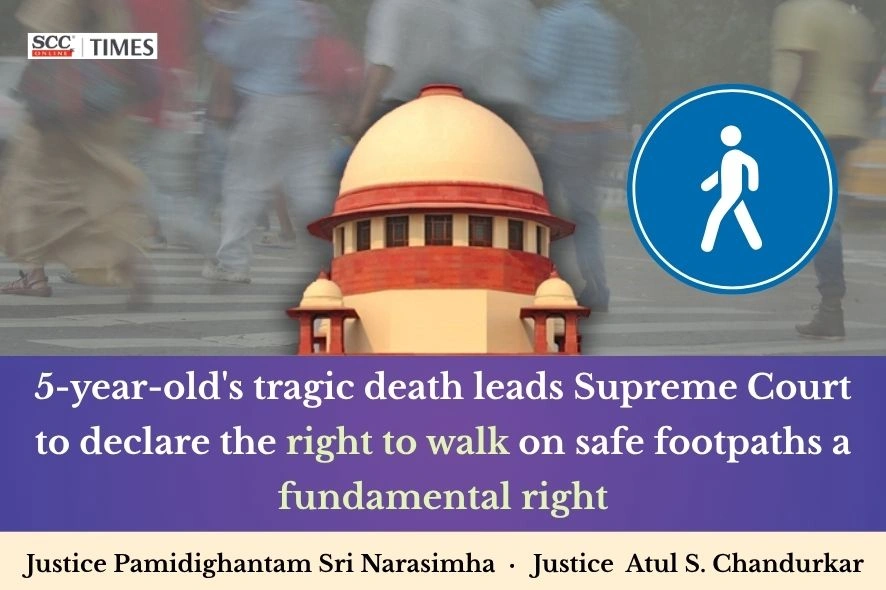
Supreme Court: In a civil appeal arising from a motor accident claim concerning the death of a 5-year-old child who was fatally run over by a tanker while walking to school with his father, a Division Bench of Pamidighantam Sri Narasimha and Atul S. Chandurkar, JJ., not only enhanced the compensation payable to the bereaved father but also addressed the larger constitutional issue of pedestrian rights in India. Observing that the “primary right of movement under Article 19(1)(d) is the Fundamental Right to Walk”, the Court declared that the right to walk on safe and well-demarcated footpaths is a fundamental right under Part III of the Constitution.
Emphasising that pedestrian rights are primary and must receive priority over movement by motorised vehicles, the Court held that Urban Development Authorities, Municipal Corporations, Municipalities and Panchayats bear an enforceable duty to provide and maintain footpaths. The Court further recognised that violation of the right to walk on demarcated footpaths entitles citizens to seek constitutional and legal remedies independent of those available under the Motor Vehicles Act, 1988, and underscored the need for a dedicated statutory framework and regulatory mechanism to protect and effectuate this right.
Background
The present case arises from a tragic motor accident that claimed the life of a 5-year-old child. On the fateful day, the appellant-father was walking with his young son to a nearby school after lovingly preparing him for the day. At about 9.00 a.m., while they were proceeding towards the school, a tanker approached from behind and struck the child, crushing his waist and lower body. The grievous injuries proved fatal, and the child succumbed shortly thereafter.
Aggrieved by the untimely death of his son, the appellant instituted a claim petition before the Motor Accident Claims Tribunal (MACT) seeking compensation of ₹25,00,000. By award dated 30 May 2016, the MACT granted compensation of ₹7,82,000 along with interest at the rate of 6 per cent per annum from the date of filing of the claim petition until realisation. Dissatisfied with the quantum awarded, the appellant preferred an appeal seeking enhancement, while the insurance company challenged the award as excessive. By the impugned judgment, the High Court dismissed the appellant’s appeal and allowed the appeal filed by the insurance company, reducing the compensation from ₹7,82,000 to ₹4,70,000. The appellant thereafter approached the Supreme Court challenging the reduction of compensation awarded for the death of his minor son.
“Accidents like this continue to occur, perhaps they are inevitable till we restructure our rights regime as regards access to roads and recognise their correlative duties. Till then, we will continue to cope with these tragedies by routinely transforming them into FIRs and Motor Accidents Claims.”
Also Read: Madhya Pradesh Motor Vehicles Act Compound Offences List 2023
Analysis and Decision
The Court held that the High Court committed an error in reducing the compensation awarded by the MACT. Referring to its recent decision in Karuna Parmar v. Prakash Sinha (2025 INSC 1244), which involved the death of a 6-year-old child, the Court adopted the same methodology for assessment of compensation. Taking the notional income of the deceased child on the basis of minimum wages, adding 40 per cent towards future prospects, deducting 50 per cent towards personal expenses and applying the multiplier of 18, the Court recalculated the loss of dependency at ₹10,11,528. Adding conventional heads, namely, loss of consortium, loss of estate and funeral expenses, the Court enhanced the compensation payable to the appellant to ₹11,44,628 and directed payment within 2 months.
The Court further observed that the case highlighted a larger constitutional concern regarding pedestrian safety. Emphasising that the “primary right of movement under Article 19(1)(d) is the Fundamental Right to Walk”, the Court declared that every citizen has a fundamental right to walk on safe and well-demarcated footpaths, which must receive priority over movement by motorised vehicles.
“The primary right of movement under Article 19(1)(d) is the Fundamental Right to Walk, a right that precedes the right to move on wheels and this precious right must extend to guaranteeing access to safe and well-demarcated footpath. The citizen’s fundamental right to walk on a demarcated footpath is primary and shall have priority over movement by motorised vehicles.”
“…walking is not just motion, it certainly embodies expressional, congregational and associational rights under Article 19(1)(a), (b) and (c). Unfortunately, we have failed to recognise these aspects to such an extent that the phrase ‘pedestrian’ has acquired pejorative shades.”
The Court noted that the absence of safe footpaths has become a “civilisational problem” and that Urban Development Authorities, Municipal Corporations, Municipalities and Panchayats bear an enforceable duty to provide and maintain such footpaths. Observing that there is presently no dedicated statutory framework protecting this right, the Court underscored the need for legislation recognising the right, identifying duty bearers, providing remedies and establishing a full-time regulator.
“We have clarified at the very outset that the Motor Vehicles Act, 1988, is not a legislation for protecting the right to walk on the footpath….
…The Motor Vehicles Act is built upon ‘vehicle’ as the subject of the legislation, while ‘human’ interests are incidental, which a motor vehicle must avoid violating — that’s all, and no further. In its discourse, the right of a pedestrian is incidental; the mainstay of this legislation is the Motor Vehicle.”
Accordingly, the Court made the following declarations:
-
The right to walk is a fundamental right under Part III of the Constitution. It is integral to the right to movement guaranteed under Article 19(1)(d), read with Articles 19(1)(a), (b), (c) and 21 of the Constitution.
-
The fundamental right to walk includes the right to demarcated footpaths. These rights are primary and shall have priority over movement by motorised vehicles.
-
The fundamental right to walk on demarcated footpaths has a correlative duty. Where a road exists, there is a duty to ensure that demarcated and well-maintained footpaths are available for walkers.
-
The duty bearers are Urban Development Authorities, Municipal Corporations, Municipalities and Panchayats, which must endeavour to demarcate, construct, maintain and safeguard footpaths and other necessary pedestrian infrastructure, as walking is integral to life.
-
The Court held that violation of the right to walk on demarcated footpaths entitles citizens to invoke constitutional and legal remedies against the duty bearers for restitution and compensation.
-
Such remedy is independent of the remedies available under the Motor Vehicles Act, 1988.
Observing the compelling necessity for a statutory framework to protect and effectuate this right, the Court directed that a copy of the judgment be forwarded to the Ministries of Housing and Urban Affairs, Rural Development, Road Transport and Highways, as well as the Law Commission, for consideration of appropriate legislation and institutional mechanisms.
Also Read: Commuter Safety a Fundamental Right under Article 21: SC | SCC Times
[Maniyar Iliyaz v. P. Ayyappan, 2026 SCC OnLine SC 1162, decided on 19-6-2026]
Buy Constitution of India HERE