Introduction
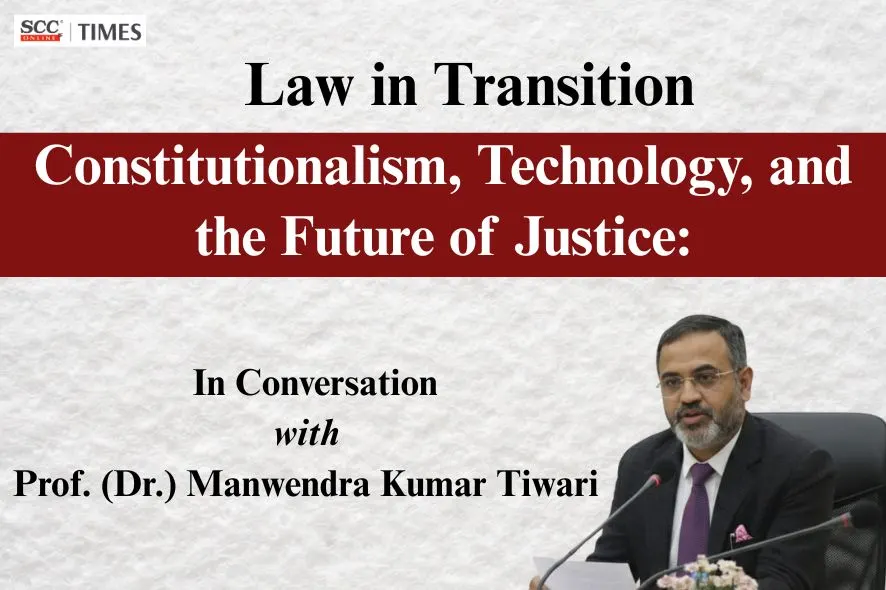
Prof. (Dr) Manwendra Kumar Tiwari is a Professor of Constitutional Law at CNLU Patna. He has been in the legal academia since 2008, and has previously taught at RMLNLU Lucknow, HNLU Raipur, and DNLU Jabalpur. His primary interests include Constitutional Law, Jurisprudence and Research Methodology. His works find home in international and national journals, including the International Journal for the Semiotics of Law (Springer), Constitutional Review (Constitutional Court of Indonesia), Indian Law Review (Taylor & Francis), Indian Journal of International Law (Springer), Economic & Political Weekly, and others. He is a regular contributor to Live Law. He is the revising author for PSA Pillai’s book on Jurisprudence (EBC, 2026) and G.C.V. Subbarao’s Jurisprudence and Legal Theory (EBC, 2026). He has been a contributor to UGC’s e-PG Pathshala for multiple modules. He will present his work at the upcoming Asian Law Institute (ASLI) Conference at Jakarta, Indonesia in June 2026 and at the International Society of Public Law (ICON-S) Annual Conference at Dublin, Ireland in July 2026.
1. To begin with, kindly introduce yourself. What motivated you to pursue a career in law?
I come from what we socially label as a “small-town”, Daltonganj, in Jharkhand. Having done BA in English Literature from Ranchi University, I completed the three-year LLB program from the Faculty of Law, BHU, Varanasi, and LLM program from Indian Law Institute, New Delhi. I completed my PhD from RMLNLU Lucknow.
My father is a practising advocate at the Daltonganj Civil Court, and I drew the initial thrust needed to study law, in the most unsaid ways, from him. The situations where my father’s clients from unprivileged sections of the society offered farm vegetables (Chana ka saag, nenua (tori), macca, kaddu) as his fees (that he never demanded), is imprinted in my childhood memories, the value of law (and of a lawyer).
2. Having been part of legal academia since 2008 across multiple National Law Universities, what initially drew you towards constitutional law? How has your intellectual engagement with the discipline evolved over time?
Initially, I understood lawyering as a deductive exercise — lawyers’ interpretative skills by dissociating their own self from the interpretive exercise. Exposure to the discipline of constitutional law, altered this impression.
In Constitutional Law, the text of law is limited, but their meanings are infinite. To quote Professor Upendra Baxi, in constitutional law, the birth of the reader is the death of the author. The expanse of the densely enmeshed interpretative frameworks for the constitutional provisions, superimposed with case-law jurisprudence, drew me to read the cases closely. Having a keen interest in jurisprudence, I gravitated towards constitutional law jurisprudence organically.
Initially, due to my impression that constitutional law is open-ended, I found the motivation behind the movement of American Realism to be the guiding light of constitutional law. It, therefore, meant that the principled constitutional law is an impossibility. Here, Ronald Dworkin’s writings played an important part in shaping my understanding about the constitutional law. Dworkin reminded me that the positive reality of incoherent and unprincipled adjudication is an aberration notwithstanding the positive law’s embrace of that aberration as law under Article 141 of the Constitution of India. I believe that the quest for truth must remain an unflinching endeavour. It importantly reminded me that even in an open-ended discipline; coherent and principled approach remains the desirable attribute.
3. Your teaching spans constitutional law, jurisprudence, and research methodology. How do you perceive the interplay between these disciplines in shaping a critically informed and analytically rigorous legal mind?
Interestingly, all these three disciplines interact with each other at various planes—for instance, first, the abstract theories of jurisprudence (like the contestations about the meanings of law) can be exemplified through the constitutional texts and interpretations; second, the theories of jurisprudence also have an unsaid presence in the courts of law within the Judges, lawyers, and the legal reporters; third, the qualitative-quantitative truths in the discipline of research methodology tells us that truth itself is a contested idea and exposes us to the idea of multiplicity of truth. It reminds us against constitutional idolatry and opens our minds to critical thinking. We must acknowledge that even the constitutional texts are not amoral truths.
4. In your work on “exorcising the colonial ghost” in international law classrooms, you raise important concerns about legacy frameworks. In your view, what remains the most significant barrier to meaningfully decolonising the Indian legal curriculum?
A significant barrier to meaningfully decolonise the Indian legal academia is the uncritical (and often unthoughtful) adoption of Euro-American scholarships to Indian classrooms. This often breeds a sense of detachment and dissociation among the students, one that I, along with my co-author, also argue in the “Exorcising the Colonial Ghost” paper (in reference to the teaching of International Law, as that was the focus of the paper). Such detachment is heightened in the discipline of international law more than the domestic laws.
While we have to be cautious against an uncritical curating of reading lists for our course outlines, we must not weed out the Euro-American scholarships. We have a lot to learn from the sophistries of their scholarships. However, the focus, in its entirety, on the legal developments in the Euro-American world must be avoided.
Our choice of pedagogical tools has extremely far-reaching consequences for the students, who read them from a place of less clarity than ours. We can choose one reading text over the other for the want of understanding, association, relatability and clarity for the students. Students may not ordinarily possess the ability to curate a reading list. Teachers must spend considerable time, energy and caution in preparing reading lists. Researchers must do the same when choosing a text (over another) for their literature review or references.
Constitutional Law scholarship has rightly turned its focus on what is known as the Global South. Recently, Gautam Bhatia through his scholarship on Kenyan and Jamaican Constitutional Law (apart from Indian Constitutional Law) has played a crucial role in this regard. Upendra Baxi, P.K. Tripathi, Tarunabh Khaitan, Pratap Bhanu Mehta, Faizan Mustafa, Madhav Khosla, Sujit Choudhry, Anashri Pillay, Amal Sethi and Aradhya Sethia have made important contributions in this field. Madhav Khosla’s article in the American Journal of Comparative Law on the Delhi High Court judgment in the Naz Foundation case3 and its focus on the Nepal and Fiji Supreme Courts led him to argue for inclusion in the scholarly domain of comparative constitutional law. Also, writings about the developments in the field of Indian constitutional law by the non-Indian authors is worth engaging; starting with Granville Austin, Marc Galanter, Sandra Fredman, Richard Albert and Yaniv Roznai and others.
Exposing oneself to this reality that Euro-American borrowing devoid of cultural context and rationale straight into the field of Indian constitutional law must be stopped, is a challenge. Yet, we must undertake this challenge if decolonising the legal curriculum in India is a task that we wish to achieve.
5. In your review of Justice Frustrated, you have analysed the issue of judicial delays. From a research perspective, what could be the possible reasons of such delays and what could the possible ways to address the same?
I am not an expert on this issue and my observations in this regard are partly anecdotal and partly stem from my reading of the book on judicial delays that I reviewed. In a vast country like India, judicial delays will remain a constant challenge. Yet, at a normative level perhaps we do not need to do much. Judicial delay in India, primarily stems from not fulfilling the norms that we have set for ourselves. For instance, no State in India at any given point of time operates at the optimum level of sanctioned posts of Judges, both at the District and the High Court level. The Supreme Court of India is the only exception in this regard. Recently, the Union Cabinet gave the nod for adding four more Judges to the Supreme Court. We do not even hear such conversations around adding the number of Judges to the District Courts and High Courts because they never operate at the optimum capacity level. The sad part is that we seem to have accepted it as a fait accompli. Adding to the number of Judges means adding the required human resource along with it. Most of the existing courts in India, especially at the District Court level, operate without the sufficient human resource. The budget expenditure on judiciary is still very low and therefore, these shortfalls help meet the budgetary target of spending on the judiciary.
At the functional level too, there are several issues. For instance, the law against adjournments is seldom adhered to and this has become an accepted judicial practice. The court’s registries across India still does not believe in managerial expertise in the handling of cases. It is high time that we take our normative prescriptions seriously and identify the role of domain experts and take their help.
6. Beginning your academic career soon after your LLM in 2008, what is one piece of advice you received as a young lecturer that has stayed with you and that you now find yourself imparting to your own doctoral scholars?
If you call a discipline as your interest area (beside knowing the contents of law) you must know thoroughly the scholars and their scholarships with depth. If you know this, you would also know the recent developments in the discipline.
At Indian Law Institute, I was taught by teachers who displayed through their conduct the importance of reading. We had mandatory reading hours at the library. This reminds me how a good reader makes a good teacher. This would sound simplistic to an older generation teacher, but its value lies more for the newer generation who sometimes see library as a redundant place, hard copies of books as unnecessary, and reading as an occasional enterprise, needed during either examinations or moot court-like exercises. Franz Kafka says, I need solitude for my reading, not that of a hermit, but that of a dead man. It is important that we, as teachers, researchers and students of law, devote time to reading in solitude—to think, to reflect upon and to raise the right questions.
7. As someone deeply engaged in legal research methodology, what are the most common pitfalls young researchers encounter? What strategies would you recommend to overcome them?
The common pitfalls for me would be majorly three: selection of a research problem/area; articulation; and choice of the platform.
As a beginner researcher, one finds it difficult to choose a research area, a research argument, and a research problem from the expansive canvas of laws and their nuances. Often, such exercises are done in a time-bound manner, and researcher choose an area, argument or problem in haste, without actually understanding the issue. One needs to read enough—about the laws, cases, and their interpretations in scholarly texts—to be able to frame a research argument or a research problem. In this scheme, a choice of literature and its review should precede a title selection.
For articulation, as English is the dominant language of most of the research in law, we must realise that reading closely and diversely shapes our articulation. If there is a scholarly text that has received a special mention by a journal or a research community, one must read it regardless of which subset of law it belongs to. Only a good reader breeds a good writer. Coherence of language and of arguments, brevity, simplicity, invocation of imageries and illustrations, placement of evidence (case laws, or data supporting one’s research argument) is learnt only by observing, very closely, authoritative scholarly texts. Reading good texts refines one’s writing.
For the choice of platform, young researchers must not fall in the artificial hierarchies of platforms. A blog post may sometimes be more novel than a research paper. Blog posts are significant platforms for testing our nascent ideas and for pointing out legal questions that may not be dealt at the length of a research paper. I often find papers written by students in their first three-four years of a five-year BA LLB program. I also sometimes find published papers that ideally should have been blog posts. I say this not to discourage the young students to write. There are many articles by them which have found a special mention in the larger academic community. All I say is that young researchers should not undervalue blogs as platforms. On a similar note, writing for law-reporting platforms like Bar and Bench, Live Law and SCI Observer and newspapers, is also a significant venture to test one’s writing and research ability. Engaging in writing explanatory pieces for such platforms should not be undermined.
For journals as platforms, one must be able to distinguish predatory journals from the rest. They must know the academic/institutional publication houses as distinct from private publication houses.
Having said about these three broad concerns, my cross-cutting concern is about over-writing—writing more than reading! Rat-race writing induced by the peer pressures and other forms of cognitive motivations. While writing is a form of one’s expression, it must come to one organically and should not be forced.
8. In your assessment, what issues are likely to be the most pressing constitutional challenges that India will confront over the next decade?
One of the enduring contributions of Indian constitutional law has been the advent of the public interest litigation (PIL). Over the years, the callous misuse and overuse of it has given an impression among the Constitutional Courts of India that PILs are no more relevant. If this were to happen, the cause of the marginalised sections, the voiceless, would not reach the courts.
The other pressing concern emanates from the enormity of the cases that the Constitutional Courts handle, especially in their appellate jurisdiction. This, on many occasions, would make a constitutional challenge otiose owing to time-lapse.
Constitutional Courts may not decide correctly, but they must decide impartially. For this, insulating the mechanism for the appointment of Judges from narrow political and ideological thrusts is important. How do we continue to ensure that will remain an everlasting challenge? Fortunately, despite its flaws, the present system of appointment has managed to guard against this. However, the power of veto seems to be with the Union Government, which ensures non-appointment of a person recommended for judgeship by the Supreme Court’s collegium. This is against the law, declared by the Supreme Court, and the Court therefore must find a way to deal with it.
9. How do you evaluate the evolving role of the judiciary in shaping public policy within a constitutional democracy such as India? Where should the balance lie between judicial intervention and institutional restraint?
Where the line exists—this has remained a perennial quagmire. However, the contestations around this issue must be seen as symbolic of a healthy democracy. It is true that the Dworkinian distinction of a principle-policy divide is not relevant in the Indian context, and therefore, the quest for drawing a line must be found in the traditionally understood domain of policy. For instance, when it comes to constitutional socio-economic adjudication, the South African reasonableness approach seems to be doing that. It examines the sufficiency of the policy measure by even declaring it insufficient but leaving the policy choice to make it sufficient, to the Government.
10. In the context of rapid advancements in artificial intelligence, data governance, and surveillance technologies, how equipped is Indian constitutional law to respond to these emerging challenges?
Our frequent responses to “newer” legal problems are a new legislation. While this might be correct for a few legal concerns, I believe that the broad canvass of constitutional interpretation carries the possibility of dealing with newer legal challenges. As most of the issues deal with life, liberty, dignity and equality, the guiding light of constitutional morality (despite the contestation around it) can take care of such newer challenges. Article 21’s expansive interpretation is a testimony of this.
Artificial intelligence, data governance or surveillance cast their weight on constitutional principles through the real-time multiplicity of effects. This multiplicity tells us the enormity of the legal problem, and taken us to simplistic argument of creating new laws. But normatively, the constitutional text is crafted well to address them.
11. Finally, what advice would you like to give to the aspiring legal scholars and future practitioners who seek to create impact through academia?
Law is a potent equalizer. The onus of a teacher, of a lawyer and of a Judge that a law student aspires to become, is extremely high. To know, acknowledge and value this onus is the first step to becoming anything. Unbecoming oneself — through religion, caste, sex, gender, regionality — also comes from law.
Having said this, we must also acknowledge that law is not a panacea—unlike most of us, invested for decades in law, many others see a heightened image of law. Law definitely is a significant tool of justice; but there are other tools too. Many answers of legal questions do not solely come from the domain of law, they come from the domains of sociology, political science, history and psychology. Therefore, we must not be disheartened to see that a normative prescription of law is not at work. It is a cause of concern to be addressed but we must accept the fact that the gulf between the normative and the empirical realities of law will always remain. This is an important lesson for an academic. Very often, we look for novel normative prescriptions as the only rationale for meaningful scholarship. Analysing the impact of law is equally important in terms of academic contribution. Impact can also be created through analytical scholarship.
1. Prof. (Dr) Manwendra Kumar Tiwari is a Professor of Constitutional Law at CNLU Patna. He can be reached at manwendra@cnlu.ac.in
2. EBC-SCC Online Student Ambassador, Faculty of Law, University of Lucknow.