


Today, Artificial Intelligence (AI) is causing anxiety in the job market. But rewind half a century, and it was our good old friend, the computer, slowly slithering into our offices and then into our living rooms, while sending the world into a quiet panic. Before that, it was the internet. Before that, robotics. Before that, Mr Ford’s assembly line. And before all of that, a mechanical loom in an 18th-century textile mill that put hundreds of hand loom workers out of work overnight.
We are indeed in the midst of another technological revolution. However, your livelihood can be at risk regardless of one. It can be threatened by a single good old-fashioned letter, a brief meeting with your HR, or a phone call you were not prepared for. A termination, whether fair or not, can certainly be stressful if it arrives without warning or hearing your side, leaving you overwhelmed with more questions than answers.
That is exactly why this piece exists. It is better to know your rights before you need to, than to Google up these questions when you are in the midst of the chaos.
Therefore, irrespective of your position in the organisational hierarchy, understanding your rights as an employee is more crucial than ever before, because not every firing is legally valid.
In this piece, we will discuss what constitutes a legally valid termination, when it becomes unfair, whether an employer can terminate without hearing the employee, whether employees can be fired without notice, what if you are on probation, whether forced resignation is legal, and various other frequently asked questions (FAQs) that every working person in India should know.
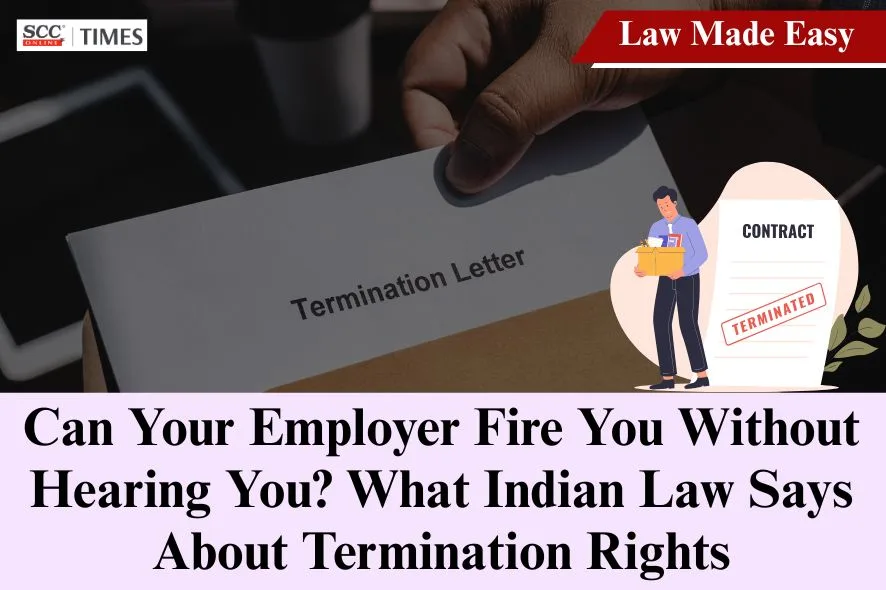
Now, let us come to the moot point. Can your employer fire you without hearing your side?
In most cases, no. The law requires fairness, especially when a decision affects your livelihood. Here’s how it works.
Who are you, whether a “worker” or an “employee”?
Starting with the basics, let us understand the distinction between the terms “worker” and “employee” defined under the new Labour Codes, viz., Industrial Relations Code, 2020. The following table lists the key differences between the two: –
|
Particulars |
Worker |
Employee |
|
Definition under the Industrial Relations Code, 2020 |
Defined under Section 2(zr) |
Defined under Section 2(l) |
|
Who is covered |
Any person employed in an industry* |
Any person employed in an industrial establishment** |
|
Type of work covered |
Manual, unskilled, skilled, technical, operational, clerical, or supervisory work |
Skilled, semi-skilled, unskilled, manual, operational, supervisory, managerial, administrative, technical, or clerical work |
|
Apprentices |
Excluded if an apprentice as per the Apprentices Act, 1961 |
Excluded if an apprentice as per the Apprentices Act, 1961 |
|
Employment terms |
Express or implied |
Express or implied |
|
Special inclusions |
Includes working journalists and sales promotion employees |
Includes persons declared as employees by the appropriate Government |
|
For Industrial Disputes Proceedings |
Includes persons dismissed, discharged, retrenched, or terminated in connection with an industrial dispute |
No specific provision |
|
Armed Forces |
Excluded |
Excluded |
|
Police and prison staff |
Excluded |
Not specifically excluded |
|
Managerial or administrative employees |
Excluded |
Included |
|
Supervisory employees |
Excluded if wages exceed the limit prescribed by the Central Government |
Included |
|
Scope |
Narrower and dispute-centric definition |
Wider definition |
Thus, to put it simply, you are an ‘employee’ if you are in a managerial, administrative or supervisory role.
Also Read: Inclusive Workforce Through Four Labour Codes in India | SCC Times
What does ‘being heard’ mean?
The right to be heard is something every person craves in every form of dialogue. While we can only hope to find good listeners in our lives, the law ensures that you get one in employment disputes. It is a basic principle of fairness. In law, it comes from the Latin maxim audi alteram partem, meaning “hear the other side”. It forms an essential part of natural justice and ensures that a person gets a fair opportunity to present their case before any decision affecting their rights is taken1. Denying this opportunity violates the principles of natural justice and Article 14 of the Constitution of India, which guarantees fairness and equality before the law.
In the landmark judgment in D.K. Yadav v. J.M.A. Industries Ltd.2, the Supreme Court of India held that every person must be given a reasonable opportunity to present their case, and the authority must act fairly, justly, reasonably, and impartially.
The doctrine has three essential requirements:
1. a person against whom an order is to be passed, or whose rights are likely to be adversely affected, must be given an opportunity of being heard,
2. a fair and transparent procedure must be followed,
3. the authority must pass a reasoned order after considering the matter properly.
These requirements have been consistently applied by courts across India and abroad3.
A fair hearing does not require a formal court-like process. The purpose of natural justice is simply to ensure that a person whose rights may be affected gets a fair opportunity to be heard4.
In employment matters, whether an employee must be heard before termination depends on the nature of the termination. If the termination is punitive or stigmatic, the employee must generally be allowed to present their side. However, in cases of simple termination, especially of probationers or contractual employees, a formal enquiry may not be required. Courts may still examine whether a seemingly simple termination was actually a disguised punitive action5.
When is termination valid?
Under Section 2(zh) of the Industrial Relations Code, 2020, “retrenchment” means termination of a worker’s service for any reason other than disciplinary punishment.
-
When can a worker be retrenched?
-
How does the permission process work?
-
The employer files an application stating the reasons for retrenchment.
-
A copy of the application must also be given to the affected workers.
-
The Government conducts an enquiry and hears all concerned parties.
-
The Government decides whether the reasons are genuine and adequate.
-
The decision must be communicated to both the employer and the workers.
-
-
What if the Government does not respond?
If no decision is given within 60 days, permission is treated as granted.
-
When does retrenchment become illegal?
Retrenchment becomes illegal if:
-
the employer does not apply for permission;
-
the Government refuses permission; or
-
the statutory procedure is not followed.
-
If a worker has completed at least one year of continuous service, the employer must satisfy both of the following conditions before retrenchment:
|
Requirement |
What the employer must do |
|
Notice |
Give 3 months’ written notice with reasons, or pay wages instead of notice |
|
Government permission |
Obtain prior permission from the appropriate Government |
|
LIFO principle |
Ordinarily retrench the worker who was employed last in that category (“Last In, First Out”), unless there is an agreement stating otherwise or the employer records reasons for retrenching another worker |
In such cases, the worker is entitled to all benefits as if the retrenchment never happened. Therefore, compliance with these conditions generally constitutes a valid retrenchment under the Code.
When is termination unfair?
The Second Schedule of the Industrial Relations Code, 2020, treats certain kinds of dismissal or discharge as unfair labour practices by the employer. A termination may be considered unfair if it is:
-
done to victimise a worker;
-
not done in good faith, but under the guise of exercising the employer’s rights;
-
based on false criminal allegations or fabricated evidence;
-
based on clearly false reasons;
-
based on false or exaggerated allegations of unauthorised absence;
-
carried out in violation of the principles of natural justice or through a rushed domestic enquiry; or
-
imposed for minor or technical misconduct without considering the seriousness of the misconduct or the worker’s past service record, resulting in excessive punishment.
Such termination amounts to an unfair labour practice. An employer found guilty may face a fine of up to ₹2,00,000. In case of repeated violations, the punishment may extend to a fine of up to ₹5,00,000, imprisonment for up to 3 months, or both.
What does your contract say?
The principles of public law and administrative law do not apply to private employment6. The rights and obligations of employees in private institutions are governed by the terms of an “employment contract”. Even in cases of wrongful termination by a private employer, the employee may, at best, be entitled to damages, provided the contract is not determinable. Any such relief must be properly pleaded and justified in the plaint7.
Contracts of private employment are distinct from public employment and do not invoke public law principles. Where a contract provides for termination by notice, only the pay corresponding to that notice period is recoverable. Under Section 14(1)(c) of the Specific Relief Act, 1963, contracts that are determinable cannot be specifically enforced8. In law, the term “determinable” means something that is “liable to end upon the happening of a contingency”, or in other words, is “terminable”9.
However, where an employment contract is terminable by notice, the only remedy available to the employee, even in cases of wrongful termination, is compensation by way of damages, not reinstatement10.
What can you do if terminated unfairly?
The first step is to identify which category you fall into under the Industrial Relations Code, 2020.
|
Nature of work |
Category |
Forum for Relief |
|
Manual, technical, clerical, or operational |
“worker” |
Labour Court or Labour Commissioner |
|
Managerial or supervisory |
“employee” |
Civil Court or arbitration, depending on your employment contract |
Relief for unfair termination:
-
If you are a “worker”
If you are wrongfully terminated, you can approach the Labour Court or Labour Commissioner. If the decision is in your favour, you may receive:
-
reinstatement in service;
-
back wages (salary for the period you were out of work); and
-
continuity of service and benefits.
-
-
If you are an “employee” in a managerial or supervisory role
Your remedies usually depend on your employment contract. Courts generally examine whether the employer followed proper procedure before termination. If the termination is found to be wrongful, you may claim:
-
unpaid salary and benefits;
-
compensation; and
-
in some cases, damages.
-
Frequently Asked Questions (FAQs)
1. Can you be fired without notice?
The answer is both yes and no. The law mandates notice, which may vary from state to state, when the employer is conducting disciplinary proceedings, as a one-sided enquiry would violate principles of natural justice. However, depending upon the terms of your employment, an employer may choose to compensate you for the notice period and terminate you immediately.
Also Read: Notice Period in Employment Contracts for Non-Workmen | SCC Times
2. What if you are on probation?
The services of a probationer can be terminated at any time before confirmation, provided that it is not a stigmatic termination11. Even if the termination order describes the performance as ‘not satisfactory’, it cannot be termed as a stigmatic termination, and it would be valid12. The Courts can interfere with the decision to terminate the services of an employee during probation if it is based on allegations of misconduct, etc., without conducting a proper inquiry or allowing the probationer to be heard13. A probationer, like a temporary servant, is also entitled to certain protection, and his services cannot be terminated arbitrarily, nor can those services be terminated in a punitive manner without complying with the principles of natural justice14.
3. Is forced resignation legal?
The answer to this question is instinctive, as it is a general trend in law that forcing someone to do something against their free will is unlawful. Similarly, a resignation must be unconditional, and a voluntary surrender of a position made freely and not under coercion or forced by the employer15. Even in a situation where the employee has chosen a future date for making their resignation effective, the employee cannot be forced to resign before that date unless they express their desire to resign with immediate effect16.
4. What does “reinstatement with back wages” mean?
If the court finds the termination unfair or illegal, the employee may be restored to their job and may also receive salary and allowances for the period between termination and rejoining service.
5. What is the time limit for payment of due wages after termination?
As per Section 17 Code on Wages, 2019, whether you resign, or you are dismissed or terminated from the service, the employer is required to pay all due wages within two working days.
Therefore, if you ever find yourself in such an unfortunate situation, the trick is to be calm and be aware of your rights. Before accepting a sudden termination, it is important to check your rights, as not every firing is legally valid.
6. *What does “industry” mean?
An “industry” generally means any organised business or work activity where employers and workers work together to produce goods or provide services for people’s needs or wants. It does not matter whether the activity makes a profit or involves investment.
However, it does not include:
-
charitable or social service organisations;
-
core government functions such as defence, atomic energy, or space activities;
-
domestic work in households; or
-
any other activity excluded by the Central Government.
7. **What does “industrial establishment” mean?
An “industrial establishment or undertaking” means any establishment where an industry is carried on. If an establishment carries out different activities, and only some of them qualify as an industry:
-
a separate unit carrying on industrial activity may be treated as an independent industrial establishment if it can function separately; or
-
if the main activity of the establishment is an industry, and the other activities are connected to or support that main activity, the entire establishment may be treated as an industrial establishment.
Also Read: Four Labour Codes Explained: Reforms, Compliance Checklists, Impact | SCC Times
1. A.K. Roy v. Union of India, (1982) 1 SCC 271
3. CCT v. Shukla & Bros., (2010) 4 SCC 785
4. M.P. Jain & S.N. Jain, Principles of Administrative Law,7th Edition, Page 319
5. Samsher Singh v. State of Punjab, (1974) 2 SCC 831
6. Binny Ltd. v. V. Sadasivan, (2005) 6 SCC 657
7. S.S. Shetty v. Bharat Nidhi Ltd., (1957) 2 SCC 696
8. L.M. Khosla v. Thai Airways International Public Co. Ltd., 2012 SCC OnLine Del 4019
9. Black’s Law Dictionary (10th edn.)
10. Executive Committee of Vaish Degree College v. Lakshmi Narain, (1976) 2 SCC 58
11. Pavanendra Narayan Verma v. Sanjay Gandhi PGI of Medical Sciences, (2002) 1 SCC 520
12. State of Punjab v. Bhagwan Singh, (2002) 9 SCC 636
13. SMUP School v. M. Noushad, Civil Appeal No. 3788 of 2017, dated 27-2-2025
14. V.P. Ahuja v. State of Punjab, (2000) 3 SCC 239
15. X v. High Court of M.P., (2022) 14 SCC 187
16. Punjab National Bank v. P.K. Mittal, 1989 Supp (2) SCC 175

This is a very informative and well-written article. I really enjoyed reading the points shared here, as they are explained in a clear and easy-to-understand manner. The content provides useful insights and makes the topic more interesting for readers. Thank you for taking the time to share such valuable information, and I look forward to reading more helpful articles like this in the future.