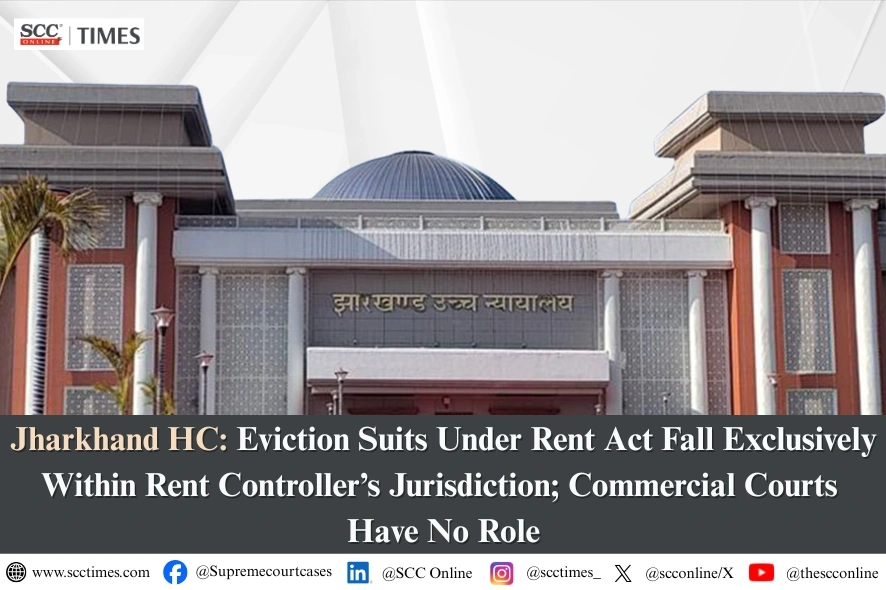
Jharkhand High Court: In a writ petition challenging the maintainability of eviction proceedings before the Rent Controller, a Single Judge Bench of Sri Ananda Sen, J., underscored that the landlord-tenant relationship was admitted and that the petitioner had been operating its business from the premises through a franchise. The Court observed that the eviction suit was instituted under the Jharkhand Building (Lease, Rent and Eviction) Control Act, 2011 (Act of 2011), which repealed the earlier tenancy legislation and vested exclusive jurisdiction in the Rent Controller, thereby excluding the Civil Courts. Emphasising the statutory bar under Section 11, Commercial Courts Act, 2015 (Commercial Courts Act), the Court held that Commercial Courts cannot assume jurisdiction in such eviction matters.
Background
The dispute arose when the petitioner terminated its franchise operating from the tenanted premises, leading to eviction proceedings initiated by the landlord before the Rent Controller. The petitioner contended that the dispute was commercial in nature, involving immovable property used for trade/commerce, and therefore fell under Section 2(1)(c)(viii), Commercial Courts Act. It was argued that the valuation exceeded ₹43,00,000 and that Section 21, Commercial Courts Act gave overriding effect, thereby ousting the jurisdiction of the Rent Controller.
The respondent countered that eviction suits are governed exclusively by the Act of 2011, and only the Rent Controller has jurisdiction. The respondent also disputed the petitioner’s claim of not being in possession of the premises, arguing that such issues should be decided during the proceedings with evidence.
Analysis
The Court emphasised that it is the petitioner’s company which has taken on lease the premises of the landlord, which is the subject matter of the eviction suit, and the execution of the lease deed between the petitioner and the landlord is undisputed. The Court also noted that it is undisputed that the petitioner, in the premises, was operating its business through a franchise. The Court highlighted that the mode of operation is for the purpose of ease of doing business and only for mere convenience between the petitioner and its franchise, which cannot extinguish the landlord-tenant relationship between the respondent and the petitioner.
It was observed that the suit is an eviction suit, which has been filed under the provisions of the Act of 2011. Further, Section 19, Act of 2011 provides the grounds of eviction of a tenant and also provides that the eviction order has to be passed by the Controller on the grounds mentioned therein.
The Court emphasised that the proceeding for eviction has to be filed before the Controller, who has the power to enquire and continue with the proceeding and, after taking evidence, can order eviction. Thus, the entire proceeding is within the jurisdiction of an officer who is an Executive Officer of the State.
The Court further noted that Section 11, Commercial Courts Act, 2015 creates a bar on the jurisdiction of Commercial Courts and Commercial Divisions to decide any application or suit relating to a commercial dispute in respect of which the jurisdiction of the Civil Court is either expressly or impliedly barred under any other law for the time being in force.
The Court traced the legislative history of tenancy law in Jharkhand to establish the implied bar on Civil Court jurisdiction. Under the Jharkhand Building (Lease, Rent & Eviction) Control Act, 2000, which was the Bihar Building (Lease, Rent & Eviction) Control Act, 1982 adopted by Jharkhand, Section 11 provided that a tenant could not be evicted except in execution of a decree passed by a Court. Section 2(d) of the Act of 2000 defined “Court” as a court having jurisdiction under the Civil Procedure Code, 1908 with power to entertain a landlord’s suit for recovery of possession. This jurisdiction, which previously vested in the Civil Court, was entirely removed by the Act of 2011. Under the Act of 2011, the power to evict a tenant was exclusively conferred upon the “Controller,” defined under Section 2(d) as a person appointed under Section 31, an Executive Officer of the State not below the rank of Sub-Divisional Officer, and not a judicial officer.
The Court held that although no provision in the Act of 2011 expressly bars Civil Court jurisdiction, the bar is clearly implied. Reading the definition of “Controller” under Section 2(d), the powers vested in the Controller under Section 19, and the repeal of the Act of 2000 together, it is evident that Civil Courts have no jurisdiction to entertain an eviction application.
In view of the aforesaid bar, in terms of Section 11, Commercial Courts Act, the Court held that the Commercial Courts of Jharkhand have no jurisdiction to entertain an eviction suit filed by the landlord against the tenant, even though in terms of Section 2(1)(c)(vii), Commercial Courts Act the immovable property is exclusively used in trade and commerce. The Court noted that the grounds and the contention raised by the petitioner, that the Commercial Courts exclusively have jurisdiction to entertain an eviction suit, cannot be accepted.
Decision
Accordingly, the writ petition was dismissed, holding that the Rent Controller/Sub-Divisional Officer has jurisdiction to continue with the eviction proceedings, and that the Commercial Courts Act does not apply to such disputes under the Act of 2011.
[Aditya Birla Lifestyle Brands Ltd. v. Devanand Singh & Son HUF, 2026 SCC OnLine Jhar 1006, decided on 3-7-2026]
Advocates who appeared in this case:
For the Petitioner: Vineeta Meharia, Sr. Advocate, Harsh Chandra, Advocate, Piyush Meharia, Advocate
For the Respondent: Amritansh Vats, Advocate, Arpan Manjash Ekka, Advocate