The Asian International Arbitration Centre (AIAC) is hosting the eighth edition of its flagship Asia ADR Week from 12th to 16th October 2026 in Kuala Lumpur.
Hosted under the theme “Kainos: Where Vision Transforms Future”, the Asia ADR Week 2026 brings together practitioners, arbitrators, mediators, academics, businesses and stakeholders from Malaysia, Asia and beyond to exchange perspectives on the developments shaping the future of dispute resolution.
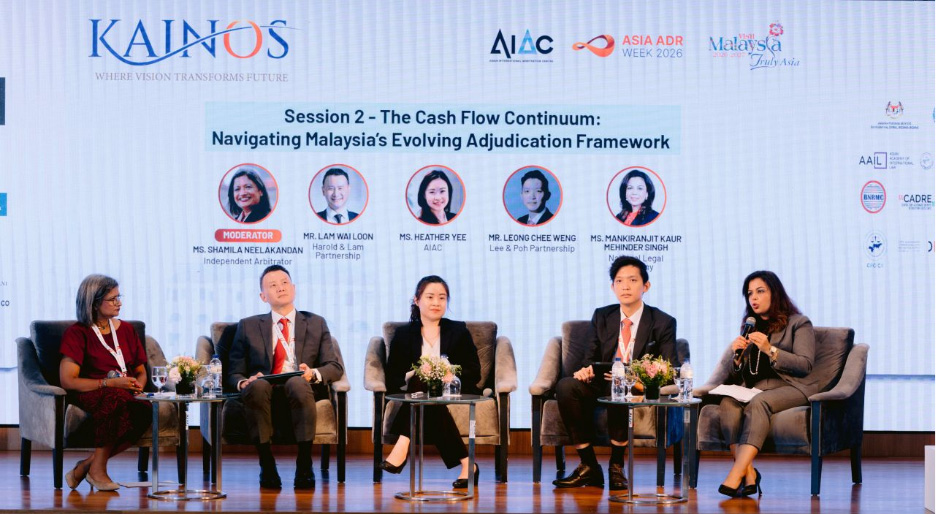
[In frame: Ms. Shamila Neelakandan, Mr. Wai Loon Lam, Ms. Heather Yee, Mr. Chee Weng Leong, and Ms. Mankiranjit Kaur Mehinder Singh]
In a panel discussion conducted on the topic “The Cash Flow Continuum: Navigating Malaysia’s Evolving Adjudication Framework”, the esteemed panellists examined the operation of the Construction Industry Payment and Adjudication Act, 2012 (CIPAA) in Malaysia, focusing on the appointment and role of adjudicators, procedural efficiency, the use of AI, enforcement of decisions, applications for stay and setting aside, recovery of adjudicated sums, and the relationship between adjudication and insolvency proceedings.
Moderated by Ms. Shamila Neelakandan, Independent Arbitrator, the 360-degree panel consisted of legal professionals from all fields, namely, Mr. Wai Loon Lam, Partner, Harold & Lam Partnership; Ms. Mankiranjit Kaur Mehinder Singh, National Legal Academy; Mr. Chee Weng Leong, Partner, Lee & Poh Partnership; and Ms. Heather Yee, Registrar, Asian International Arbitration Centre (AIAC).
After introducing the panellists, Ms. Shamila Neelakandan explained that the session would address two broad areas: adjudication and the challenges associated with the adjudication process, followed by effective means of resolving disputes to facilitate cash-flow recovery. The discussion would focus on enforcement difficulties, applications for stay and setting aside, recovery from third parties, and the extent to which an adjudication decision can form the basis for winding-up proceedings against a non-paying party.

Appointment of adjudicators and institutional administration: Ms. Heather Yee
Responding to the moderator’s question on how an adjudicator should be selected while balancing availability, technical expertise, and case-management capabilities within the statutory timeline, Ms. Heather Yee explained that Malaysia’s statutory adjudication framework under CIPAA had been in operation since 2014. Despite amendments and regulations, the statutory timeline remained unchanged.
She explained that the AIAC, acting as the adjudication authority, was required to comply with the statutory appointment timeline of five working days. She noted that the institutional structure had undergone a change with effect from 1 January 2026, with some reforms, such as the creation of the Court of Arbitration. The Court comprises a president and 25 members who conduct the internal nomination process.
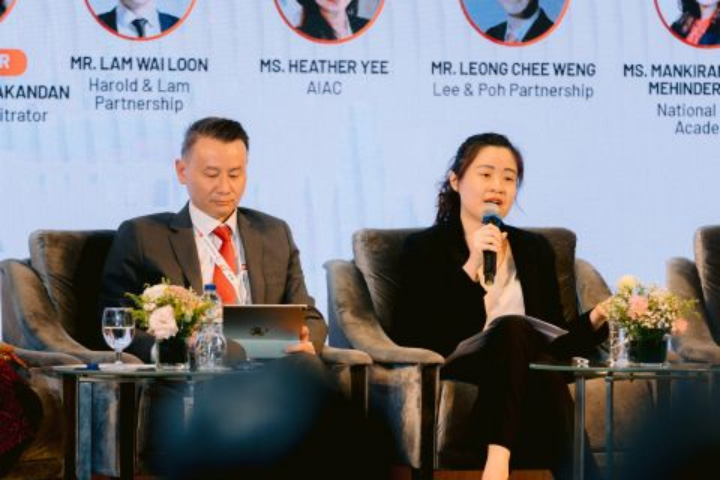
Ms. Yee explained that the nomination process considered the suitability and availability of prospective adjudicators, including whether they were already handling ongoing cases. The complexity of the dispute was another important consideration, particularly where the legal and factual issues were intertwined with other disputes. Despite the additional institutional layers introduced by the restructured appointment process, she remarked that AIAC had continued to comply with the five-working-day statutory timeline.
Case management, natural justice and procedural efficiency: Mr. Wai Loon Lam
Addressing the challenges arising from voluminous documentation, repeated requests for further submissions, late expert evidence and demands for oral hearings, Mr. Wai Loon Lam agreed that effective case management depended substantially on the adjudicator’s approach, confidence, and ability to maintain control over the proceedings.
Drawing on his experience as an adjudicator, Mr. Lam stated that he was generally receptive to genuine requests for further submissions on legal, factual, or technical issues. He opined that parties should ordinarily be afforded an opportunity to address relevant matters unless the request was being used as a procedural tactic to delay the adjudication. The critical consideration was ensuring that additional submissions did not cause the proceedings to exceed the prescribed timeline.
Mr. Lam referred to the 45-working-day period for delivering the adjudication decision, which, as he explained, began after the adjudication reply had been submitted. He considered the available period sufficient to accommodate genuine requests for additional submissions, provided the adjudicator managed the timetable effectively. He observed that the actual process of preparing a decision would not ordinarily require the entire 45-working-day period, and that even difficult legal, factual, or technical questions could generally be considered within a shorter period.
Regarding the challenges of document-heavy disputes, Mr. Lam stated that in such cases, he considered an oral hearing useful because counsel could guide the adjudicator through material issues, enabling the adjudicator to focus on the important points relevant to the determination.
He also suggested that parties could be asked to agree to an extension or to arrangements under which the 45-working-day period would begin only after the final oral submissions or further submissions had been made. Mr. Lam disclosed that he had allowed approximately 90% of the requests for further submissions that he had received, while ensuring that the proceedings remained within the applicable timeline.
He considered this approach important not only for decision-making but also for maintaining the parties’ confidence in the process. Affording parties a sufficient opportunity to be heard helped ensure that they felt their cases had been properly considered.

Use of AI in adjudication:
On whether AI could legitimately assist in preparing adjudication decisions, Mr. Lam drew a distinction between using AI to support the parties’ preparation and allowing it to determine or draft the adjudicator’s decision. He stated that an adjudication decision should be written by the adjudicator, rather than produced by an artificial system.
He nevertheless acknowledged that AI could assist parties in preparing their cases. If an adjudicator intended to use AI for a limited purpose in the decision-writing process, then it was important to disclose that intention from the outset and obtain the parties’ agreement. He suggested that AI might assist with organising the introduction, the parties’ respective cases and their arguments, but the adjudicator would have to verify the material and personally prepare the decision before signing it.
Mr. Lam also criticised the practice of delivering decisions only on the final day, or close to the end of the statutory period. He advocated beginning to structure the decision while the parties were submitting their documents. This would allow the adjudicator to capture the issues raised by both sides and reserve the remaining time for determining contentious questions rather than beginning the drafting process from scratch.
AI, confidentiality, and adjudication costs: Ms. Heather Yee
Responding to the moderator’s question about whether greater efficiency through AI could lead AIAC to reconsider its fee structure, Ms. Yee stressed that the use of AI had to be approached considering the statutory grounds on which an adjudication decision could be challenged. She cautioned that an AI-assisted process could create risks if the reasoning supporting a decision is inadequately developed. Referring to the importance of control and disclosure, she agreed that an adjudicator using AI should disclose its intended use and obtain the parties’ agreement.
Ms. Yee particularly highlighted confidentiality as a concern. Documents and information submitted during adjudication had to remain confidential, and the adjudicator is required to comply with the relevant AIAC code of conduct. She cautioned against using AI without disclosure or consent, noting that the confidentiality obligations applicable during adjudication had to be considered even if the decision was subsequently challenged in court. AI could be used responsibly for limited assistance, but it should not take over the adjudicator’s decision-making or draft the determination itself.
Regarding cost and fees, Ms. Yee explained that the applicable statutory framework, regulations, and rules provided for standard and recommended adjudicator fees. AIAC’s administrative fee was calculated by reference to the adjudicator’s fee under the relevant schedule. Thus, she stated that the institution had limited scope to negotiate or revise the fee structure merely because AI was being used. Any material change would require amendments to the relevant legislation, rules, or regulations.
Stay and setting aside applications: Mr. Chee Weng Leong
Turning to the commercial effectiveness of statutory adjudication, Ms. Neelakandan asked Mr. Chee Weng Leong whether opportunities to seek a stay or set aside an adjudication decision had diluted CIPAA’s original objective of providing an effective means of obtaining payment.
Mr Leong observed that the framework had originally been associated with the principle of “pay now, argue later”. However, the availability of stay and setting-aside applications could mean that a successful claimant obtained an adjudication decision but still had to pursue further proceedings before receiving payment. He described the practical difficulty as a situation in which parties could end up arguing both before and after the decision, while payment was delayed.
Nevertheless, Mr. Leong considered that the framework had to balance the successful party’s right to receive payment against the unsuccessful party’s right to challenge a decision where there were genuine grounds to do so. He explained that a party seeking a stay might be concerned that it would be unable to recover the adjudicated sum if the decision were later reversed in arbitration or litigation. Similarly, a setting-aside application might raise legitimate concerns that a defence had not been considered, that natural justice had been breached, or that the adjudicator had exceeded the scope of the jurisdiction.

In his view, the difficulty arose when such applications are filed without genuine grounds and are instead used to delay payment. This could impose additional costs on the successful party, which would have to resist the applications and wait longer to recover the adjudicated amount.
As a possible reform, Mr. Leong referred to approaches adopted in Singapore and Hong Kong, where the adjudicated sum could be required to be paid into court to be held pending the challenge. He observed that this also allowed a successful party to draw down part of the amount to meet legal costs. Such arrangements, he suggested, could deter unmeritorious applications while protecting the successful party’s entitlement if the challenge ultimately failed.
He also proposed introducing time limits for filing stay and setting-aside applications. Referring to his experience in enforcement proceedings, he explained that an application could be filed shortly before the hearing, delaying the enforcement process after the parties had already exchanged affidavits and submissions. Thus, such time limits could help preserve the balance between the right to challenge a decision and the successful party’s right to timely payment.
Insolvency as a ground for stay: Ms. Mankiranjit Kaur Mehinder Singh
Ms. Neelakandan asked Ms. Mankiranjit Kaur Mehinder Singh whether the potential insolvency of a claimant could constitute a special circumstance justifying a stay under Section 16 of the CIPAA.
Responding to the question, Ms. Singh referred to the Federal Court decision in Econpile (M) Sdn Bhd v. ASM Development (KL) Sdn Bhd1, explaining that the court had recognised that insolvency could constitute a relevant ground, subject to strict requirements, namely: how the claimant’s insolvency was established and the stage at which the stay application was filed.
On the first consideration, she explained that the court had linked special circumstances to the “real danger” test. The applicant had to demonstrate a real danger that, if the adjudicated sum were paid to the claimant, the respondent would be unable to recover it if successful in subsequent arbitration or litigation. A mere belief that the claimant was in poor financial health would not be sufficient. The applicant had to produce evidence establishing a genuine risk, for example, a pending winding-up petition or the appointment of a liquidator to manage the claimant’s estate.
The second consideration was timing. She stated that a stay application under Section 16 CIPAA had to be filed, heard, and determined before the enforcement application under Section 28 was heard. Once an enforcement order had been made, the adjudication decision would have been converted into a court judgment, and a stay under Section 16 would no longer be available in the same manner.

Thus, Ms. Singh concluded that the claimant’s insolvency could constitute a special circumstance, provided the real-danger test was satisfied, and the application was brought at the appropriate stage.
Whether the employer’s own financial difficulties could justify a stay
In a follow-up question, Ms. Singh rejected the proposition that an employer could seek a stay on the ground that paying the adjudicated sum would cause the employer to become insolvent. She explained that the purpose of the stay mechanism was to prevent injustice arising from the risk that a claimant would be unable to repay the adjudicated sum if the respondent subsequently succeeded in arbitration or litigation. The claimant’s financial position was central to the inquiry.
She described the real-danger test as directed towards the claimant’s ability to repay the amount, rather than the respondent’s financial hardship. Allowing an employer to rely on its own financial difficulties would undermine the purpose of CIPAA, which was introduced to ensure timely payment to contractors and prevent construction projects from being stalled by payment disputes.
Thus, she stated that an employer’s own financial hardship should not, by itself, constitute a basis for a stay under Section 16 of the CIPAA.
Depositing the Adjudicated Sum and the Enforcement Framework: Ms. Heather Yee
Adding to the discussion on stay applications, Ms. Yee stated that Malaysian law already contained a provision permitting the court to order the deposit of an adjudicated sum with AIAC. She explained that the institution had received court orders directing parties to deposit such sums. She distinguished this arrangement from the approach discussed in relation to Hong Kong, noting that the Malaysian provision permitted such an order rather than making the deposit an automatic prerequisite in every case.
Ms. Yee also referred to Bludream City Development Sdn Bhd. Kong Thye2, in which the setting-aside application and the stay application had been dismissed at the High Court stage, but the Court of Appeal subsequently allowed the appeal in the context of a notice of demand. She explained that the Federal Court had upheld the Court of Appeal’s decision after the leave to appeal was dismissed, as she understood it. Thus, she underscored that Malaysian law required parties to pay the adjudicated sum or undertake the winding-up process.
Section 30 and recovery from third parties:
Ms. Neelakandan then turned to Section 30 of the CIPAA and asked whether the provision, which addresses payment in the event of non-payment, was a statutory benefit for claimants because it could operate beyond the ordinary doctrine of privity of contract.
Mr. Lam agreed that Section 30 was beneficial, particularly for subcontractors seeking payment for work already completed. He emphasized, however, that its effect was limited to payment and did not extend the dispensation from privity to other potential liabilities, damages or claims. Using the relationship between an employer, a main contractor and a subcontractor as an example, Mr Lam observed that the employer was ultimately the beneficiary of the work carried out by the subcontractor. In that context, Section 30 could provide a means of recovering payment for completed work.
He also highlighted the safeguards available to employers. An employer would only be required to pay if an amount was due or payable to the main contractor. If no amount is due, the employer would not be obliged to make payment under the provision.
Furthermore, Mr. Lam acknowledged that employers might object to being drawn into legal proceedings when they had not been parties to the original adjudication. However, he considered that this inconvenience could be reduced if the parties acted transparently, and the employer provided objective evidence showing that no payment was due to the main contractor.
He observed that employers sometimes refused to make payment for different reasons, not all of which were necessarily legitimate. In his view, Section 30 remained a significant benefit for subcontractors.
Referring to the Court of Appeal decision in KTCC Mall Sdn Bhd v. TCS Construction Sdn Bhd3, Ms. Neelakandan asked Ms. Singh whether the prioritisation of the Malaysian Companies Act, 2016, over Section 30 of the CIPAA undermined the statutory framework’s objective of protecting contractors’ and subcontractors’ cash flow.
Ms. Singh answered in the negative, explaining that the Court of Appeal’s reasoning supported the conclusion that the application of insolvency law did not unlawfully undermine the CIPAA. She identified three principal reasons for the Court of Appeal’s approach:
-
Specific legislation prevails over general legislation: She explained that CIPAA was concerned with construction cash flow, whereas the Companies Act specifically addressed insolvency matters, including the distribution of the assets of an insolvent company. In circumstances involving an insolvent contractor or employer, she considered it appropriate for insolvency law to prevail.
-
Pari passu principle: Under this principle, the assets available for distribution should be shared equally among creditors in accordance with the applicable insolvency framework.
-
Preventing circumvention: She explained that allowing Section 30 to prevail in the case of an insolvent contractor could reduce the pool of assets available in the liquidation estate and effectively alter the statutory priority governing the distribution of those assets.
For these reasons, she opined that the Court of Appeal’s reasoning in KTCC Mall (supra) was justified.
Winding-up proceedings based on adjudication decisions: Mr. Chee Weng Leong
Ms. Neelakandan next asked Mr. Leong whether a successful claimant could rely on a statutory adjudication decision to initiate winding-up proceedings against an employer that had failed to pay.
Mr. Leong referred to Bludream (supra) and the more recent decision in VKPT Sdn Bhd v. LLC Infra Sdn Bhd4, explaining that the latter considered the position established in Bludream (supra). He stated that the court distinguished between an adjudication decision that had been registered or enforced under Section 28 and one that had not been enforced. Discussing VKPT (supra), Mr. Leong explained that the case involved a claimant who had lost the adjudication and had been ordered to pay costs to the respondent. The claimant’s failure to pay those costs led to a winding-up petition. The case therefore raised the question of whether an adjudication decision could be enforced in that particular context.
Mr. Leong explained that if an adjudication decision had not been registered under Section 28, the resulting debt was not necessarily indisputable. In winding-up proceedings, a genuinely disputed debt could not ordinarily form the basis of a winding-up petition. A party resisting such a petition would therefore need to demonstrate that the debt was genuinely disputed. He cautioned, however, that commencing separate legal proceedings would not automatically establish a genuine dispute. The court would examine the circumstances, including the intention behind the proceedings and the timing of their commencement. A claim initiated shortly before a winding-up petition could invite scrutiny as to whether the dispute was genuine.
By contrast, where an adjudication decision had been registered or enforced under Section 28, he explained that the debt became indisputable as liability. In such circumstances, the party resisting a winding-up petition would have to establish a cross-claim or set-off of equivalent or greater value. It would not be enough merely to state that a claim for set-off had been filed; actual evidence supporting the cross-claim would have to be produced for the winding-up court to decide the genuineness of the cross-claim.
Following Mr Leong’s explanation, Ms. Yee returned to Bludream (supra) and stated that arbitration proceedings were ongoing in that matter. She raised the question of whether a dispute pursued in arbitration could affect the characterisation of the amount claimed under the adjudication decision as disputable or indisputable.
Mr. Leong responded that, based on the Court of Appeal’s reasoning, the commencement of arbitration could itself constitute evidence of a genuine dispute. However, he emphasised that the court would still examine the timing and circumstances of the challenge to determine whether the dispute was genuine.
Safeguards against abuse of winding-up proceedings: Ms. Mankiranjit Kaur Mehinder Singh
Ms. Neelakandan described the situation as a legal paradox: adjudication decisions were intended to provide temporary finality, yet their enforcement could potentially result in the winding up of a company. Agreeing with this observation, Ms. Singh stated that although an adjudication decision was temporarily binding, it was not without substantial consequences and could ultimately contribute to the winding up of a company.
Referring to the Econpile (supra), she noted that even a substantial cross-claim had not enabled the respondent to succeed in its application for a stay. Nevertheless, she identified several safeguards that could be available to a respondent facing a winding-up threat, which are as follows:
-
Fortuna injunction: This could be sought where the respondent had a bona fide basis for contending that the debt was disputed and could satisfy the applicable requirements.
-
Stay application: A stay application could be filed under Section 16 of the CIPAA, provided that special circumstances existed and the real-danger test was met.
-
Corporate restructuring and insolvency-related mechanisms: Under the Companies Act, there were several mechanisms like judicial management and corporate voluntary arrangement, which could be used to demonstrate that it remained viable notwithstanding the adjudication decision.
However, she emphasised that these safeguards depended on satisfying the relevant legal requirements and were not automatic protections against enforcement.
Mediation and the continuing relevance of adjudication: Ms. Heather Yee
On the question of whether adjudication could remain an effective mechanism when arbitration offered a more final determination and mediation provided a collaborative means of resolving disputes, Ms. Yee emphasised the potential role of mediation in resolving disputes that had already entered adjudication. Drawing on AIAC’s institutional experience, she stated that several matters had settled at different stages of the process, including before an adjudicator was appointed and after appointment.
In some instances, parties had withdrawn the claim altogether after settling. Ms. Yee considered these outcomes significant because the statutory framework permitted parties to pursue adjudication alongside other remedies, including arbitration and court litigation.
She therefore maintained that adjudication continued to serve an important purpose by providing a speedy dispute-resolution mechanism. Its effectiveness did not depend solely on the delivery of a formal decision: the process could also facilitate settlement before the adjudicator reached that stage. The possibility of resolving the dispute during adjudication, while preserving the availability of other remedies where necessary, supported the continuing relevance of the framework.
Proposed reforms for making adjudication framework more effective and sustainable
In the closing round, Ms. Neelakandan invited the panellists to identify changes that could make the adjudication framework more effective and sustainable.
-
Ms. Mankiranjit Kaur Mehinder Singh: Although Ms. Singh believed that enough safeguards were available in relation to stays, enforcement and setting aside, she stated that courts could address frivolous applications through costs orders. However, she supported further consideration of a requirement for the adjudicated sum to be deposited into court. She suggested that such a requirement would have greater practical effect if incorporated into the law rather than left to the court’s discretion after an application had been filed.
-
Mr. Chee Weng Leong: Mr. Leong observed that CIPAA had been in operation for more than 12 years, with most of its development taking place through judicial decisions rather than substantial legislative amendments. Thus, he gave the following suggestions:
-
The Parliament should clarify the relationship between Section 30 and insolvency legislation, particularly which regime should prevail when the two provisions intersect.
-
The requirement for payment of the adjudicated sum as a prerequisite to filing a setting-aside application should be considered.
-
Statutory time limits should be introduced for filing stay and setting-aside applications, as well as for hearing and determining them.
-
-
Mr. Wai Loon Lam: Mr. Lam identified two areas in which he considered legislative clarification particularly important.
-
The first concerned whether commencing adjudication proceedings suspended the running of the limitation period. He explained that parties sometimes initiated adjudication close to the expiry of the limitation period. Even if they succeeded in adjudication, subsequent proceedings before the High Court, Court of Appeal or Federal Court could delay the matter considerably. If the adjudication decision was eventually reversed, the party might discover that the time for commencing arbitration or court proceedings had expired. He suggested that Parliament or the relevant amendments committee consider whether filing a notice of adjudication should suspend the limitation period, at least in respect of the claims covered by the adjudication.
-
His second proposal concerned the number of appellate stages available after an adjudication decision. Mr. Lam stressed that adjudication was intended as a stopgap measure providing temporary finality and facilitating cash flow. While parties could pursue arbitration or court proceedings to resolve the underlying dispute, the availability of multiple levels of appeal could undermine the purpose of the adjudication process. He noted that parties could challenge decisions before the High Court and then proceed to the Court of Appeal and Federal Court, with further disputes arising over stays, insolvency, and novel legal arguments. This could leave successful contractors and subcontractors waiting for payment despite having obtained an adjudication decision in their favour. Thus, he proposed that a challenge should ordinarily receive only one opportunity for review before the High Court, with no further appeal. He acknowledged that this was a bold proposal but considered it consistent to secure timely payment.
-
-
Ms. Heather Yee: Addressing the proposals for legislative reform from an institutional perspective, Ms. Yee emphasised that, although adjudication decisions were intended to provide temporary finality, CIPAA had also resolved a substantial number of disputes without further challenges. She stated that, when CIPAA came into effect in 2014, AIAC recorded 29 cases. By 2024, the number had increased to 626. She cautioned that not all those cases proceeded to setting-aside or other challenges, and stated that, based on information from an earlier discussion with a member of the judiciary, most parties complied with adjudication decisions. She noted that the actual figures remained subject to confirmation by the judiciary. In her view, this demonstrated the positive role of adjudication in resolving disputes and providing finality in practice, even where the decisions were temporarily binding in law.
Ms. Yee also outlined AIAC’s intention to continue developing its institutional standards and training initiatives to strengthen the effectiveness and sustainability of CIPAA. The institution conducted continuing professional development workshops involving experts who discussed recent developments in case law. It also organised events and workshops to facilitate comparative understanding of adjudication. She explained that AIAC was working on improving the competency standards applicable to its panel of adjudicators, which comprised approximately 700 members. The proposed improvements would consider the grounds on which adjudication decisions were challenged and the quality of the decisions themselves.
Conclusion
The panellists examined how effective case management, compliance with statutory timelines, and responsible use of AI could support the adjudication process in construction disputes. They also considered the consequences of stay and setting-aside applications, the recovery of adjudicated sums, the interaction between Section 30 of the CIPAA and insolvency law, and the circumstances in which an adjudication decision could support winding-up proceedings.
SCC Times is the official media partner for AIAC Asia ADR Week 2026. Read more about AIAC Asia ADR Week 2026:
-
Malaysia strengthens ADR Ecosystem ahead of AIAC’s Asia ADR Week 2026
-
How ADR supports Malaysia’s evolving energy landscape: AIAC and LHAG masterclass at Asia ADR Week 2026
-
AIAC Arbitration Rules 2026: Experts examine award scrutiny, expedited procedures and third-party funding at Asia ADR Week 2026
-
AIAC Asia ADR Week 2026: Experts debate who has the right to a domain name in the digital world?
1. [2024] 4 MLRA
2. Civil Appeal No.: B-01(A)-55-01/2020
3. Civil Appeal No. B-02(C)(A)-130-01/2024
4. Civil Appeal No. W-02(NCC)(A)-171-02/2025