


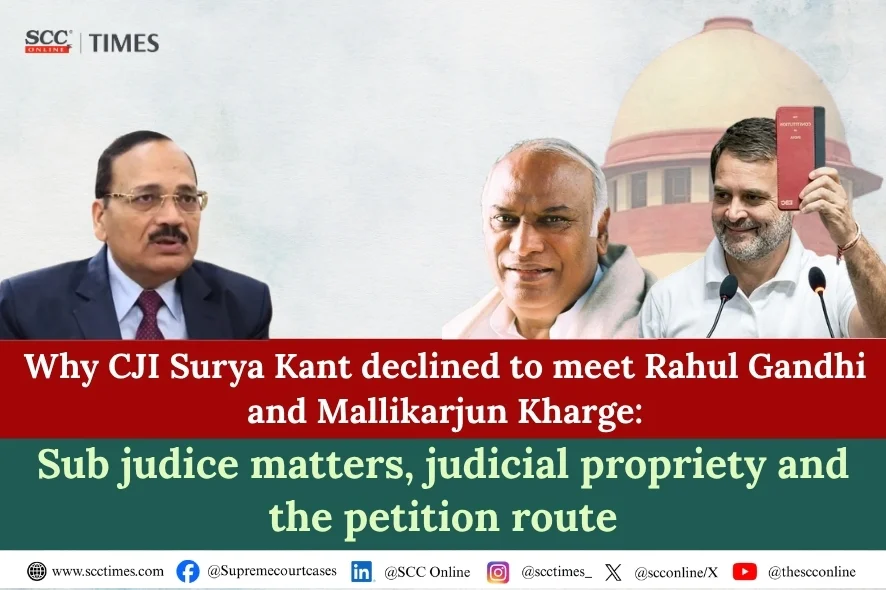
Chief Justice of India (CJI), Justice Surya Kant, has declined a meeting requested by Leader of Opposition in the Lok Sabha Rahul Gandhi and Leader of Opposition in the Rajya Sabha Mallikarjun Kharge to submit a memorandum concerning the Election Commission, arrests of students and restrictions on public transport in Delhi. The CJI said that the issues were already pending before the Supreme Court and that discussing them at a meeting would be incompatible with the separation of powers and judicial propriety.
In a letter dated 11 October 2026, addressed to Rahul Gandhi and Mallikarjun Kharge, the CJI referred to their request dated 10 October 2026 for an appointment on 12 October 2026, between 4 PM and 5 PM. The proposed memorandum concerned:
-
the Chief Election Commissioner and the Election Commission of India;
-
the alleged arbitrary arrest of several students;
-
the closure of metro stations; and
-
the cancellation of trains, among other issues.
Memorandum concerned Election Commission and electoral roll revision
The request came amid the opposition’s campaign against Chief Election Commissioner Gyanesh Kumar over alleged irregularities in the electoral process, including the Special Intensive Revision (SIR) of electoral rolls. The opposition has alleged that the revision resulted in the wrongful deletion of voters and has raised concerns about the Election Commission’s functioning.
According to reports concerning the proposed memorandum to the CJI, the opposition intended to demand an end to alleged discrepancies in the election process, the CEC’s resignation, a halt to the SIR exercise and a return to paper ballots. The proposed meeting was part of the INDIA bloc’s plan to march to the Supreme Court on 12 October and submit its memorandum.
The concerns over student arrests and transport restrictions arose in the context of protests in Delhi. The Supreme Court had also considered restrictions on metro services and train operations imposed ahead of planned demonstrations on 9 October, with the Court examining the proportionality of the measures taken.
CJI cites separation of powers and judicial propriety
In his reply, CJI Surya Kant stated that the issues referred to in the proposed memorandum were already sub judice before the Supreme Court. He observed that convening a meeting to discuss pending cases would contravene the principle of separation of powers, an intrinsic facet of the basic structure doctrine, and would be incompatible with established ethics and judicial propriety.
The CJI further stated that the Supreme Court does not have administrative powers to deal with the issues highlighted in the letter. However, he said that the Court is duty-bound to consider, on the judicial side, the substance of issues affecting citizens through its jurisdiction under Article 32 of the Constitution and its other plenary powers, including judicial review.
Reiterating the Court’s commitment to preserving and protecting the fundamental rights of every citizen, the CJI said that citizens are entitled to seek enforcement of those rights at all hours through the procedure established by law. He therefore advised Gandhi and Kharge to invoke the Court’s judicial powers rather than submit a memorandum on the administrative side.
CJI indicates route for filing a petition
The letter also referred to matters raising similar issues that were scheduled for hearing on Tuesday, 13 October 2026. CJI Surya Kant stated that Gandhi and Kharge could, if they so wished, file a petition on Monday, either physically at the Supreme Court between 10:30 AM and 4:30 PM or through the Court’s e-filing facility, which permits filing at any time and on any day.
The CJI assured the two leaders that any such petition would be heard at the earliest possible opportunity, in accordance with the law.
Also Read: CJP Election Protest: Delhi Police closes 57 Metro | SCC Times





