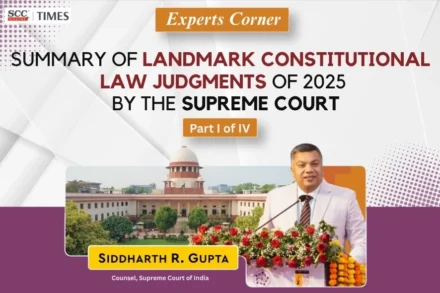
Landmark Constitutional Law Judgments in 2025 by the Supreme Court of India (Part I of IV)
by Siddharth R. Gupta* and Uddaish Palya**
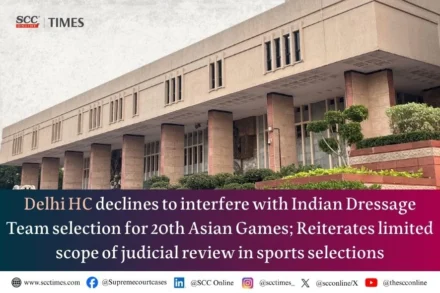
Delhi High Court dismissed challenges to the Indian Dressage Team selection for the 2026 Asian Games, holding that the EFI followed the prescribed Selection Criteria and reiterating the limited scope of judicial review in sports selections.
The Delhi High Court held that Pan masala, gutka or any other form of chewing tobacco is meant for human consumption will fall under the ambit of Section 3(1)(j) of Food Safety and Standards Act, 2006.
Supreme Court said that the denial of promotion was on the ground that candidates do not possess the prescribed requisite qualification namely “Diploma in Civil Engineering”, and not because they possess a two-year diploma not three-year diploma.
Exemption from payment of Entertainment tax given to a film is a concession granted by the Government to encourage the film makers to use Tamil title for their films. Concession can never be claimed as a matter of right.
Constitution of India — Arts. 14, 12, 266, 136 and 32 — State action in a matter arising from non-statutory contract: Scope
Madras High Court reiterated that wearing “gown” is only optional and not mandatory before any Courts other than the Supreme Court or the High Courts. Thus, it held that the order of the National Company Law Board imposing a dress code for Advocates for appearance before the Tribunal is without authority and hence, illegal.
Supreme Court said that the conduct of the judge and her/his decisions must reflect and show independence, adherence to the democratic and constitutional values. This is necessary as the judiciary holds the centre stage in protecting and strengthening democracy and upholding human rights and the Rule of law.
The confessional statement was signed beyond the official hours in the office premises in the presence of only male witnesses.
There was an apparent error of law in the order passed by the Gujarat High Court as the writ court is primarily concerned with examination of the decision-making process when a disciplinary action is challenged. Accordingly, the Supreme Court upheld the order of removal from service passed by the disciplinary authority.
Allahabad High Court viewed that the tender authority, has been given a certain degree of leverage by the courts, being the best person to understand its requirements. Hence, a mere disagreement with the authority's decision-making process is not a reason for a constitutional court to interfere.
by Vijay K. Tyagi†
Supreme Court: On the issue of the scope of judicial review of action by the State in a matter arising from a
Allahabad High Court: In a public interest litigation petition instituted under Article 226 of the Constitution of India challenging the
Tripura High Court: In a batch of writ petitions filed for directing the State Government to provide similar Pension benefit as granted
Supreme Court: The 3-judge bench of NV Ramana, CJI and Krishna Murari and Hima Kohli, JJ has referred the question relating to
Supreme Court: In a big relief for A.G. Perarivalan, convicted for assassination of former Prime Minister Rajiv Gandhi, the 3-judge bench of
“Section 432 (2) of the CrPC would stand defeated if the opinion of the presiding judge becomes just another factor that may be taken into consideration by the government while deciding the application for remission.”
“The purpose of a disciplinary proceeding by an employer is to enquire into an allegation of misconduct by an employee which results in a violation of the service rules governing the relationship of employment.”
Delhi High Court: The Division Bench of D.N. Patel, CJ and Jyoti Singh, J., held that the Chairman of Central Administrative Tribunal