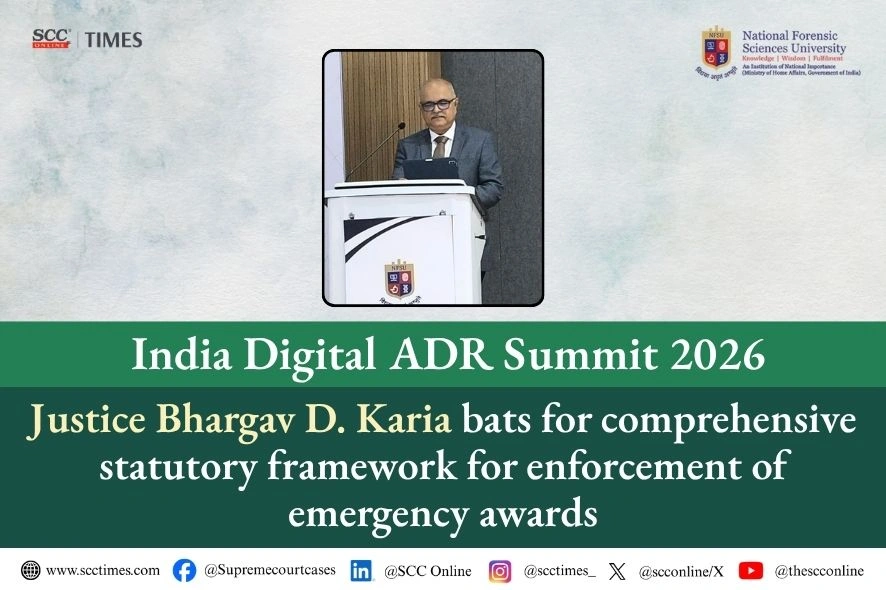
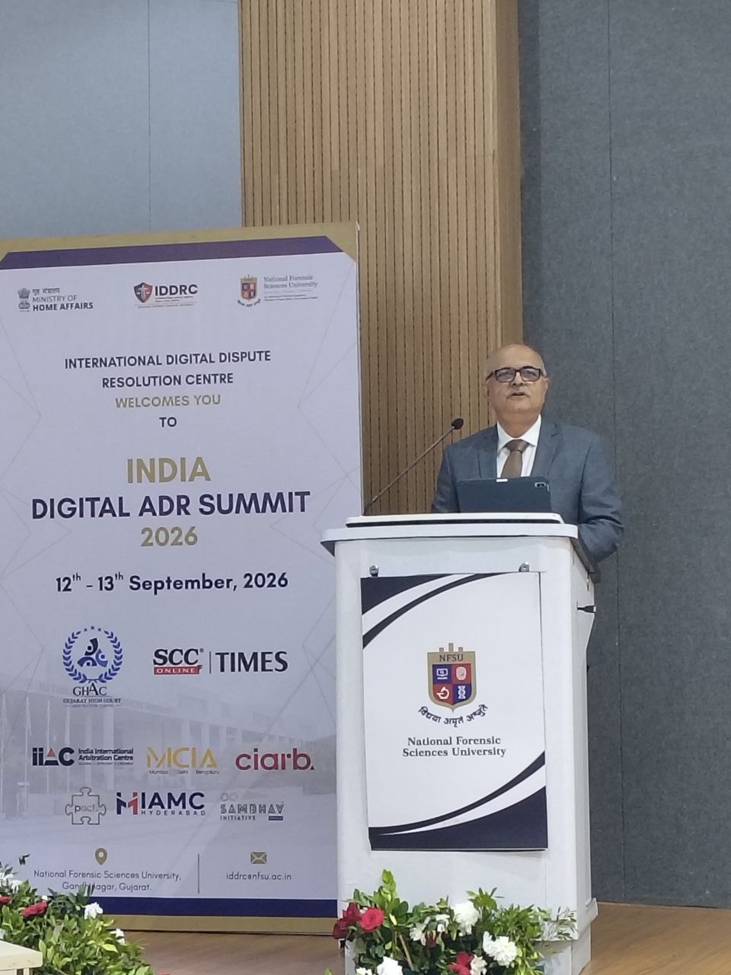
The India Digital ADR Summit 2026, held at the National Forensic Sciences University (NFSU), Gandhinagar, featured a keynote address by Justice Bhargav D. Karia, Judge, Gujarat High Court, on the topic “Emergency Arbitration & Interim Relief: Court-Tribunal Interface”. In this speech, Justice Karia explained the meaning and importance of emergency arbitration, delved into India’s stance, and urged adoption of a comprehensive statutory framework for enforcement of emergency awards in India regardless of seat.
Justice Karia began his address by asking a pertinent question: “What value does the final arbitral award hold if by the time it is delivered, the assets have disappeared, the evidence has been destroyed, or the subject matter of the dispute has changed beyond its scope?” Answering this question, he underscored the importance of interim reliefs which prevent irreparable harm, maintain status quo, and protect the subject matter of disputes until a final award is made.

Emergency Arbitration, its need, and India’s stance
This interim relief, he stated, is an emergency arbitration which contemplates interim measures and remedies akin to Section 9 of the Arbitration and Conciliation Act, 1996 (the Act). It offers a formal institutional process for obtaining urgent protection before the arbitration tribunal is constituted. He explained that unlike ad hoc arbitration where the only remedy was available under Section 9 of the Act, institutional arbitration provided a party two options: approaching an emergency arbitrator before establishment of arbitral tribunal or approaching the Court under Section 9. An emergency arbitrator grants protection during the period between the commencement of arbitration and appointment of the tribunal.
He added that this was now a familiar feature of most major institutional arbitration rules because the grant of interim measures cannot always wait for the regular tribunal to be formed. However, at present, the Act does not expressly recognise the concept of emergency arbitration despite recommendations being given in the Law Commission Report1 preceding the 2015 amendment and the High-level Committee Report2 preceding 2019 for the statutory recognition of emergency arbitration as per the institutional rules.
Consequently, parties in India have to rely predominantly on Section 9 for interim protection. However, Justice Karia stated that Indian Courts have been addressing this statutory lacuna by giving practical effect to emergency arbitration adopted by parties under institutional arbitration rules.
Furthermore, he mentioned that the draft Arbitration and Conciliation Amendment Bill, 2024, was a significant step in this direction as it contains Section 9A which expressly recognises emergency arbitrators. If Section 9A is read with Section 17(2), the Act would allow emergency interim orders in India-seated arbitration to be enforced as court orders.
Until the express statutory recognition of emergency arbitration in India, Justice Karia explained that the legal position was governed by the Supreme Court decision in Amazon.Com NV Investment Holdings LLC v. Future Retail Ltd., (2022) 1 SCC 209. In this judgment, the Supreme Court gave judicial recognition to the concept of emergency arbitration and held that an order passed by an emergency arbitrator in India-seated arbitration is enforceable under Section 17 of the Act. The decision gave effect to the parties’ choice of institutional rules, reinforced the principle of party autonomy, and confirmed that emergency arbitration may operate within India’s existing statutory framework governing interim relief, including enforceability.
In view of this interpretation, he stated that for an India-seated arbitration, the expression ‘arbitral tribunal’ in Section 17(1) can include an emergency arbitrator appointed under the institutional rules selected by the parties. The emergency interim order is therefore treated as an order of the tribunal and may be enforced under Section 17(2) of the Act in the same manner as a Court order. This gives emergency arbitration real practical force rather than leaving it as a merely contractual promise.
He added that emergency arbitration might not always be the preferable course of action, as the choice is not determined by whether the forum is a tribunal or the Court; rather, it is determined by the:
-
urgency and nature of the relief sought,
-
location of the relevant assets and evidence,
-
person against whom the order is intended to operate, and
-
degree of expedition with which the order can be implemented and enforced.
Justice Karia underscored that the central question was enforcement, as a remedy is only useful if it can secure compliance in the place where the assets, evidence, parties or subject matter are located. For example, if the assets are in India, a Court order might be easier to enforce and might provide immediate access to coercive powers. However, if the assets are spread across several jurisdictions, emergency arbitration might offer faster and more cordial initial protection even though Court assistance might still be required in a particular jurisdiction.
Key Considerations
Justice Karia stated that a few advantages of emergency arbitration were that it is confidential because the application remains within the institutional arbitration process rather than in an open Court, which is available in the public domain, and it is faster and more flexible. However, this depends on the governing rules of the arbitral institution, the complexity of the dispute, and whether court enforcement will later be necessary.
However, he also stated that if emergency arbitration is followed by a separate Section 9 proceeding for enforcement, the party might face duplicate expenses and delays. Another consideration was whether relief was needed without notice to the opposition. In an emergency arbitration, the opposition has to be given notice. Thus, for an ex parte order, the party can only approach the Court under Section 9 of the Act.
Since notice to the other party can lead to desecration of assets, destruction of assets, or some other act that would defeat the purpose of the application, institutional rules were now being amended to address this concern. Justice Karia highlighted that the Singapore International Arbitration Centre’s Arbitration Rules, 2025, provided that a party may seek a provisional ex parte order in a situation where prior notice could frustrate the relief.
Importance of seat of arbitration
Justice Karia emphasised the importance of selecting the seat of arbitration as it would impact the legal position of an emergency arbitration. In an India-seated arbitration, an emergency arbitration order can be enforced under Section 17 of the Act, which might reduce the need to approach the court separately under Section 9. Whereas, in a foreign-seated arbitration, Part 2 of the Act does not provide a mechanism for enforcing an interim order. A party that wishes to rely on such an emergency arbitration order in India must usually seek fresh interim relief under Section 9 unless the parties have expressly excluded that remedy in a foreign-seated arbitration.
In this regard, he referred to Raffles Design International India (P) Ltd. v. Educomp Professional Education Ltd., 2016 SCC OnLine Del 5521, wherein the Delhi High Court held that an emergency award given by a Singapore-seated arbitral tribunal could not be enforced under Section 17 of the Act. Nevertheless, the Court granted independent interim relief under Section 9, taking the emergency arbitrator’s order into account.
Contrary to the aforesaid decision, the Delhi High Court four years later in Ashwani Minda v. U-Shin Ltd., 2020 SCC OnLine Del 1648, refused a Section 9 application after the emergency arbitration had rejected the request for interim relief through a detailed and reasoned order. The Court denied a second attempt to obtain substantially the same relief.
Noting the aforesaid, Justice Karia remarked that the message was clear, i.e., Court support should not become a route for rearing a matter already considered within arbitral process. The conclusion that emerged from these cases was that in India-seated arbitrations, the emergency order is enforceable under Section 17 of the Act, whereas in foreign-seated arbitration, the party may still need fresh interim relief under Section 9 as it impacts the choice of the emergency order and the extent of court involvement.
He suggested that the amendment of the Provision to Section 2(2) and the inclusion of the proposed Section 9A would establish a clear legal mechanism for recognition and enforcement of emergency awards issued by foreign seated tribunals in India.
“The governing use of emergency arbitration promotes both autonomy and efficiency while preserving judicial assistance where it is genuinely required.”
Advantages of recognising Emergency Arbitration in India
Justice Karia explained that statutory recognition of emergency arbitration was essential as it had three clear advantages:
-
It would strengthen confidence in institutional arbitration and support its growth in India.
-
It would reduce unnecessary court applications under Section 9 of the Act by allowing urgent relief to be granted and enforced within the arbitration process and ensure the principle of minimal judicial intervention as per Section 5 of the Act.
-
It would make India a more attractive arbitral seat by assuring parties that emergency orders can be enforced effectively.
He suggested that wherever possible, urgent applications should be decided within emergency arbitration and the Court should step in where coercive powers, third-party orders, territorial enforcement, or any ineffective arbitral remedy make their assistance necessary. Therefore, a balanced framework would clarify the respective roles of the Courts and the arbitral tribunals, reduce unnecessary proceedings, ensure that parties remain protected before the regular tribunal is constituted.
Conclusion
Justice Karia remarked that the effectiveness of emergency arbitration must be assessed not merely by the speed by which an order is rendered but also by the certainty, enforceability, and practical efficacy of that order.
“India should move beyond the case-specific judicial accommodation and adopt a comprehensive statutory framework that provides clarity for enforcement of both India-seated and foreign-seated proceedings, while preserving judicial intervention for circumstances in which arbitral process is legally or practically insufficient.”
He underscored that if this balance is achieved, the interface between courts and tribunals can develop into a coherent and complementary partnership that protects the rights of the parties to seek urgent interim relief without undermining party autonomy, confidentiality, and speed, while enduring enforceability.
In conclusion, he stated that such an approach would strengthen confidence in India’s arbitral framework and enhance its standing as a modern, credible, and globally competitive seat of arbitration.
1. Twentieth Law Commission Report No. 246: Amendments to the Arbitration and Conciliation Act, 1996.
2. Justice B.N. Srikrishna Report, 2017