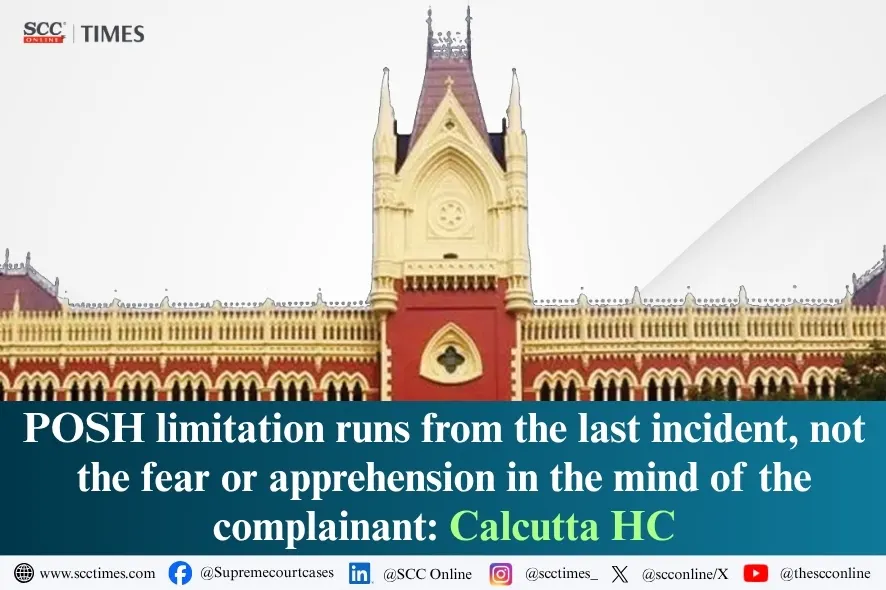
Calcutta High Court: In a writ petition filed against an order passed by the W.B. Administrative Tribunal, setting aside the ICC’s report under the Sexual Harassment of Women at Workplace (Prevention, Prohibition and Redressal) Act, 2013 (POSH), a division bench of Madhuresh Prasad and Prasenjit Biswas, JJ., declared that a 3-months period of limitation as per Section 9 of the Act is to be reckoned with reference to the date of the last incident of Sexual Harassment. Also, the Act does not recognize mere fear or apprehension in the mind of the complainant as a ground for lodging a complaint.
Factual Background
The case arose from allegations of sexual harassment at the workplace by the complainant, an “aggrieved woman” and contractual Data Entry Operator (DEO) posted at the office of the CID, West Bengal. She alleged that the DSP had on numerous occasions between September 2021 and July 2022, inappropriately touched or stroked her back and waist while she was working on the computer. However, no specific incident or date was cited within the said period. She remained silent and tolerated the alleged conduct due to fear and compelling circumstances. Later, she was posted under the DSP, SOG and homicide section. Subsequently, on seeing the DSP at the CID office after his return from leave, she apprehended that she might again be posted under him and subjected to similar harassment. She accordingly lodged the complaint dated 05.01.2023. The Internal Complaints Committee (ICC) report found the allegations to be true and recommended departmental action against the DSP for misconduct under the applicable service rules. The DSP challenged the said report before the West Bengal Administrative Tribunal (‘Tribunal’ for short) and the Tribunal, by its order, set aside the ICC’s report. The State, hence, challenged the Tribunal’s order under the POSH, in the present writ proceeding.
Issues
-
Whether POSH complaint contains bar by limitation?
-
Whether the complaint merely discloses an apprehension in the complainant’s mind, inducing fright and leading her to lodge the complaint?
Analysis
The Court considered the reliance of respondent upon a decision of a Coordinate Bench in the case of Nirmal Kanti Chakraborti v. Vaneeta Patnaik, 2024 SCC OnLine Cal 11896, wherein, the Court found that the complaint made more than 3 months after the last incident of Sexual Harassment to be unsustainable. This was affirmed by the Supreme Court in X8 v. Nirmal Kanti Chakrabarti, 2025 SCC OnLine SC 1964. The Coordinate Bench considered the Judgment of the Supreme Court in the case of Popat Bahiru Govardhane v. LAO, (2013) 10 SCC 765, where it stated that the “law of limitation may harshly affect a particular party but it has to be applied with all its rigour when the statute so prescribes”. The Court analyzed that the period of limitation i.e. 3 months, as per Section 9 POSH is to be reckoned with reference to the date of the last incident of Sexual Harassment.
Notably, the same Supreme Court decision was cited on both sides. The State had relied on X8 v. Nirmal Kanti Chakrabarti, along with a decision of the Allahabad High Court in Dr. Tapas Kumar Das v. Harish Chandra Research Institute, 2026 SCC OnLine All 4976, to argue that the harassment was recurring and that the complaint of January 2023 was within time. The Court distinguished X8 v. Nirmal Kanti Chakrabarti on facts and observed that there, the complainant’s removal by the perpetrator was a distinct, independent event occurring after the last incident of harassment, which the Supreme Court held did not amount to a “recurring wrong.” The Court, hence, noted that the said reasoning did not assist the State here, since the present complaint disclosed no comparable independent incident of sexual harassment after July 2022, only an apprehension of future harassment.
Examining the definition, the Court noted that Section 2(n) of the Act defines “sexual harassment” to include unwelcome physical contact and advances, a demand or request for sexual favours, sexually coloured remarks, showing pornography, or any other unwelcome physical, verbal or non-verbal conduct of a sexual nature. Section 3(2) further sets out the circumstances, such as an implied or explicit threat affecting the complainant’s employment, or the creation of an intimidating or hostile work, that would amount to sexual harassment.
The Court noted that the Act neither mentions nor contemplates apprehension of sexual harassment in the complainant’s mind as constituting sexual harassment or as a basis for a complaint but only a submitted report recommending action under the Act. The complaint merely reflected the complainant’s apprehension and resultant fear, which led her to lodge the complaint. In the absence of any incident of sexual harassment within three months preceding the filing of the complaint, such complaint is also barred by limitation under the POSH Act.
Decision
The Court, hence, held that the complaint filed in January 2023 was barred by limitation under Section 9 POSH, as it disclosed no incident of sexual harassment after July 2022. The appeal was dismissed as the court found no error in the Tribunal’s order quashing the ICC report as being time barred and also opined that tribunal’s order need no interference in the exercise of extra ordinary, discretionary jurisdiction under Article 226 of the Constitution of India. Therefore, the connected application disposed of and interim order was vacated.
[State of W.B. v. Lala Mir, 2026 SCC OnLine Cal 13644, 31-8-2026]
*Judgment authored by: Justice Madhuresh Prasad
Advocates who appeared in this case:
For the State/Petitioners — Mr. Guddu Singh and Mrs. Sarda Sha
For the Respondents — Mr. Srijib Chakraborty and Mr. Washim Akthir Dafader