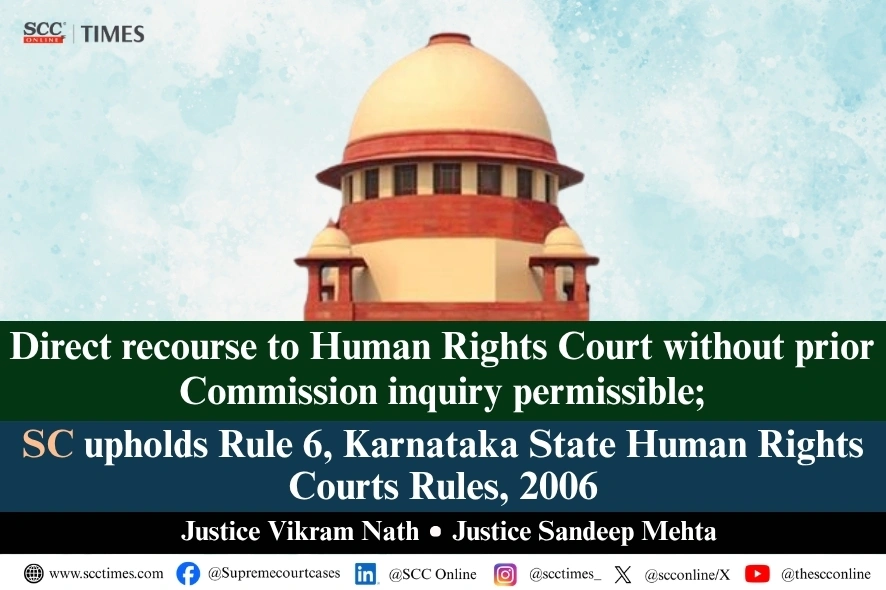
Supreme Court: In the appeals challenging Karnataka High Court’s judgment and order dated 17 July 2025, whereby it had struck down Rule 6, Karnataka State Human Rights Courts Rules, 2006 (2006 Rules), which enables a victim of an offence arising out of a violation of human rights, or specified persons acting on the victim’s behalf, to approach the Human Rights Court directly and prescribes the procedure to be followed thereafter, holding the same to be unconstitutional, inconsistent with the Protection of Human Rights Act, 1993 (Human Rights Act), and beyond the State Government’s rule-making power under Section 41, Human Rights Act, the Division Bench of Vikram Nath* and Sandeep Mehta, JJ., set aside the impugned judgment and order, holding that Rule 6, 2006 Rules, is valid and intra vires the Human Rights Act. The Human Rights Commission and Human Rights Court constitute two distinct and complementary mechanisms under the Human Rights Act and the Rule 6 merely supplies the procedural machinery for invoking the jurisdiction of a Human Rights Court under Section 30 and does not create a substantive or parallel regime. The Court, further, held that a prior inquiry or recommendation by the National/State Human Rights Commission was not a mandatory condition precedent for approaching a Human Rights Court.
Background
The appellant was an accused in crime no. 30 of 2023, registered at Jalanagar Police Station, Vijayapura. While in custody in connection with that case, he alleged that certain police officials had violated his human rights.
On 19 January 2024, the appellant instituted a private complaint before the Principal District and Sessions Judge and Special Judge, Human Rights Court, Vijayapura, alleging violation of his human rights by police officials in connection with his custody.
The complaint was registered as PCR no. 1 of 2024 and on 20 January 2024, the Human Rights Court referred the complaint to the Superintendent of Police, Vijayapura, for investigation under Section 156(3), Criminal Procedure Code, 1973 (CrPC). Pursuant to Human Rights Court’s direction, crime no. 15 of 2024 was registered at Jalanagar Police Station against the concerned police officials.
The concerned police officials approached the Karnataka High Court through writ petition, challenging the validity of Rule 6, 2006 Rules, registration of crime no. 15 of 2024 and the proceedings arising from PCR no. 1 of 2024.
By judgment dated 17 July 2025, the High Court allowed the writ petition and declared Rule 6 of the 2006 Rules unconstitutional, held it inconsistent with the Human Rights Act and that it ultra vires the State Government’s rule-making power under Section 41 of the Act, quashed crime no. 15 of 2024 and held that the order dated 20 January 2024 in PCR No. 1 of 2024 did not survive.
Aggrieved, the appellant and the State of Karnataka approached the Supreme Court. The Supreme Court, by order dated 27 October 2025, had stayed the operation of the impugned judgment.
Issue for Consideration
Whether Rule 6, 2006 Rules, insofar as it enables an aggrieved person to directly approach the Human Rights Court and prescribes the procedure to be followed on such complaint, is inconsistent with the scheme of the Human Rights Act or travels beyond the rule-making power conferred upon the State Government under Section 41 of the Act?
Analysis
Statutory Framework
At the outset, the Court examined the statutory framework and noted that the Human Rights Act was enacted for the constitution of the National Human Rights Commission, State Human Rights Commissions and Human Rights Courts for the better protection of human rights. Section 2(d) defines “human rights” as rights relating to life, liberty, equality and dignity of the individual, guaranteed by the Constitution or embodied in international covenants and enforceable by courts in India. Sections 12 to 18 provide for the functions and powers of the Human Rights Commissions, including inquiry and investigation into complaints and recommendations for prosecution or other suitable action.
However, the Human Rights Act separately provides for Human Rights Courts under Section 30. Section 30 empowers the State Government, with the concurrence of the Chief Justice of the High Court, to specify a Court of Session in each district as a Human Rights Court “to provide speedy trial of offences arising out of violation of human rights”. The Court therefore treated Sections 12 to 18 and Section 30 as provisions creating two distinct institutional mechanisms.
The Court noted that Section 41(1) authorises the State Government to make rules to carry out the provisions of this Act. Section 41(2) specifies certain matters on which rules may be framed, but begins with the words “in particular and without prejudice to the generality of the foregoing power”. The Court opined that the matters specifically enumerated in Section 41(2) are illustrative and not exhaustive of the general rule-making power under Section 41(1).
The Court further observed that Rule 6, 2006 Rules permits a victim of an offence arising out of violation of human rights, his legal representative or a registered NGO or public person, subject to the prescribed authorisation, to file a complaint against a public servant alleged to have committed or abetted such an offence while acting “under the colour of his office as a public servant”. Upon receiving such complaint, the Human Rights Court may:
-
direct investigation by a police officer not below the rank of Superintendent of Police; or
-
conduct its own inquiry in accordance with the procedure applicable to private complaints under the Code.
The Rule 6, 2006 Rules further regulates the procedure where the investigating officer reports that no offence is made out; consideration of sufficient material to proceed against the accused; forwarding of material to the competent authority for sanction wherever required; disposal of the request for sanction within 30 days; conduct of trial according to the procedure for a Sessions trial and day-to-day trial of the offence. Accordingly, the Court characterised Rule 6 as a provision prescribing the procedure for complaints before a Human Rights Court.
Two Distinct Mechanism under Human Rights Act
The Court drew a clear distinction between the two statutory mechanisms and stated that the National and State Human Rights Commissions possess powers of inquiry, investigation and recommendation under Sections 12 to 18. On the other hand, the Human Rights Court was constituted under Section 30 for the speedy trial of offences arising out of violations of human rights. Their functions are not identical as the Commission performs primarily an “inquisitorial and recommendatory role” and the Human Rights Court exercises judicial power in relation to offences arising from human-rights violations.
Prior recourse to the Human Rights Commission not mandatory
The Court rejected the proposition that a complaint must necessarily first pass through the Human Rights Commission before criminal proceedings can be initiated. The Court opined that “mere conferment of power upon the Commission to inquire into a complaint and, where appropriate, recommend initiation of prosecution cannot …be construed as making such an inquiry or recommendation an indispensable condition precedent to the initiation of criminal proceedings”.
The Court reasoned that Sections 12 to 18 do not expressly provide that every prosecution concerning an offence arising out of violation of human rights must originate from a Commission recommendation. Likewise, Section 30 does not make the jurisdiction of a Human Rights Court dependent upon completion of proceedings before the Commission. The Court emphatically held that reading such a restriction into the statute would amount to “supplying a condition which Parliament itself has not enacted”.
Accordingly, the Court held that the recourse to the Human Rights Commission is not a mandatory gateway to the Human Rights Court.
Rule 6 doesn’t create new offence/enlarge the Act
Further, the Court rejected the argument that Rule 6 impermissibly enlarges the jurisdiction of the Human Rights Court. It noted that Rule 6 does not create a new offence, prescribe a new punishment, enlarge the statutory meaning of “human rights” or confer jurisdiction alien to Section 30. Instead, it provides the procedural means by which the jurisdiction already conferred upon the Human Rights Court under Section 30 may be invoked and exercised. The offences ultimately tried remain offences punishable under the applicable penal law.
Therefore, Rule 6 regulates only the manner in which a complaint is received, investigated and proceeded with.
Section 41 confers general rule-making power
The Court also rejected the argument that Section 41(2) exhaustively defines the rule-making power of the State Government and stated that Section 41(1) contains a broad enabling provision authorising rules to carry out the provisions of this Act. Further, the opening words of Section 41(2), “in particular and without prejudice to the generality of the foregoing power”, demonstrate that the matters specifically enumerated therein do not exhaust the general power under Section 41(1). Consequently, the Court held that the State Government could prescribe procedural machinery necessary to give meaningful effect to Section 30.
Delegated Legislation: Rule may Supplement but not Supplant the Act
The Court reiterated the settled principle that delegated legislation cannot travel beyond the parent enactment and cannot alter its substantive scheme [State of Karnataka v. H. Ganesh Kamath, (1983) 2 SCC 402 and Kunj Behari Lal Butail v. State of H.P., (2000) 3 SCC 40]. At the same time, where the parent statute confers a general rule-making power, the delegate may prescribe procedural machinery necessary for giving meaningful operation to the statutory provisions, provided such machinery is not inconsistent with the Act.
Relying on St. Johns Teachers Training Institute v. Regional Director, NCTE, (2003) 3 SCC 321, the Court observed that rules cannot “supplant” the enabling Act, but may “supplement” it by dealing with ancillary matters and filling in details necessary to effectuate the legislative scheme. The Court also found direct support in Paramvir Singh Saini v. Baljit Singh, (2021) 1 SCC 184.
Applying the above discussed principle, the Court held that, Rule 6 supplements Section 30 and it does not supplant the Human Rights Act.
High Court’s Reasoning — Unsustainable
The Court noted that the High Court proceeded on an erroneous premise that the mechanism under Sections 13, 14, 17 and 18, Human Rights Act constituted the exclusive route through which an alleged human-rights violation had to proceed before prosecution could be initiated.
The Court stated that the High Court read a limitation in the statute which the text does not contain, failed to give independent operation to Section 30, incorrectly treated Rule 6 as creating a parallel substantive regime and misunderstood the nature of the Commission’s inquiry in relation to double jeopardy.
The Court clarified that a Human Rights Commission’s inquiry or recommendation does not amount to a prior prosecution or punishment and therefore simultaneous recourse to the Commission and Human Rights Court does not attract the constitutional protection against double jeopardy.
Decision
The Court held that Rule 6, 2006 Rules is not inconsistent with the Human Rights Act and does not travel beyond the rule-making power conferred upon the State Government under Section 41 thereof. Therefore, Rule 6, 2006 Rules is intra vires the Human Rights Act and is valid.
The Court allowed both appeals and set aside the impugned judgment dated 17 July 2025, consequential quashing of crime no. 15 of 2024 and High Court’s finding that the order dated 20 January 2024 in PCR No. 1 of 2024 did not survive. The Court also directed that the proceedings should continue from the stage at which they presently stand, in accordance with law.
The Court expressly clarified that it had not expressed any opinion on the merits of the allegations. All contentions and defences of the parties were left open for consideration by the competent Court on their own merits.
[Sayad Asifulla v. State of Karnataka, 2026 SCC OnLine SC 1817, decided on 25-8-2026]
*Judgment Authored by Justice Vikram Nath
Advocates who appeared in this case:
For the Petitioner: Mr. Avishkar Singhvi, A.A.G. Mr. Aujaswi Maken, Adv. Mr. Rajesh Gulab Inamdar, AOR Mr. B.L.N Sanjit, Adv. Ms. Rakshita Singh, Adv. Mr. Ritik Grover, Adv. Ms. Bhawna Piplani, Adv. Mr. Abhishek Kaushik, Adv. Ms. Sonal Priya, Adv. Mr. Nizam Pasha, Adv. Mr. Mushtaq Salim, Adv. Mr. Lzafeer Ahmad B. F., AOR Mr. Sidharth Kaushik, Adv. Ms. Awstika Das, Adv. Mr. Arif Ali, Adv.
For the Respondents: Ms. Patil Rekha Chandra Gouda, AOR Ms. Kiran Suri, Sr. Adv. Mr. Sheelavant Vijaykumar Maheswarappa, Adv. Mr. S.J. Amith, Adv. Ms. Aishwarya Kumar, Adv. Mr. Vishwanath Gururaj Joshi, Adv. Dr. Vipin Gupta, AOR