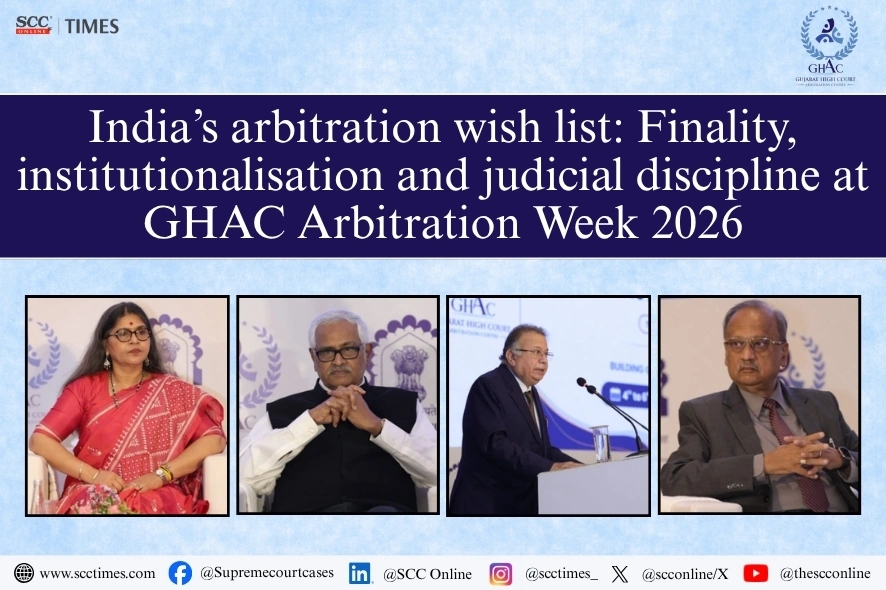
The Gujarat High Court Arbitration Centre (GHAC) Arbitration Week 2026 started its third day with a session titled “A Judge’s wish list of what the law ought to be”, inviting the judiciary to articulate what India’s arbitration framework should aspire to become. The discussion moved beyond the conventional question of excessive judicial intervention and examined the responsibilities of arbitral tribunals, counsel, courts, institutions and the Government in creating an arbitration system that delivers speed, cost-effectiveness and finality.
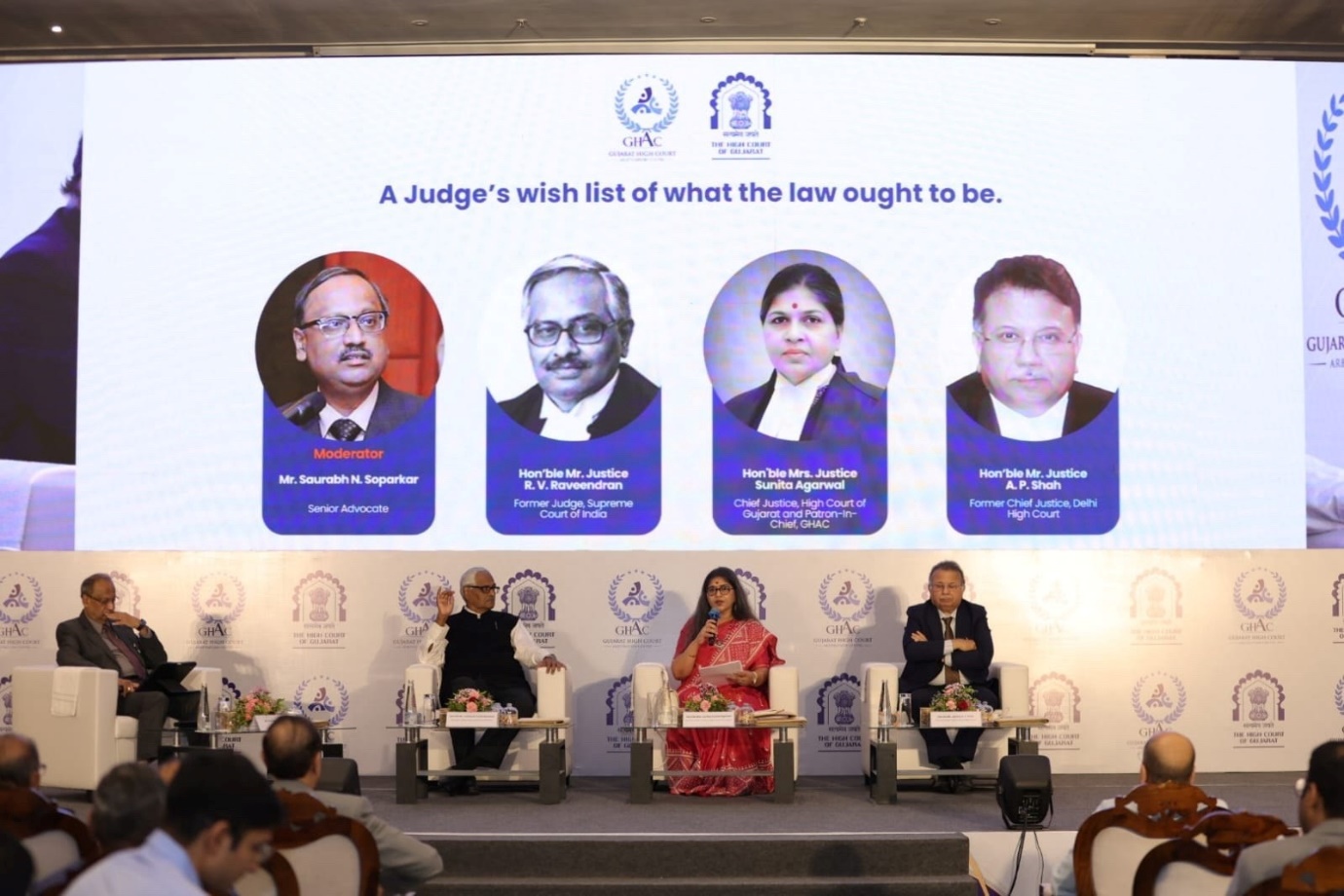
[In the picture from left to right: Mr Saurabh N. Soparkar, Justice R. V. Raveendran, Justice Sunita Agarwal and Justice A. P. Shah]
The panel featured Justice Sunita Agarwal, Chief Justice, High Court of Gujarat, Justice R. V. Raveendran, Former Judge, Supreme Court of India and Justice A. P. Shah, Former Chief Justice, Delhi High Court. The session was moderated by Mr Saurabh N. Soparkar, Senior Advocate.
A judge’s wish list: transparency, accountability and predictability
Opening the session, Justice Sunita Agarwal described the theme as an unusual opportunity for judges to consider the arbitration framework not merely in terms of legislative intention, but through the experience of applying the law in practice.

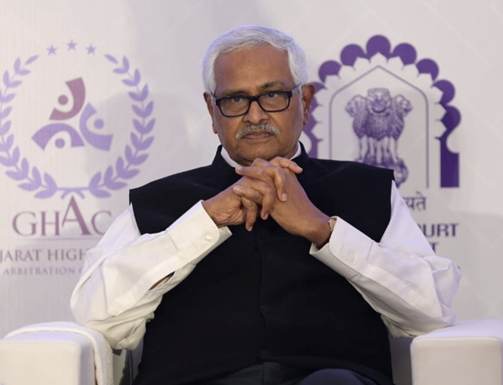
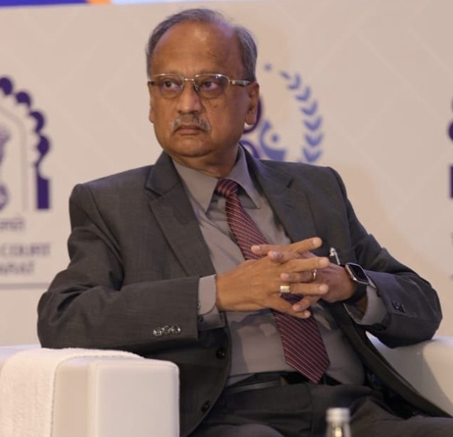
[In picture: Justice Sunita Agarwal]
She observed that judges generally answer the question, “what is the law?”, whereas the session posed the more fundamental question of what the law ought to be. In her view, experience should not be understood as criticism of the past, but as an opportunity to improve the future. Arbitration, she noted, derives much of its strength from its ability to evolve, learn from experience and address difficulties as they arise.
Justice Agarwal said that the wish list of judges should ultimately coincide with that of arbitration users:
“…a clearer law, disciplined procedure, greater institutional trust and finality of adjudication.”
Reducing her vision to three words, she identified transparency, accountability and predictability. For users, she explained, the law should provide clarity before a dispute arises, confidence in the process while the dispute is being adjudicated, and certainty that the dispute will finally come to an end.
Judicial intervention begins with the quality of arbitration
Justice R. V. Raveendran approached the question from the perspective of a former judge who now acts as an arbitrator. He cautioned against beginning the discussion with the assumption that the principal problem was excessive judicial intervention.
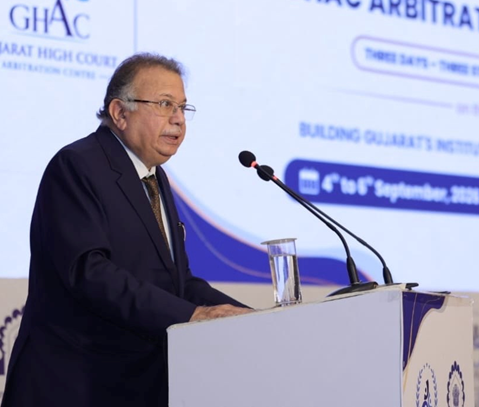
[In picture: Justice R. V. Raveendran]
According to him, the more fundamental questions were whether arbitration was being conducted expeditiously, whether it was cost-effective and whether arbitral awards were solid, sound and valid. If these objectives were achieved, the justification for judicial intervention would correspondingly diminish.
Justice Raveendran was particularly critical of the culture of routinely challenging arbitral awards. He observed that Section 34 proceedings had effectively become another appellate stage, despite arbitration being intended to provide finality.
He argued that arbitrators, arbitration lawyers, corporate general counsel, law firms and Government lawyers recommending challenges must also examine their own role before attributing excessive intervention to the courts. Arbitral tribunals, he pointed out, may spend several years dealing with thousands of pages of material and produce lengthy awards, only for virtually every award to be challenged.
In his view, the burden on courts could be reduced by improving the quality of arbitral awards. The more responsible the arbitral tribunal, the less likely it would be that courts would be confronted with awards requiring intervention.
The DMRC dilemma: when judicial conscience meets arbitral finality
Justice Raveendran then turned to the difficult question of why judges sometimes intervene despite knowing that Section 34, Arbitration and Conciliation Act, 1996 (Arbitration and Conciliation Act) jurisdiction is intended to remain narrow.
He explained that judges are trained to resist injustice. When confronted with an award that appears manifestly unjust, a judge may face a conflict between the statutory limits on judicial review and the judicial instinct to prevent injustice. He referred extensively to DMRC Ltd. v. Delhi Airport Metro Express (P) Ltd., (2024) 6 SCC 357 arbitration litigation to illustrate this tension.
Justice Raveendran noted that the controversy surrounding the DMRC award involved, among other things, the manner in which the arbitral tribunal had dealt with contractual language and evidence. The award involved substantial monetary claims, and the matter eventually reached the Supreme Court and subsequently the Court’s curative jurisdiction.
His broader point was that simply repeating that judicial review is limited would not eliminate the underlying tension. If arbitral tribunals produce awards that courts perceive as perverse or fundamentally unsustainable, judges may feel compelled to find a means of correcting them.
He therefore placed a corresponding responsibility on arbitral tribunals.
“The more the limitation on restriction or restriction on the judicial review, the greater the responsibility of the arbitral tribunal.”
Justice Raveendran said arbitrators must strictly follow the contract, deal with material evidence, address important submissions, provide reasons where required and ensure that their conclusions can reasonably be sustained by the contractual terms and evidentiary record.
He ultimately described the desired balance as one in which responsible tribunals produce proper awards while responsible courts respect the limits of their jurisdiction.
“We want a system in which responsible arbitral tribunals make proper awards and responsible courts respect the limits of their jurisdiction.”
Consistency in Supreme Court jurisprudence is essential
Justice Raveendran also addressed what he regarded as uncertainty caused by changing judicial approaches to Section 34, Arbitration and Conciliation Act. He referred to the line of decisions involving ONGC v. Saw Pipes Ltd., (2003) 5 SCC 705, ONGC v. Western Geco International Ltd., (2014) 9 SCC 263, Associate Builders v. DDA, (2015) 3 SCC 49 and DMRC Ltd. v. Delhi Airport Metro Express (P) Ltd., (2024) 6 SCC 357, observing that the Supreme Court bears a heightened responsibility to maintain consistency, certainty and uniformity in the law it lays down.
He explained that judges can approach apparently unjust awards differently. Some may adhere strictly to the statutory limitations, while others may be more willing to intervene where they perceive a serious failure of justice. This produces uncertainty for parties and lower courts dealing with arbitral challenges.
The problem, according to Justice Raveendran, becomes particularly acute when concepts such as public policy and patent illegality are interpreted expansively. He warned that repeated exposure to poorly reasoned or unsustainable awards could encourage courts to expand these concepts, thereby gradually shifting the boundaries of judicial review.
Section 29A and the responsibility to control delay
Justice Raveendran questioned the effectiveness of the statutory timeline under Section 29A, Arbitration and Conciliation Act particularly the expectation that arbitrations should ordinarily conclude within the prescribed period.
He asked how many arbitrations actually conclude within the statutory period and how often courts actively require tribunals to explain delays. In his assessment, the statutory provision would have limited value if tribunals did not control delays and courts routinely extended the timelines.
The central point, however, was not simply to impose tighter statutory controls. Justice Raveendran argued that tribunals must themselves recognise that the greater the protection given to arbitral awards from judicial review, the greater their responsibility to conduct proceedings properly.
India’s arbitration problem is also a problem of institutional culture
Justice A. P. Shah, drawing upon his experience as former Chairman of the 20th Law Commission of India, placed India’s arbitration journey within the broader history of legislative reform.
[In picture: Justice A. P. Shah]
He noted that the 2015 amendments, the B. N. Srikrishna Committee’s 2017 report, the 2019 amendments, the T. K. Viswanathan Committee’s work and subsequent reform proposals had repeatedly attempted to improve arbitration in India. Yet, despite decades of legislative refinement, he observed that domestic companies and foreign investors could still perceive Indian arbitration as “civil litigation by another name in another venue”, sometimes at greater cost.
Justice Shah identified the fundamental promises of arbitration as speed, cost-effectiveness and finality and argued that all three remained under strain.
“Due process paranoia” and the need for procedural discipline
Justice Shah referred to the T. K. Viswanathan Committee’s description of “due process paranoia”, under which arbitrators may become excessively concerned about the possibility of an award being challenged and therefore permit lengthy arguments, cross-examinations and repeated procedural applications.
Although the Civil Procedure Code, 1908 (CPC) and the Evidence Act, 1872 do not govern arbitrations in the same manner as ordinary civil litigation, Justice Shah observed that their practices frequently become the de facto norm in arbitration.
He also raised concerns about the professional bandwidth of arbitrators. Referring to the Viswanathan Committee’s recommendation that an arbitrator should ordinarily have no more than 15 active matters, he argued that arbitrators accepting excessive appointments can make continuous hearings virtually impossible. The result is fragmented hearings, fading memory, repeated arguments and prolonged proceedings.
Justice Shah argued for procedural standards including limits on written submissions, focused oral hearings and defined time for cross-examination. He also suggested that model procedural rules could be adopted by arbitral institutions without necessarily being incorporated directly into legislation.
A structural shift from ad hoc to institutional arbitration
Justice Shah strongly advocated a transition from ad hoc arbitration to institutional arbitration.
He argued that ad hoc arbitration can become a replica of civil litigation because there are often no standardised procedural rules or administrative structures. While India has developed several arbitral institutions, he cautioned that institutions must provide much more than physical infrastructure and administrative services.
He highlighted the advantages of institutional arbitration, including:
-
fixed procedural timelines;
-
established rules and modern arbitration clauses;
-
transparent costs and fee structures;
-
professional administration;
-
streamlined arbitrator appointments;
-
transparent challenge framework;
-
scrutiny of awards; and
-
greater use of emergency arbitration, expedited hearings, joinder, consolidation and early dismissal mechanisms.
Justice Shah referred to examples from the Mumbai Arbitration Centre, stating that emergency arbitrators had been appointed within 24 hours in two cases and interim applications decided within 14 days.
He also argued that Government support could include infrastructure assistance and tax incentives, while specialised institutions could be developed for particular industries with sector-specific expertise. Arbitration institutions should also expand beyond Tier 1 cities.
Justice Agarwal’s three legislative wishes
Justice Agarwal subsequently identified three specific changes she would like to see in the Arbitration and Conciliation Act.
-
First: remove court appointment under Section 11, Arbitration and Conciliation Act
Her first wish was that the court’s jurisdiction to appoint arbitrators under Section 11 should be removed.
She proposed that arbitral institutions should become default appointing authorities, thereby eliminating one stage of judicial intervention. The courts, in her view, would continue to retain their role at subsequent stages, including judicial scrutiny where appropriate.
Justice Agarwal suggested that High Courts should designate arbitral institutions, while appointments themselves should be made by the institutions. She further proposed that legislation should identify a default appointing authority where no institution has been designated or where the designated institution fails to act within the prescribed period. She emphasised that this model could work only if arbitral institutions command the trust and confidence of users. Referring to GHAC’s own rules, she noted that the Centre already has provisions enabling it to appoint arbitrators or presiding arbitrators in specified circumstances.
-
Second: one level of challenge
Justice Agarwal’s second wish concerned Sections 34 and 37, Arbitration and Conciliation Act.
She proposed that instead of two levels of appellate scrutiny, there should be one level of challenge before the High Court under Section 37, Arbitration and Conciliation Act, incorporating all permissible grounds of challenge.
-
Third: greater flexibility for fast-track arbitration
Her third proposal concerned Section 29B, Arbitration and Conciliation Act, relating to fast-track arbitration.
She suggested that parties should not necessarily be required to decide upon fast-track arbitration only before or at the time of constitution of the tribunal. Instead, the option could potentially be made available after pleadings have been exchanged or at the evidence stage, particularly where the nature of the dispute has become clearer.
Follow the existing Arbitration Act fully
When the moderator asked the panellists what single provision or principle they would change if given the opportunity to rewrite the Arbitration and Conciliation Act after 30 years of experience, Justice Raveendran gave a strikingly different answer.
He said he had no wish to amend the legislation merely for the sake of amendment.
“I want people to follow the existing Arbitration Act fully.”
Justice Raveendran argued that lawyers, arbitrators and courts must properly apply the existing statutory framework before repeatedly seeking legislative changes. He suggested that if existing provisions concerning timelines and arbitral procedure were properly implemented, many of the problems currently attributed to the statute could be reduced.
He nevertheless identified one area where additional expertise could improve arbitral decision-making: technical disputes. Construction, marine and energy arbitrations, he noted, often involve specialised technical questions with which arbitrators may not be familiar.
He therefore suggested that tribunals could have access to independent domain experts or technical advisers to assist with technical aspects of complex disputes.
The case for removing Section 11 from the courts
Justice Agarwal elaborated on why she believed Section 11, Arbitration and Conciliation Act appointments should move away from the courts.
Drawing from her experience dealing with Section 11, Arbitration and Conciliation Act matters, she observed that arguments before the court frequently concern the merits of the dispute or questions concerning the jurisdiction of the arbitral tribunal, which are generally matters for the tribunal itself to consider.
She described the existing process as a gateway through which parties repeatedly return to court and suggested that institutional appointments could remove this layer without eliminating judicial scrutiny altogether.
She also noted that Section 11, Arbitration and Conciliation Act orders are routinely challenged, creating another level of proceedings. In her view, moving appointments to trusted institutions would eliminate one source of such litigation.
Judicial consistency and the problem of “back and forth”
The moderator then raised the issue of uncertainty caused by changing Supreme Court approaches on questions such as the applicability of Part I to international commercial arbitration, inadequately stamped arbitration agreements and the status of non-signatories.
[In picture: Mr Saurabh N. Soparkar]
Justice Raveendran agreed that consistency was essential. He discussed the evolution of the law relating to stamping and argued that what may initially appear to be a straightforward statutory question can become considerably more complicated when successive judicial decisions reinterpret the issue.
Justice Shah described the repeated movement in Supreme Court jurisprudence as more than merely back and forth. He stressed that once the Supreme Court lays down the law, there must be a degree of finality and judicial discipline so that lower courts and arbitration users know which principles govern.
When Bench composition shapes arbitration jurisprudence
Asked whether the Supreme Court should lay down definitive principles to guide lower courts in Section 34 and Section 37, Arbitration and Conciliation Act matters, Justice Raveendran responded with a striking observation about the structure of the Supreme Court.
“We have 17 Supreme Courts. So, the results depend upon the Bench before which the matter comes.”
He argued that the widening interpretation of patent illegality had created uncertainty and cautioned against turning arbitration into a system involving first and second appeals. He recalled Justice Nariman’s suggestion of a full appeal as an indication of the degree of frustration generated by the existing system but argued that if arbitration ultimately becomes subject to full appellate scrutiny, its very purpose of finality would be undermined.
Section 29A: unrealistic timeline or necessary pressure?
The discussion returned to Section 29A, Arbitration and Conciliation Act, with the moderator observing that the provision had, in his view, failed to prevent delay.
Justice Shah acknowledged that the one-year timeline was unrealistic for complex commercial arbitrations. He noted that, based on comparative statistics presented to the Government, two to two-and-a-half years could be a normal duration for a complicated commercial matter.
At the same time, he cautioned against simply deleting Section 29A, Arbitration and Conciliation Act. Despite its shortcomings, the provision continued to operate as a form of pressure on arbitrators to complete proceedings within a reasonable period.
Justice Agarwal explained that when Section 29A, Arbitration and Conciliation Act applications come before the court, the stage of arbitration is relevant. If proceedings have reached evidence or final arguments, the court is more likely to extend the timeline because the objective remains to bring the dispute to finality. She nevertheless indicated that judicial training could encourage judges dealing with such applications to ask more meaningful questions about the reasons for delay.
Can district judges question retired judges acting as arbitrators?
A question from the audience raised a practical concern about Section 29A, Arbitration and Conciliation Act applications where the arbitrator is a retired High Court or Supreme Court judge. The concern was whether district judges might feel constrained from questioning the reasons for delay when the arbitrator appearing before them is a former superior court judge.
Justice Raveendran rejected the suggestion that the status of the arbitrator should affect the exercise of statutory powers. He emphasised that a retired judge remains a retired judge, while a sitting district judge remains the judicial authority entrusted by statute with the relevant power. Accordingly, the district judge should exercise the jurisdiction conferred by the statute irrespective of the identity of the arbitrator.
Public policy and patent illegality: how far should the grounds extend?
The final substantive exchange involved Mr Kamal Trivedi, Advocate General, State of Gujarat, who questioned Justice Shah about the continuing uncertainty surrounding public policy of India, fundamental policy of Indian law, and the most basic notions of morality and justice.
Drawing upon the evolution of judicial interpretation, Mr Trivedi asked whether these concepts should have been defined more precisely when the 2015 reforms were introduced, so that courts would have clearer boundaries within which to operate.
Justice Shah acknowledged the difficulty of defining public policy with precision. He referred to the expression most basic notions of morality and justice and traced it to the jurisprudence concerning enforcement of foreign arbitral awards. He cautioned that overly broad and vague language can make the task of judges more difficult. His position was that where legislation intends to restrict judicial jurisdiction, the statutory language should be sufficiently specific.
“…if you are giving a wide jurisdiction to a court, use general terms. But if your idea is to restrict the jurisdiction, as in Section 34, Arbitration and Conciliation Act, you must be specific.”
Mr Trivedi also referred to the evolving jurisprudence on fundamental policy and patent illegality, underscoring the continuing concern that expansive judicial interpretation could undermine the finality that arbitration is intended to provide.
Closing Remarks
The concluding session of GHAC Arbitration Week 2026 placed the judiciary’s perspective at the centre of India’s arbitration reform debate. Rather than presenting judicial intervention as a problem existing in isolation, the panellists connected it to the quality of arbitral awards, the conduct of proceedings, institutional capacity, procedural discipline and the confidence of arbitration users.
Justice Agarwal’s three-word formulation of transparency, accountability and predictability provided a useful framework for the discussion. Justice Raveendran emphasised that tribunals must earn the limited judicial review afforded to their awards by acting with professionalism, responsibility and care. Justice Shah, meanwhile, argued for a deeper structural shift towards institutional arbitration, specialised judicial capacity and greater procedural discipline.
The session’s central message was therefore not simply that courts should intervene less. It was that arbitration must become sufficiently reliable, disciplined and professionally administered to make restraint by the courts both possible and sustainable.
As Justice Raveendran put it, the objective is neither a system in which arbitral awards are beyond scrutiny nor one in which every challenge becomes an appeal. The goal is a system where tribunals make sound awards and courts respect the boundaries of their jurisdiction.
The session thus brought GHAC Arbitration Week 2026 back to its central question: not merely what the law currently provides, but what must change in the law, institutions and professional culture for India to build an arbitration system capable of delivering genuine speed, cost-effectiveness, certainty and finality.