








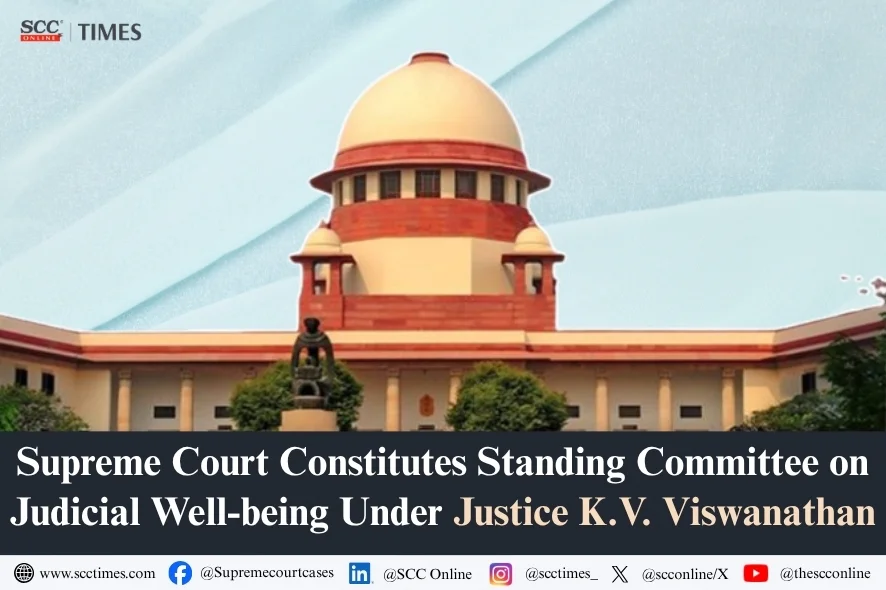
In a move to institutionalize measures for the mental and physical well-being of judicial officers, Chief Justice of India Surya Kant, CJ, has constituted a Standing Committee on Judicial Well-being under the aegis of the Supreme Court of India. The Committee has been constituted on the occasion of World Mental Health Day, recognizing the need to address the professional and personal challenges faced by members of the judiciary.
The Committee will be chaired by Supreme Court Judge Justice K.V. Viswanathan and will include experts in psychiatry and psychology; a Supreme Court Advocate-on-Record and a judicial officer associated with the Supreme Court’s Centre for Research and Planning.
Composition of the Committee
The Standing Committee will comprise the following members:
-
Justice K.V. Viswanathan — Chairperson, Judge, Supreme Court of India.
-
Dr. Savita Malhotra — Former Dean, PGIMER, Chandigarh, and Professor and Head, Department of Psychiatry.
-
Rajat Mitra — Psychologist, Director and Co-founder, Swanchetan Society for Mental Health.
-
Mrinal Kanwar — Advocate-on-Record, Supreme Court of India.
-
Aarti Singh — Registrar (J), Centre for Research and Planning, Supreme Court of India
Addressing the Unique Challenges Faced by Judges
Judicial officers routinely function in demanding professional environments characterised by mounting caseloads, extended working hours, complex adjudicatory responsibilities and administrative obligations. Their work also frequently involves dealing with sensitive disputes and cases involving significant emotional and human consequences.
Against this backdrop, the constitution of the Committee seeks to establish an institutional mechanism through which concerns affecting the well-being of judicial officers can be systematically identified and addressed.
The initiative recognises that the well-being of judicial officers extends beyond individual welfare. Their ability to discharge judicial functions effectively is closely linked to the quality, efficiency and long-term sustainability of the justice delivery system.
Research-Based Institutional Initiative
The constitution of the Committee follows a research exercise undertaken by the Centre for Research and Planning, Supreme Court of India, focusing on the well-being of judicial officers serving in the District Judiciary.
The research examines the various professional and institutional factors that influence judicial well-being, including occupational stress, excessive workload, mental and physical exhaustion, staff shortages, inadequate infrastructure, administrative burdens, transfers, work-life balance and access to institutional support.
The exercise provides a research-based foundation for identifying areas of concern and developing appropriate measures to address the difficulties encountered by judicial officers in the discharge of their duties.
Mandate of the Committee
The Standing Committee is envisaged as a continuing institutional mechanism for examining concerns relating to judicial well-being and facilitating appropriate interventions.
Its mandate includes identifying issues that require institutional attention, coordinating welfare-related measures, formulating suitable guidance and periodically assessing the initiatives undertaken for the benefit of judicial officers.
The establishment of a standing mechanism is intended to ensure that judicial well-being receives sustained institutional consideration, rather than being addressed only through isolated or occasional interventions.
Alignment with Global Initiatives
The initiative also reflects the increasing international emphasis on protecting the mental and physical well-being of members of the judiciary.
It is aligned with the Nauru Declaration on Judicial Well-being, adopted on July 25, 2024, which calls attention to the importance of systemic and evidence-based measures to safeguard judicial officers’ health and well-being.
In a further recognition of the issue at the international level, the United Nations General Assembly, in March 2025, proclaimed July 25 as the International Day for Judicial Well-being. The observance highlights the connection between the well-being of judges and the effective administration of justice.
Strengthening the Foundations of Justice
The constitution of the Standing Committee marks a move towards a more structured and sustained institutional response to the challenges faced by judicial officers across the country.
Through research-based interventions, coordination of welfare measures and periodic review of initiatives, the Committee is intended to provide a continuing platform for addressing concerns affecting judicial well-being.
The initiative places judicial well-being within the broader institutional framework of justice administration, recognising that the physical and mental health of judicial officers is closely connected with the effective functioning, independence and long-term sustainability of the judicial system.









0 replies