Procedural lapses do not vitiate inquiry without real prejudice: Bombay HC quashes reinstatement of school peon
The Court held that the School Tribunal’s approach was perverse as it overlooked the actual charges against the peon.

Bringing you the Best Analytical Legal News


The Court held that the School Tribunal’s approach was perverse as it overlooked the actual charges against the peon.
The petition challenged the Trial Court’s order allowing the plaintiff to amend the plaint under Order VI Rule 17 CPC to include a claim for mesne profits at the rate of ₹50,000 per month.
Key Supreme Court rulings on Article 227, RTE, Teachers Eligibility Test, custody, GST rebate, etc.
Articles 226 and 227 should ordinarily not be used to correct interlocutory procedural orders of an Arbitral Tribunal unless there is a patent jurisdictional defect or exceptional perversity.
Supreme Court holds that a writ petition under Article 226 cannot be treated as one under Article 227 to deny an appellate remedy. Revenue Court orders can be challenged under Article 226.
While the arbitrator and the Tribunal proceeded on the presumption that claimant continued to be a member of respondent Society, the Delhi High Court found that material documentary evidence concerning his resignation, transfer of his share and rejection of his subsequent membership application had been overlooked.
The Supreme Court examined whether a writ petition challenging an NCLT order passed under the Insolvency and Bankruptcy Code, 2016 could be entertained when the Code provides a statutory right of appeal under Section 61, in the context of the judicial discipline governing exercise of writ jurisdiction.
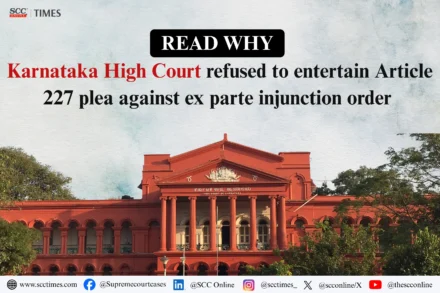
“…the petitioner, instead of availing the statutory remedy available to him, has chosen to file a petition under Article 227 of the Constitution of India.”

Reiterating the legislative policy of minimal judicial interference in arbitral proceedings, the Court observed that interference under Article 227 is warranted only in rare cases involving a patent lack of inherent jurisdiction that is apparent on the face of the record
“Scheme of the Arbitration Act does not envision arbitration proceedings to cease with the death of a party. Section 35, Arbitration Act, extends the finality of an arbitral award not only to parties to the award, but also to ‘parties claiming under them’.”

The Bombay High Court held that creation of the Kolhapur Circuit Bench does not divest the Principal Seat of jurisdiction, as both the DRT (Pune) and DRAT (Mumbai) fall within its territory and the appellate order forms a substantial part of the cause of action.

“Mere filing of an appeal cannot and does not operate as a stay of the order appealed against, unless an order of stay operation of the same has been passed.”
“We find the conduct of HMDA not only to be in blatant disregard of the law but also evincing desperation to avoid the processes of law by pushing back their obligation to make payment to CEL by filing one vexatious proceeding after another.”
“Once the panchnama was found to be of doubtful evidentiary worth, the correct course would have been to proceed with adjudication on available legal grounds, and not to relegate the parties to a fresh round of proceedings without justification.”
“Where the plaintiff attempts to under-value the plaint and reliefs, the Court has to intervene.”
Once it is found that the original order is passed by the Competent Authority without giving any opportunity of hearing to the petitioner, the same is liable to be set aside as having been passed in violation of the principles of natural justice.
“Consideration to condone can be made only if there is a reasonable explanation and the condonation cannot be merely because the appellant is a Government body where procedural and bureaucratic delays are well known.”
When the Court requested the advocate to remove her face cover, she asserted that a woman advocate can appear with her face covered and claimed the same as her fundamental right.
“Where the additional evidence sought to be adduced removes the cloud of doubt over the case, the evidence has a direct & important bearing on the main issue in the suit and interest of justice clearly renders it imperative that the evidence must be permitted to be taken on record, then such an application may be allowed.”
Allahabad High Court reiterated that Arbitration Act transcends all territorial barriers.