As disputes involving cryptocurrencies, stablecoins, decentralised finance (DeFi) projects and other digital assets continue to grow in volume and complexity, leading arbitration practitioners, arbitrators and industry experts gathered at RPC’s London office for a member-hosted session during London International Disputes Week (LIDW) 2026 to examine whether arbitration is equipped to meet the unique challenges of the digital economy. Titled “Crypto Arbitration: Stable as a Coin or a (Black) Swan Dive?”, the session explored issues ranging from valuation, asset tracing and enforcement to emerging forms of blockchain-based dispute resolution, while considering whether arbitration is sufficiently agile to respond to the realities of an increasingly decentralised and technology-driven commercial landscape.
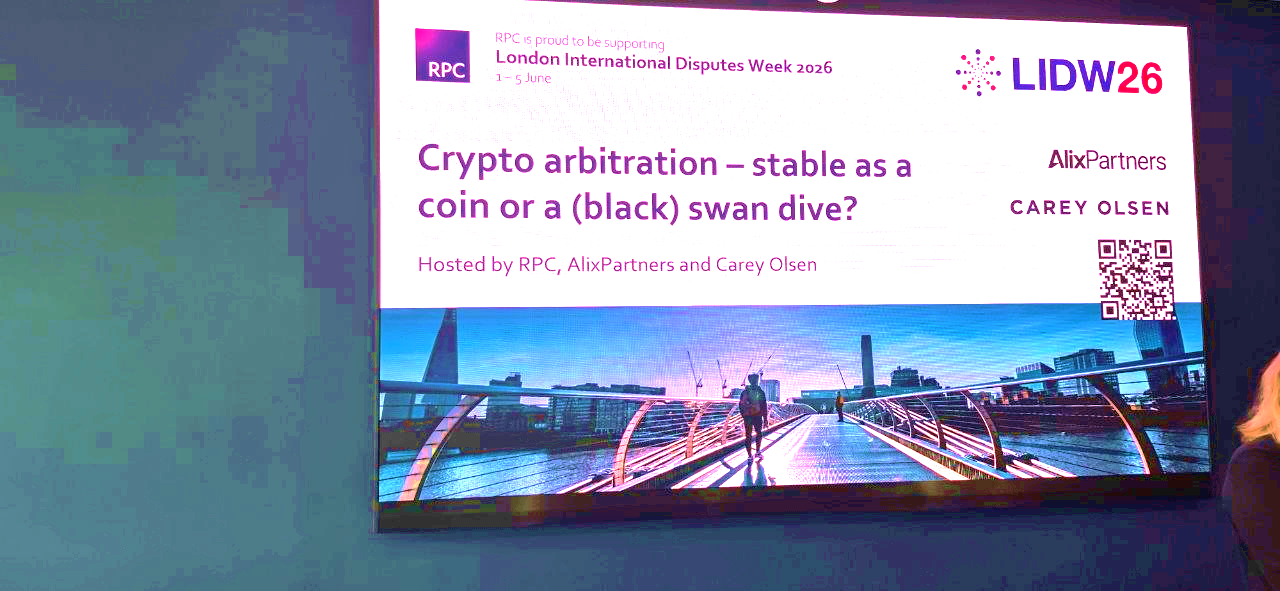
The discussion was moderated by Mr. Jonathan Crompton, Partner and Head of Commercial Disputes at RPC Hong Kong, and brought together a panel of leading practitioners at the forefront of digital-asset disputes and arbitration. The panellists included Ms. Rebecca Warder, Deputy Chair of the London Chamber of Arbitration and Mediation (LCAM) and Head of Knowledge at HFW; Ms. Anne-Marie Hitchin, Director at AlixPartners and a specialist in forensic investigations, valuation and quantum analysis; Ms. Mihaela Apostol, international arbitrator and Co-Founder of ArbTech, an initiative focused on the impact of emerging technologies on dispute resolution; Mr. Richard Brown, Partner at Carey Olsen in the British Virgin Islands (BVI), who regularly advises on cryptocurrency, insolvency and cross-border commercial disputes and Professor Sarah Green, Arbitrator and Digital Assets Expert at D2 Legal Technology, whose contributions have significantly influenced the development of the United Kingdom’s legal framework for digital assets, who was also introduced as a panellist.
Framing the Discourse
Opening the discussion, Mr. Jonathan Crompton explained the significance of the panel’s title. Stablecoins, he observed, are intended to provide stability within an otherwise volatile market. However, an increasing number of disputes concern whether the assets underpinning those coins were ever genuinely “stable” in the first place.
Turning to the concept of a “black swan” event, Mr. Crompton described it as a sudden and highly unpredictable occurrence capable of causing significant disruption to financial markets. Referring to major market corrections in the cryptocurrency sector, including the dramatic downturn experienced in October 2025, he noted that the digital-asset ecosystem continues to demonstrate both extraordinary innovation and extraordinary volatility.
Against that backdrop, the panel sought to address a fundamental question: is arbitration capable of delivering the certainty, speed and enforceability required by participants operating within the digital-asset economy?
The discussion that followed explored the types of disputes currently emerging across the crypto sector, the suitability of existing arbitral mechanisms, the emergence of specialist dispute-resolution frameworks, and the practical realities of valuation, enforcement and asset recovery in a decentralised environment.
The Growing Range of Digital-Asset Disputes
Introducing the first topic, Mr. Jonathan Crompton observed that Hong Kong is witnessing a broad spectrum of cryptocurrency-related disputes. These include business-to-business disputes, stablecoin-related claims and disputes concerning whether particular projects constituted legitimate businesses or, in some cases, outright frauds.
He noted that exchanges continue to be frequent targets of litigation and that legal practitioners are increasingly being approached by groups of users seeking collective redress following market failures or exchange collapses.
Although Hong Kong does not currently have a formal class action regime, relying upon representative actions instead, Mr. Crompton pointed out that the Hong Kong International Arbitration Centre (HKIAC) has developed sophisticated procedures concerning consolidation, representative participation and the management of related claims. In practice, these mechanisms can often achieve outcomes similar to those sought through class proceedings.
Offering an offshore perspective, Mr. Richard Brown described the British Virgin Islands as one of the most significant jurisdictions for digital-asset businesses. With approximately 25,000 residents but nearly 400,000 registered companies, the jurisdiction has actively positioned itself as an attractive destination for crypto-related enterprises through a relatively accommodating regulatory environment.
As a result, the BVI has become home to a significant number of token issuers, stablecoin projects, exchanges and DeFi ventures. According to Mr. Brown, disputes arising from these structures frequently involve Simple Agreements for Future Tokens (SAFTs), commercial contractual disputes, shareholder conflicts and disagreements between founders and investors.
Explaining the nature of SAFTs, Mr. Brown described them as the digital-asset equivalent of high-risk venture-capital investments. Investors provide capital in anticipation of receiving future token allocations once a project launches. In practice, however, these arrangements are often documented through agreements of varying quality, creating fertile ground for disputes when projects fail to deliver as expected.
Ms. Anne-Marie Hitchin observed that many crypto disputes are, at their core, remarkably similar to disputes arising in more traditional industries. The difference lies in the nature of the assets involved and the quality of the records available.
She explained that shareholder disputes, allegations of diverted assets or business opportunities, post-acquisition disagreements, fraud claims and insolvency-related matters are all common features of the crypto disputes landscape. Cases such as the collapse of FTX have demonstrated that many of the underlying legal issues are familiar, even if the factual circumstances are not.
A recurring challenge, however, is the quality of record-keeping. Ms. Hitchin noted that governance structures frequently fail to keep pace with the rapid growth of digital-asset businesses. Many entities operate without audited financial statements, while others rely on accounting systems ill-suited to highly complex blockchain-based operations. As a result, significant portions of disputes often involve reconstructing financial records before the substantive issues can even be addressed.
Mr. Crompton noted that such disputes are not always resolved through arbitration, pointing to FTX as an example of a major insolvency proceeding. Nevertheless, Ms. Hitchin observed that from a quantum perspective, the analytical challenges remain largely the same regardless of whether the matter proceeds before a court or arbitral tribunal.
Blockchain Arbitration and the Rise of Specialist Schemes
The discussion then turned to one of the most innovative developments in the sector: bespoke arbitration mechanisms designed specifically for digital-asset disputes.
Speaking in her capacity as Deputy Chair of the London Chamber of Arbitration and Mediation (LCAM), Ms. Rebecca Warder outlined a blockchain arbitration scheme developed in conjunction with a security platform to resolve disputes arising from bug-bounty programmes.
Bug bounties reward ethical security researchers, often referred to as white-hat hackers for identifying vulnerabilities in software and blockchain systems and reporting them responsibly. While the concept may appear niche, the sums involved can be substantial. Ms. Warder noted that some researchers have accumulated rewards exceeding US$10 million, demonstrating the significant commercial value attached to security research within the blockchain ecosystem.
Disputes frequently arise over whether a reported vulnerability qualifies for a reward or whether the correct amount has been paid. Historically, such disputes have proven difficult to resolve because many researchers wish to remain anonymous.
To address these challenges, the LCAM scheme1 incorporates several novel features. Proceedings are designed to move rapidly, anonymity can be preserved vis-à-vis the opposing party, and digital assets deposited into the scheme can be distributed automatically following the issuance of an award. The institution and arbitrator retain access to the researcher’s identity for conflict checks and procedural fairness, while carefully structured safeguards regulate when anonymity may be lifted.
Another innovative aspect is the scheme’s treatment of asset location. By deeming the relevant assets to be located in London, the framework seeks to minimise disputes regarding the situs of digital assets and facilitate enforcement where necessary.
The scheme also contemplates direct on-chain enforcement. In practical terms, this allows payments to be released automatically following an award, avoiding some of the delays and complexities associated with conventional enforcement procedures. Traditional enforcement mechanisms, including those available under the New York Convention2, remain available where required.
For Ms. Warder, the significance of the scheme extends beyond bug-bounty disputes. It provides a possible blueprint for how arbitration procedures may evolve to accommodate the realities of digital commerce more broadly.
The Future of Dispute Resolution in the Web3 Economy
Having examined the disputes currently emerging across the digital-asset ecosystem, the panel turned to a broader question: whether existing arbitral frameworks are capable of meeting the expectations of an industry built around speed, decentralisation and technological innovation.
Ms. Mihaela Apostol observed that several arbitral institutions are already exploring ways to adapt their procedures to the realities of digital-asset disputes. One area attracting particular attention is the service of notices and procedural documents. As blockchain technology continues to reshape commercial relationships, institutions are increasingly considering whether electronic service can be expanded and, in some cases, whether blockchain-based mechanisms such as NFT-enabled service may become viable options.
While courts in several jurisdictions have already experimented with NFT service orders, Ms. Apostol noted that introducing similar mechanisms into arbitration raises additional challenges, particularly in relation to due process and enforcement. Nevertheless, the discussion illustrates the extent to which institutions are beginning to rethink traditional procedural assumptions.
Another emerging trend is the creation of specialist panels of arbitrators with expertise in digital assets, blockchain technology and fintech disputes. Ms. Apostol explained that institutions have long maintained specialist rosters for sectors such as finance, construction and maritime disputes. The question now is whether crypto disputes have matured sufficiently to justify similar specialist treatment.
Despite these developments, she suggested that many institutions remain cautious. Most continue to adopt a “wait-and-see” approach, drawing lessons from existing disputes before implementing significant procedural innovations. Consumer disputes, in particular, are influencing that evolution, as many digital-asset disputes arise between exchanges and retail users, often leading to mediation or settlement rather than fully contested proceedings.
Mr. Crompton noted that the consumer dimension raises additional questions regarding the enforceability of arbitration agreements, particularly where statutory consumer protections may limit the effectiveness of certain contractual provisions.
Metaverse Courts, Automated Resolution and the Search for Speed
The discussion then moved beyond current institutional developments to consider more speculative forms of dispute resolution.
Ms. Rebecca Warder observed that many participants in the Web3 ecosystem are philosophically committed to decentralisation and often approach traditional institutions with a degree of scepticism. As a result, various proposals have emerged for entirely blockchain-native systems of dispute resolution.
Among the ideas attracting attention are so-called “metaverse courts”, where parties would participate through virtual reality platforms rather than physical or virtual hearing rooms. Such concepts seek to replicate traditional legal proceedings within digital environments while preserving the borderless nature of blockchain transactions.
However, Ms. Warder cautioned that innovation should not come at the expense of enforceability. Unless such systems qualify as arbitration or are otherwise recognised by domestic legal frameworks, there is a significant risk that decisions may ultimately prove unenforceable.
The panel broadly agreed that enforceability remains arbitration’s greatest strength. Regardless of how technologically sophisticated a dispute-resolution mechanism may be, its value is significantly diminished if successful parties are unable to enforce outcomes in the real world.
Mr. Richard Brown suggested that the digital-asset sector may eventually develop a demand for highly automated and highly expedited dispute-resolution systems resembling sophisticated small-claims procedures. Many participants in the industry are accustomed to transactions occurring in real time and often struggle to understand why disputes should require months or years to resolve.
According to Mr. Brown, this creates a significant opportunity for arbitration. If arbitral institutions can provide efficient and technology-enabled procedures while preserving enforceability, they may be uniquely positioned to bridge the gap between traditional legal systems and the expectations of the digital economy.
The panellists also discussed the role of mediation. Ms. Warder explained that the LCAM scheme incorporates mediation before arbitration, reflecting a broader belief that many digital-asset disputes are capable of settlement if addressed at an early stage.
Mr. Brown agreed, observing that despite its global reach, the digital-asset community often functions as a surprisingly close-knit ecosystem. Participants frequently have ongoing commercial relationships and may therefore be more willing to compromise than is sometimes assumed.
Arbitration Clauses in the Crypto Industry
The conversation then shifted from procedural innovation to the practical reality of how digital-asset disputes are currently being managed through contractual arrangements.
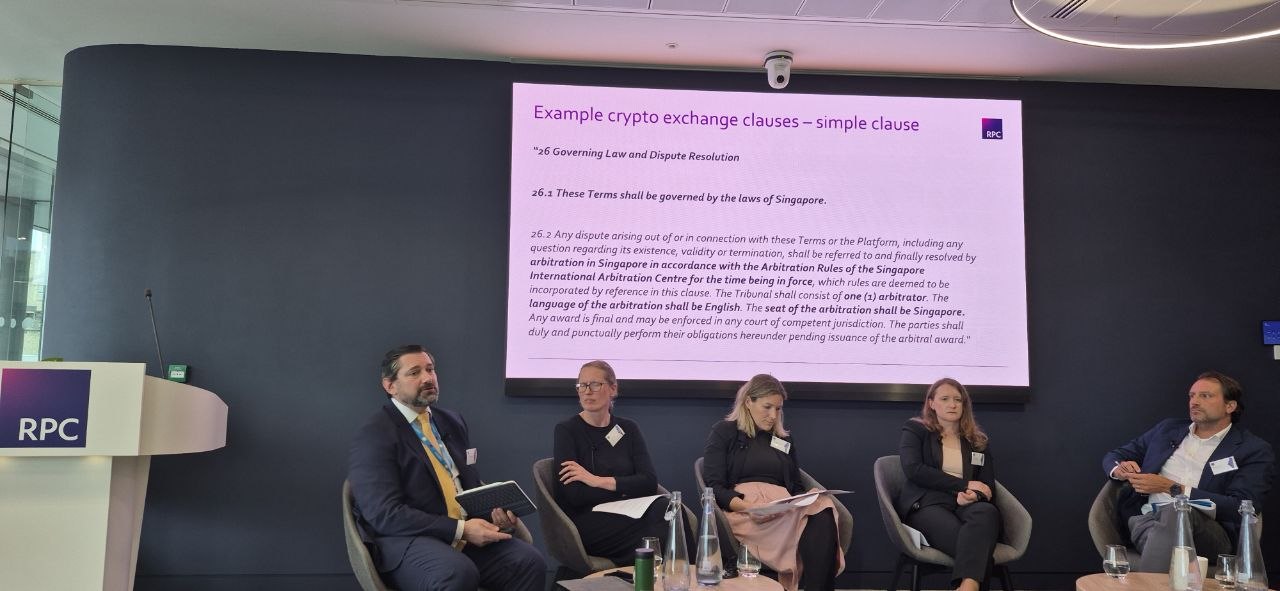
Drawing upon a series of anonymised examples, Mr. Crompton examined dispute-resolution clauses used by major cryptocurrency exchanges.
At one end of the spectrum were relatively conventional arbitration agreements providing for arbitration under established institutional rules, such as those of SIAC, with clearly defined governing laws, seats and procedural frameworks.
At the other end were significantly more aggressive provisions designed to minimise litigation risk for exchanges.
One such clause required disputes to proceed through a mandatory negotiation period before arbitration. More notably, it imposed strict limitations on collective proceedings, prohibiting class actions, representative actions, consolidated proceedings and arbitrations involving multiple claimants.
Additional provisions shortened limitation periods, imposed extensive confidentiality obligations and restricted the procedural options available to users.
According to Mr. Jonathan Crompton, these clauses reflect a broader effort by exchanges to avoid exposure to mass claims arising from market events, exchange failures or large-scale losses suffered by users.
He explained that the issue is becoming increasingly significant as regulatory authorities and courts begin to scrutinise the enforceability of such provisions. He further expressed that legislative developments in jurisdictions such as British Columbia and judicial decisions emerging from Canadian courts suggest that class-action waivers in crypto disputes may face increasing challenges.
The result, Mr. Crompton suggested, is likely to be a growing body of litigation concerning the interaction between arbitration agreements, consumer rights and collective redress mechanisms.
Poor Drafting, AI and Jurisdictional Confusion
Mr. Richard Brown noted that while some exchanges deliberately employ sophisticated dispute-resolution provisions, others suffer from the opposite problem.
Many agreements, he observed, appear to have been copied from unrelated precedents, assembled from multiple templates or generated with limited legal oversight. In some instances, a single commercial relationship may be governed by multiple agreements containing inconsistent governing-law clauses and conflicting dispute-resolution provisions.
The result is uncertainty regarding where proceedings should be commenced and which legal framework should apply.
Such inconsistencies can create substantial opportunities for jurisdictional challenges and procedural disputes before the substantive merits of a claim are ever considered.
Although these issues have undoubtedly contributed to delays and inefficiencies, Mr. Brown expressed optimism that drafting standards are improving as the industry matures and more sophisticated legal advisers become involved in structuring digital-asset businesses.
Offshore Structures and the Growth of Crypto Arbitration
The discussion also considered the role of offshore jurisdictions in the development of digital-asset disputes.
Mr. Brown noted that while the British Virgin Islands International Arbitration Centre has not yet seen the volume of crypto arbitrations some originally anticipated, this should not be mistaken for a lack of activity involving BVI entities.
He clarified that many disputes involving BVI companies are currently being resolved through arbitrations seated in London, Hong Kong or Singapore under institutional frameworks such as LCIA, HKIAC and SIAC.
Nevertheless, the BVI’s courts and government continue to maintain a strongly pro-arbitration stance, and Mr. Brown predicted that the use of BVI-based arbitration for digital-asset disputes is likely to increase as the sector continues to mature.
Arbitrator Expertise and Technical Complexity
A recurring theme throughout the discussion was the importance of technical expertise.
Ms. Anne-Marie Hitchin explained that although arbitrators are becoming increasingly familiar with blockchain technology and digital assets, many disputes still require significant educational components.
Experts are frequently called upon to explain how blockchain systems operate, how transactions are recorded and how particular technologies function before tribunals can properly assess the evidence before them.
This educational process is not unique to crypto disputes, but the speed with which the underlying technology evolves means that tribunals must often grapple with concepts that remain unfamiliar even to experienced practitioners.
Mr. Jonathan Crompton illustrated the point by referring to a dispute involving a shareholder who claimed to have lent a company 300 Bitcoin at a time when Bitcoin traded at only a few hundred dollars per coin. By the time the dispute emerged, the value of the alleged loan had increased exponentially.
Such disputes, he observed, raise questions that rarely arise in conventional commercial litigation, including whether directors should have exposed businesses to such extraordinary levels of digital-asset risk in the first place.
Speed, Quantum and the Challenge of Valuation
The discussion then turned to what many participants regarded as one of the defining features of digital-asset disputes: volatility.
While confidentiality, flexibility and neutrality remain important attractions of arbitration, Ms. Anne-Marie Hitchin suggested that speed may ultimately be the feature most valued by participants in the digital-asset sector.
Unlike many traditional commercial disputes, the value of digital assets can fluctuate dramatically over relatively short periods of time. During the lifespan of a dispute, a claim may increase or decrease substantially in value, creating significant uncertainty for parties and tribunals alike.
Ms. Hitchin referred to a recent matter in which Bitcoin’s value increased from approximately US$60,000 to more than US$100,000 during the course of proceedings. Such fluctuations, she explained, can materially alter the economic value of a claim and complicate the assessment of damages.
From a valuation perspective, she explained, digital-asset businesses often share many characteristics with conventional businesses. Questions concerning revenue generation, growth prospects, business models and risk remain central. However, the volatility of the underlying assets frequently requires experts to move beyond traditional valuation methodologies and adopt multiple probability-weighted scenarios.
In many respects, valuing digital-asset ventures resembles venture-capital analysis more closely than conventional corporate valuation. Assessments often involve evaluating a range of possible outcomes and assigning probabilities to each, rather than arriving at a single definitive valuation.
For this reason, the panel repeatedly returned to the importance of expedited procedures. By shortening the period between the commencement of proceedings and the issuance of an award, arbitration can reduce the distortive effects of market volatility and provide outcomes that more closely reflect the commercial realities the parties originally confronted.
Ms. Rebecca Warder explained that the LCAM blockchain arbitration scheme was deliberately designed with this objective in mind. The framework aims to deliver awards within approximately four months of the appointment of the arbitrator, an ambitious target that necessarily requires procedural compromises.
According to Ms. Warder, many participants in the digital-asset sector are willing to accept such compromises in exchange for speed and certainty. A rapid outcome, even one achieved through a streamlined procedure, is often considered preferable to a prolonged process conducted against the backdrop of significant market fluctuations.
Mr. Jonathan Crompton observed that clients frequently profess a desire for speed at the outset of a dispute, only to become more interested in procedural safeguards once those shortcuts begin to affect their own position. Nevertheless, he agreed that expedition remains a critical consideration in digital-asset disputes.
Ms. Hitchin acknowledged that accelerated proceedings can create practical difficulties, particularly where financial records are incomplete or unreliable. Reconstructing historical transactions, identifying ownership structures and analysing blockchain data frequently require substantial time and resources. Yet the need for speed often forces parties and tribunals to focus on the issues that matter most.
Valuing SAFTs and Future Tokens
The conversation then moved to one of the most difficult valuation questions currently confronting practitioners: how should Simple Agreements for Future Tokens (SAFTs) be valued when the promised tokens have never been issued?
Ms. Anne-Marie Hitchin explained that no universal methodology exists. The answer depends heavily upon the specific characteristics of the project, its commercial prospects, its risk profile and its likelihood of generating value in the future.
Drawing on her experience, she noted that many digital-asset businesses receive payments in newly launched tokens whose market value is highly uncertain at the time of receipt. In such circumstances, valuation exercises often require multiple scenarios reflecting different assumptions regarding future performance.
Transparency is therefore essential. Experts must clearly explain the assumptions underpinning their analyses, the risks they have identified and the extent to which alternative outcomes may affect valuation conclusions.
Mr. Richard Brown observed that many SAFT disputes never reach a hearing. In numerous cases, projects fail to launch or never issue the promised tokens, leaving investors attempting to recover losses from entities that may have little more than a website, a white paper and an unrealised business plan.
The scarcity of decided cases has resulted in a significant lack of precedent. As courts and tribunals begin to confront these disputes more frequently, their decisions are likely to play an important role in shaping the future treatment of digital-asset investments.
Ms. Hitchin added that the absence of reliable comparators further complicates valuation exercises. Thousands of token projects have been launched over the past decade, yet only a small percentage have achieved meaningful commercial success. Determining which projects are genuinely comparable often proves exceptionally difficult.
Mr. Crompton noted that, from the client’s perspective, these questions ultimately come down to a simple commercial calculation: how much can realistically be recovered, and at what cost? Volatility, uncertainty and enforcement risk make those questions significantly harder to answer in the digital-asset context than in more traditional disputes.
Digital Assets and Investment Arbitration
The discussion then shifted from commercial disputes to investment arbitration, an area that has received comparatively little attention in discussions concerning digital assets.
Ms. Mihaela Apostol observed that most commentary on crypto-related disputes focuses on commercial arbitration, despite the growing potential for investor-State claims involving digital assets.
As an example, she highlighted the ongoing case of Nexo v Bulgaria3, which arises out of actions taken by Bulgarian authorities in relation to the cryptocurrency lending platform Nexo.
According to Ms. Apostol, the claim concerns allegations that a criminal investigation initiated by the Bulgarian authorities caused substantial reputational harm, disrupted business opportunities and impaired the company’s ability to raise capital. The proceedings have already generated complex jurisdictional questions concerning the existence of a protected investment and the continued operation of the relevant bilateral investment treaty.
More broadly, she suggested that digital assets challenge several foundational concepts of investment arbitration.
One such question is whether cryptocurrencies and related digital assets qualify as investments at all. Utility tokens, speculative tokens and stablecoins may each require different treatment depending upon their characteristics and economic function.
Another challenge concerns the traditional requirement that investments contribute to the economic development of the host State. Establishing a sufficient territorial connection may prove difficult where assets exist on decentralised networks and business activities span multiple jurisdictions simultaneously.
Ms. Apostol also pointed to evolving treaty practice and domestic legislation. Switzerland’s Distributed Ledger Technology framework, for example, grants legal recognition to tokenised assets in a manner that may provide greater certainty for future investment disputes.
At the same time, digital assets are forcing tribunals to reconsider established concepts such as expropriation, fair and equitable treatment and full protection and security. Questions concerning cyberattacks, platform restrictions, forced disclosure requirements and limitations on digital-asset activities may increasingly become subjects of investor-State claims.
In her view, the emergence of digital assets is not simply creating new disputes; it is prompting a re-examination of some of the most fundamental principles of investment arbitration.

Property Rights, Volatility and the Problem of Remedies
Building on those themes, Mr. Jonathan Crompton highlighted the practical difficulties that arise when disputes involving digital assets proceed through lengthy legal processes.
Referring to the well-known Gatecoin liquidation in Hong Kong, he noted that the dispute unfolded during a period in which Bitcoin’s value changed dramatically. By the time key judicial decisions were issued recognising cryptocurrency as a form of property, the value of the relevant assets had increased many times over.
This creates a fundamental question that should claimants receive the cryptocurrency itself, or should they receive monetary compensation reflecting its value at a particular point in time? The answer can have enormous financial consequences.
Some claimants prefer the return of the underlying asset, believing it will continue to appreciate in value. Others prefer a monetary award that crystallises their recovery immediately. For courts and tribunals, determining the appropriate remedy remains one of the most difficult issues arising in digital-asset disputes.
Asset Tracing, Enforcement and Recovery
The final portion of the discussion focused on a practical reality repeatedly encountered by practitioners in the field: obtaining a favourable decision is often only the beginning of the challenge.
During the audience discussion, participants highlighted a question frequently asked by clients: even if a claim succeeds, can the assets actually be recovered?
Ms. Anne-Marie Hitchin explained that asset tracing has become a central feature of many digital-asset disputes. Modern investigations frequently combine traditional forensic accounting techniques with blockchain analytics and digital forensic tools.
In one matter involving incomplete records, investigators were able to identify hundreds of additional wallets by combining known wallet information with on-chain and off-chain data. Nevertheless, tracing becomes considerably more difficult once assets move through mixers, exchanges or other intermediaries.
Mr. Jonathan Crompton emphasised the importance of acting quickly. Digital assets can be transferred across jurisdictions almost instantaneously, and by the time evidence is assembled and applications for relief are made, the assets may already have disappeared.
Addressing enforcement, Mr. Richard Brown explained that recovery may be relatively straightforward where assets remain within identifiable exchanges or regulated intermediaries. Greater difficulties arise when assets are held in private wallets or under the direct control of individuals.
In such cases, injunctions, disclosure orders and freezing relief often become critical tools.
The panel also discussed Hong Kong’s much-publicised “tokenised injunctions”. Mr. Crompton observed that the term can be misleading. These orders do not freeze assets simply by virtue of being recorded on a blockchain. Rather, they involve the service of court orders through blockchain mechanisms, providing notice to those interacting with particular wallets.
While innovative, such measures are not a substitute for conventional enforcement tools. Ultimately, the most effective strategy remains identifying and securing assets before they can be moved.
Responding to questions concerning beneficial ownership and offshore structures, Mr. Brown noted that regulators and law-enforcement agencies increasingly possess sophisticated tools for investigating digital assets. However, their objectives are not necessarily aligned with those of private litigants.
As a result, he emphasised, parties often remain dependent upon civil tracing remedies and court-ordered disclosure processes when seeking to identify individuals connected with digital-asset structures.
Conclusion
Throughout the discussion, a recurring theme was the tension between the decentralised nature of digital assets and the structured framework of legal dispute resolution. While cryptocurrencies and blockchain-based projects are often designed to operate without traditional intermediaries, disputes arising from those ecosystems continue to require mechanisms capable of delivering certainty, procedural fairness and enforceable outcomes.
The panellists broadly agreed that arbitration remains particularly well suited to addressing many of the challenges posed by digital-asset disputes. Its flexibility allows parties to tailor procedures to rapidly evolving technologies, while its confidentiality, neutrality and international enforceability offer significant advantages over many domestic court systems. Equally important is arbitration’s ability to accommodate specialist expertise, an increasingly valuable feature as disputes become more technically complex.
At the same time, the discussion highlighted that arbitration cannot remain static. The growth of crypto-related disputes is already encouraging institutions to rethink traditional procedural assumptions, including how notice may be served, how anonymity can be preserved, how specialist tribunals should be constituted and how awards might be enforced in a digital environment. Initiatives such as blockchain-based arbitration schemes, on-chain enforcement mechanisms and expedited procedures demonstrate that innovation is occurring not only within the digital-asset industry itself, but also within the systems designed to resolve disputes arising from it.
The session also underscored a practical reality that continues to confront parties involved in digital-asset disputes: obtaining a favourable award is often only part of the challenge. Asset tracing, recovery and enforcement remain central concerns in a world where value can move across jurisdictions within seconds and where ownership structures are frequently opaque. Questions of valuation are equally complex, particularly where assets may experience dramatic fluctuations in value over the course of a dispute.
As regulatory frameworks mature and digital assets continue to gain commercial significance, the volume and sophistication of crypto-related disputes are likely to increase. The panel’s discussion suggested that the future of crypto arbitration will not be determined by whether arbitration remains relevant, but by how successfully it adapts to the technological and commercial realities of a rapidly evolving digital economy.
The session provided a compelling illustration of how developments in digital assets are increasingly shaping the evolution of international dispute resolution itself. As arbitration continues to confront issues of decentralisation, digital ownership, technological complexity and cross-border enforcement, many of the innovations currently emerging in crypto disputes may ultimately influence the future direction of arbitration more broadly.
This report forms part of SCC Times’ special coverage of London International Disputes Week (LIDW) 2026. As a Media Partner for the event, SCC Times is reporting key conversations across the conference, highlighting emerging trends and perspectives from the international dispute resolution community.
SCC Times extends its appreciation to Zehra Naqvi, EBC—SCC Online Foreign Student Ambassador and Lawyer, for her on ground presence, valuable assistance and contribution to the reporting of this event.
Read more LIDW 2026 Coverage:
1. LCAM Blockchain Expedited Arbitration Rules, December 9, 2024
2. United Nations Convention on the Recognition and Enforcement of Foreign Arbitral Awards, New York, 10 June 1958
3. ICSID Case No. ARB/24/2