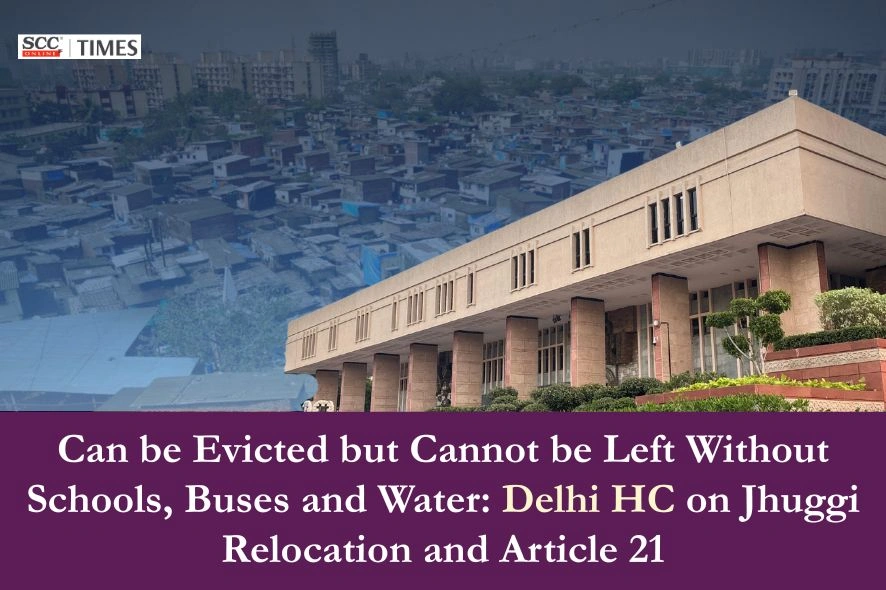
Delhi High Court: In the bunch of petitions arising from the proposed eviction and rehabilitation of residents of “Juggis and JJ Bastis” at Bhai Ram Camp, DID Camp, and Masjid Camp in Delhi and to Economically Weaker Section (EWS) flats at Savda Ghevra, Delhi on the ground that the relocation violated their rights under Article 21 of the Constitution and was contrary to the Delhi Urban Shelter Improvement Board Rehabilitation Policy, 2015 (DUSIB Policy) and the Draft Protocol for removal of Jhuggis and JJ Bastis in Delhi (DUSIB Protocol), the Single-Judge Bench of Purushaindra Kumar Kaurav,* J., upheld the Relocation of “Jhuggis and JJ Bastis” Residents to EWS Flats at Savda Ghevra, holding that mere eviction and rehabilitation at alternative accommodation would not violate the petitioners’ fundamental right to shelter and livelihood under Article 21 as long as the their interests were secured as per the mandate of DUSIB Policy and Protocol.
Factual Matrix
The petitioners in both matters were residents of Bhai Ram Camp, DID Camp, and Masjid Camp. The lead petition filed by 29 petitioners originally challenged the eviction notice dated 29 October 2025 through which the petitioners were directed to vacate the camps without any rehabilitation arrangement. Subsequently, during the pendency of proceedings, the authorities decided to rehabilitate the residents at Savda Ghevra and issued notices dated 19 February 2026 and 27 February 2026 directing eligible residents to obtain allotment letters for EWS flats. This later decision became the subject matter of challenge in the connected petition.
On 13 November 2025, the Court issued notice and directed that the petitioners should not be evicted without adherence to the procedural safeguards prescribed by the Supreme Court in Directions in the matter of demolition of structures, In Re, 2024 SCC OnLine SC 3291.
During the pendency of proceedings, the High-Powered Committee (Committee) constituted pursuant to directions issued in Court on its own motion v. Union of India, W.P. (C) 9470/2022, decided on 18 September 2023, approved rehabilitation of the residents at Savda Ghevra in its 4th meeting held on 29 January 2026. The Committee had been created for streamlining utilisation and allotment of housing units constructed under various government schemes.
When the matters were listed on 3 March 2026, the petitioners submitted that they were being compelled to vacate by 6 March 2026 without compliance with the safeguards mandated in Re: Directions (supra). The Court extended the time for vacating till 11 March 2026 while observing prima facie that the offer of alternative accommodation diluted the allegation of arbitrary eviction.
The matters were thereafter heard extensively on several dates in March and April 2026. The respondents filed additional applications placing on record the minutes of the DUSIB meeting dated 9 April 2026 granting formal approval to the rehabilitation exercise and the notice dated 8 April 2026 convening the said meeting. Since the petitioners did not oppose bringing these documents on record and the documents related to subsequent developments, the Court allowed the applications.
Issues for determination
-
Whether the impugned action violated the petitioners’ rights under Article 21?
-
Whether the rehabilitation exercise was contrary to law or government policy?
Analysis
-
Violation of Article 21
The Court recorded the petitioners’ contention that their families had lived in the camps for generations, had built their livelihood and educational arrangements around the locality and relocation to Savda Ghevra would jeopardise their employment and education.
The respondents, in reply, highlighted that the civic amenities were already available at the rehabilitation site including sewer lines, water supply, roads, parks, and municipal facilities. However, the Court noted that these amenities did not adequately answer the petitioners’ concerns regarding livelihood and education.
The Court reiterated that “the right to life under Article 21 of the Constitution of India does not connote mere animal existence but envisages a right to lead life with dignity”. It relied on Olga Tellis v. Bombay Municipal Corpn., (1985) 3 SCC 545, wherein it was held that the right to livelihood is intricately connected to the right to life under Article 21 and Shantistar Builders v. Narayan Khimalal Totame, (1990) 1 SCC 520, wherein it was emphasised that shelter for a human being is not mere protection of the body but suitable accommodation allowing physical, mental, and intellectual growth.
Reference was also made to Chameli Singh v. State of U.P., (1996) 2 SCC 549 and Ahmedabad Municipal Corpn. v. Nawab Khan Gulab Khan, (1997) 11 SCC 121, where the Supreme Court recognised the constitutional duty of the State to provide shelter to economically weaker sections.
The Court discussed Sudama Singh v. State (NCT of Delhi), 2010 SCC OnLine Del 612, pursuant to which, the DUSIB Policy and DUSIB Protocol were framed and Ajay Maken v. Union of India, 2019 SCC OnLine Del 7618, held that the right to housing is a bundle of rights including livelihood, education, health, water, sanitation, and transport facilities. Residents of jhuggi bastis are not to be viewed merely as illegal occupants but as rights-bearing citizens entitled to constitutional protection.
The Court held that “lack of adequate shelter is bound to affect a person’s livelihood” and inadequate rehabilitation lacking basic facilities such as transport, education, sanitation, and clean drinking water would adversely affect the petitioners’ right to life.
The Court examined Clause 6D(vii) DUSIB Protocol which obligates DUSIB to coordinate with educational authorities, health services, transport agencies, and other departments to ensure proper facilities at rehabilitation sites. It concluded that if these obligations were complied with, the petitioners’ concerns would be substantially mitigated and their Article 21 rights would remain protected.
-
Violation of Law/Government Policy
The Court asserted that the directions issued in Re: Directions (supra) were inapplicable to the present case. It was noted that the Supreme Court itself had clarified that its directions would not apply to unauthorised structures situated on public places such as roads, streets, footpaths, railway lines, or water bodies.
The Court observed that the petitioners were residents of jhuggi jhopri bastis and that Section 2(f) of the DUSIB Act specifically defined “jhuggi” as a structure not duly authorised by the local authority and not conforming to land use norms. Thus, the petitioners were unauthorised occupants within the meaning of the statute.
The Court further noted that judgment in Re: Directions (supra) concerned punitive demolitions connected with criminal allegations, whereas the present eviction was undertaken for rehabilitation and clearance of land for strategic and public purposes. Consequently, it held that the procedural requirements of that judgment were inapplicable.
The Court rejected the petitioners that the action was initiated at the instance of the Land and Development Office (L&DO) despite the land allegedly belonging to the Army and Air Force. It noted that the L&DO’s supplementary affidavit stated that the land belonged to the Union Government through L&DO, while defence establishments were merely lessees or allottees. The Court stated that the unsigned and undated document relied upon by the petitioners regarding ownership of the clusters lacked authenticity and could not override the categorical stand of the respondents.
On the issue of non-compliance with the DUSIB Protocol, the Court acknowledged that the survey had not been conducted by DUSIB itself and that certain procedural requirements had not been strictly followed. However, no prejudice had been caused because all petitioners had ultimately been declared eligible for rehabilitation. It also rejected objections concerning the computerized draw of lots conducted without representatives of the petitioners, observing that no prejudice could be inferred from absence of representation in an automated process.
Importantly, the Court noted that 192 dwellers had accepted allotment letters and 136 had already taken possession of the allotted flats and applied for electricity connections. Reversal of the process at that stage would adversely affect those residents who had accepted rehabilitation.
Relying on Chandra Singh v. State of Rajasthan, (2003) 6 SCC 545, the Court reiterated that exercise of writ jurisdiction under Article 226 is discretionary and courts are required to balance equities while considering relief.
Regarding in-situ rehabilitation, the Court examined Clause 2(iii), DUSIB Policy which permits rehabilitation beyond 5 kilometres in exceptional circumstances with prior approval of DUSIB. The respondents had explained that no rehabilitation site or constructed housing units were available within a five-kilometre radius and therefore relocation to Savda Ghevra had become necessary. The Court accepted this explanation and referred extensively to the additional affidavit and DUSIB agenda documents explaining the administrative background, the impact of the COVID-19 pandemic, the Affordable Rental Housing Complex policy, and the decisions of the High Powered Committee.
The Court also found that the objection regarding lack of formal DUSIB approval had been cured by the DUSIB meeting held on 9 April 2026 granting ratification and formal approval to the rehabilitation exercise.
-
National Security Considerations
The Court accepted the respondents’ justification that eviction was necessary as the jhuggi clusters were situated adjacent to operational defence installations and that continued occupation posed risks to national security and public safety.
The relied on Ex-Armymen’s Protection Services (P) Ltd. v. Union of India, (2014) 5 SCC 409, wherein it was stated that questions concerning national security are matters of executive policy and ordinarily not amenable to judicial substitution of opinion.
The Court observed that in contemporary geopolitical circumstances the national security concerns articulated by the respondents constituted sufficient justification for clearing the area adjoining defence establishments. It further held that courts should not interfere with executive policy decisions unless tainted by mala fides, arbitrariness, or unreasonableness.
The Court additionally noted that the Union Government had relaxed the beneficiary contribution payable under the DUSIB Policy and had granted 3 months’ time for payment of maintenance charges, thereby easing the financial burden on the petitioners.
Decision
The Court held that the petitioners have fundamental rights to shelter and livelihood under Article 21 of the Constitution and these rights are intricately connected to the fundamental right to life and any violation of one of them would generally entail violation of all of them. However, “their mere eviction and rehabilitation at alternative accommodation would not violate the said rights as long as the interests of the petitioners are secured as per the mandate of DUSIB Policy and Protocol.”
The Court further held that although the respondents had not strictly adhered to every procedural requirement under the DUSIB framework, no prejudice had been caused to the petitioners because all residents had ultimately been made eligible for rehabilitation and several deficiencies had already been rectified.
Accordingly, the Court disposed of the petitions with the following directions:
-
The respondents were directed to ensure compliance with the DUSIB Policy and Protocol, particularly with respect to education, transport, water supply, sanitation, and allied civic amenities at the rehabilitation site.
-
The respondents were bound by their undertaking relaxing the beneficiary contribution payable by the residents.
-
Petitioners who had not yet accepted allotment letters were directed to obtain the same immediately after verification and take possession of the allotted flats.
-
The petitioners were directed to vacate the existing camps within fifteen days, failing which the respondents would be at liberty to take action in accordance with law.
-
Liberty was granted to the petitioners to initiate fresh proceedings if the respondents failed to fulfil the obligations that are directed in the judgment.
[Khushnuma Khan v. Union of India, 2026 SCC OnLine Del 3265, decided on 11-5-2026]
Advocates who appeared in this case:
Mr Pankaj Sinha, Ms Garima, Mr. Sunil Tiwari, Counsel for the Petitioners
Mr.Chetan Sharma ASG, Mr. Syed Abdul Haseeb CGSC With Ms.Nasreen Khatoon G.P for Union Of India and Mr. Muhammad Aamir Khan and Mr. Syed Abdur Rahman, Mr Piyush Gupta CGSC, Mr Atishay Jain, Mr. Vishesh Goel for UOI. Mr. Shrey Sharawat, SPC, along with Mr. Himanshu Sihag, Counsel for the Respondents 1 and 2
Mr. Anuj Chaturvedi, Ms. Richa Dhawan, Ms. Yashita Jain (Advocates) with Sh. P. K. Jha (Principal Director) and Pranav Siroha (LA), Counsel for DUSIB.
Ms. Meenakshi, Counsel for DUSIB.
Buy Constitution of India HERE