Disclaimer: This has been reported after the availability of the order of the Court and not on media reports so as to give an accurate report to our readers.
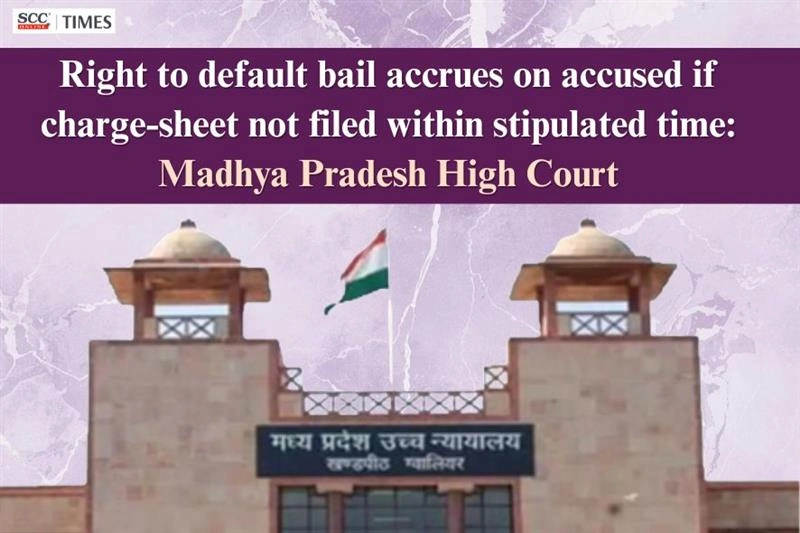
Madhya Pradesh High Court: In a criminal revision filed by a man whose default bail was denied by the trial court, the Single Judge Bench of Dwarka Dhish Bansal, J., allowed the petition, holding that the petition was maintainable and deserved to be allowed. The Court held that if the Court is closed on the last day of filing a charge-sheet, and the charge-sheet is filed on the 61st day or any other later/subsequent day, then default bail can be granted.
Background
As per the prosecution’s story, the accused and his co-accused were found in possession of 4632.80 grams of hydroponic cannabis (ganja) while travelling in a train. Accordingly, they were arrested as per Section 42, Narcotic Drugs and Psychotropic Substances Act, 1985 (NDPS Act) under Sections 8(c), 20(b)(ii)(B), 28, 29, 35 and 54, NDPS Act. They were remanded the next day.
The accused applied for default bail under Section 187(2), Nagarik Suraksha Sanhita, 2023 (BNSS), but it was rejected by the trial court. Hence, the present revision petition.
Analysis
Noting the facts, the Court stated that as per Section 187(3)(ii) BNSS, the charge-sheet was to be filed within 60 days from the date of remand, i.e., 3 November 2025. Undisputedly, the challan was filed on 5 January 2026, and before that, on the same day, the application for the grant of default bail was filed. As per the calculation of the Court and after including the date of remand, it would be completed on 1 January 2026.
The Court further noted that due to winter vacation, the courts were closed from 1 January 2026 to 4 January 2026, i.e., the courts reopened on 5 January 2026. Under Section 36-A(c) and (d), NDPS Act, despite holidays, a challan could have been filed before the Magistrate available on remand duty, but the charge-sheet was filed before the Special Court on 5 January at 1.00 p.m.
The Court held that even though the courts were closed from 1 to 4 January, these days could not be excluded from the period of 60 days. Thus, the 60th day would be 1 January, and upon filing the challan after 60 days at 1.00 p.m., the application for default bail filed at 12.30 p.m. could be allowed. The Court added that though the impugned order runs into single-spaced 6 pages, for the reasons best known to the trial court, this aspect was not considered in the impugned order. More so, the trial court has, on the oral prayer of the prosecution, condoned the delay in filing the challan/charge-sheet.
Thereafter, the Court relied on Raja Bhaiya Singh v. State of M.P., 2021 SCC OnLine MP 27, wherein it was held that the period for filing the challan will run from the date of the remand order, and “one day” will be complete on the next day of the remand. Therefore, the first date of remand will be excluded, but the last date will be included. It was also held that the last date, which is Sunday or a holiday, will be counted as the 90th day.
Regarding whether challan has to be filed before the Special Court only or it can be filed before the Remand/Duty Magistrate, the Court placed reliance on Rammu v. State of M.P.1, wherein a coordinate Bench held that at this stage, merits of the case are not to be considered and the bail is to be allowed to the accused, as termed by the Supreme Court, “bail on default” of the prosecution in failing to file the challan within 90 days as required under Section 167, Criminal Procedure Code, 1973 (CrPC), i.e., Section 187 BNSS. The coordinate Bench also reiterated that the challan need not be filed in the Court, it could be filed before the Magistrate, and the prosecution cannot claim the benefit of the 90th day being a holiday.
The Court also referred to Ashok Sharma v. State of M.P.2, wherein the coordinate Bench reiterated that Section 10(1), General Clauses Act, 1897, is not attracted to the provisions of Section 167(2) because these provisions do not contain any prescribed period for the filing of a charge-sheet by the police.
As to whether the date of remand has to be included in the 60 days or not, the Court referred to Chaganti Satyanarayana v. State of A.P., (1986) 3 SCC 141, wherein the Supreme Court held that the stipulated 60- or 90-day remand period under Section 167 CrPC ought to be computed from the date when a Magistrate authorises remand. If the first day of remand is excluded, the remand period will extend beyond the permitted 60/90 days’ period, resulting in unauthorised detention beyond the period envisaged under Section 167 CrPC.
The Court relied on Subhelal v. State of Chhattisgarh, (2025) 5 SCC 140, wherein the Supreme Court held that default bail can be granted irrespective of the nature of the offence. The Supreme Court stated that Section 167(2)(a)(i) and (ii) of the Code provide for the grant of bail if a charge-sheet is not filed within the stipulated time. The provision is aimed at the expeditious conclusion of the investigation. It also protects the liberty of an accused where the investigating agency fails to conclude the investigation and file a charge-sheet within a stipulated time. The legislature has deemed it proper to protect his interest by awarding him a right of bail, irrespective of the nature of the offence, if the charge-sheet is not filed within the stipulated time-limit. That right is absolute and indefeasible.
The Court remarked that, surprisingly, despite being a Special Judge of the NDPS Court, the trial Judge did not spare any time to peruse/follow the aforesaid settled and binding legal position and, on extraneous reasons, dismissed the application for grant of default bail, despite accrual of an indefeasible right to the accused due to non-filing of charge-sheet within the stipulated period.
Decision
In the light of the aforesaid factual and legal scenario, the Court held as follows:
(i) Where the last day, which is Sunday or a holiday, will be counted in the 60th day.
(ii) Date of remand will be included in the period of 60 days, and provisions of the General Clauses Act or the Limitation Act, 1963, would not apply to Section 187 BNSS, hence no question arises for condonation of delay.
(iii) If there is a holiday, i.e., the Court is closed on the last day of filing the charge-sheet, and the charge-sheet is filed on the 61st day or any other later/subsequent day, then default bail can be granted.
(iv) Even if the Court was closed from the 60th to the 64th day, filing of a charge-sheet on the 61st or 64th day can be considered as a non-compliance of the mandatory provision under Section 187(3)(ii) BNSS.
(v) To avoid non-compliance with the aforesaid mandatory provision, and further with a view to maintaining the dignity of the prosecution, a charge-sheet can be submitted before a Remand/Duty Magistrate.
(vi) If the accused is prepared to furnish bail as ordered and does furnish bail, even an oral application for the grant of default bail before a Remand/Duty Magistrate is sufficient.
(vii) If an accused is entitled to default bail, then, irrespective of the merits and demerits of the case, he deserves to be granted default bail.
Thus, the Court held that the impugned order passed on the default bail application was not an interlocutory order, the instant criminal revision was maintainable and deserved to be allowed.
Accordingly, the Court allowed the revision and directed the release of the accused on furnishing a bail bond of Rs 50,000 with one solvent surety of the like amount to the satisfaction of the trial court for his regular appearance, and he shall also abide by the conditions enumerated under Sections 437(3) CrPC/480(3) BNSS.
[Armaan Hussain v. Union of India, 2026 SCC OnLine MP 6299, decided on 15-4-2026]
Advocates who appeared in this case:
For the petitioner: Divyansh Soni
For the respondents: Vidhan Mishra and Hritik Dubey
1. (1993) 2 MPWN 66.
2. 1993 JLJ 99.