Disclaimer: This has been reported after the availability of the order of the Court and not on media reports so as to give an accurate report to our readers.
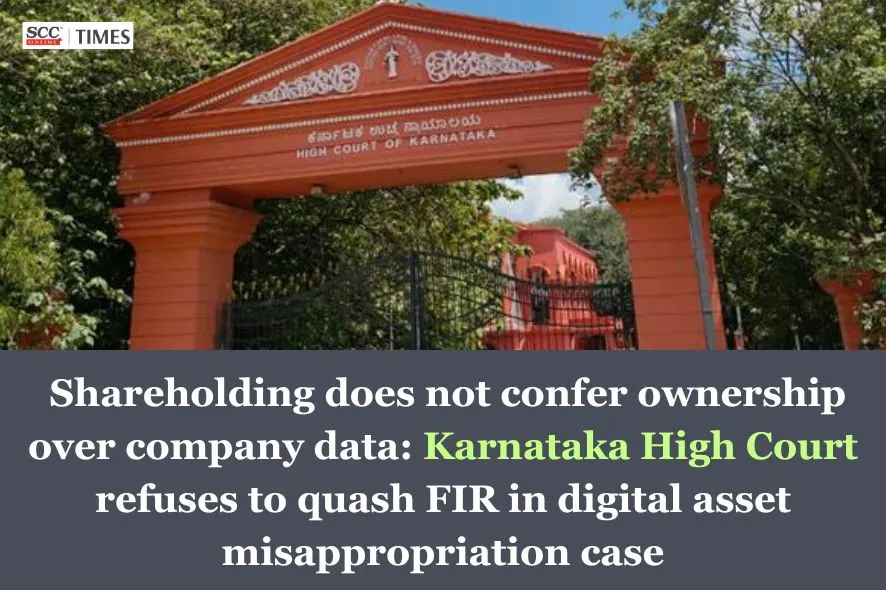
Karnataka High Court: In a petition filed under Section 528, Nagarik Suraksha Sanhita, 2023 (BNSS) seeking quashment of FIR against the petitioner, alleged whistleblower, registered by Respondent 1, for the offences under Sections 65 and 66, Information Technology Act, 2000 (IT Act) and Sections 316 and 318(4), Nyaya Sanhita, 2023 (BNS), a Single Judge Bench of M. Nagaprasanna, J., held that the assets of a company are not confined to physical or movable property, they extend to data, code and intellectual propriety and such digital assets, no less than physical ones, are owned exclusively by the Company.
The Court stated that the petitioner by virtue of his shareholding, does not possess ownership over the entirety of the Company’s data. Thus, the Court dismissed the said petition.
Background
In the present case, a company was engaged in the domain of quantitative trading, wherein it leveraged advanced mathematical models, statistical techniques, and data-driven strategies to develop proprietary trading algorithms. The petitioner claimed that he was one of the founding members of the company as well as well adirector, promoter, and shareholder in the said Company.
Two other Directors along with the petitioner were founder directors and equal shareholders, one of whom was Respondent 2. The petitioner stated that in collaboration with the other two Directors, he had jointly conceived and established the Company with a shared vision and mutual understanding, as all three of them were close friends at one point in time.
In 2018, all three Directors enter into identical employment agreements and were appointed/continued as Directors of the Company for remuneration. The petitioner stated that there were no formal working hours for these Directors and around June 2024, disputes arose between the founder Directors of the Company owning various conflicts and disagreements among them. The other two Directors, one being the complainant Respondent 2, allegedly tried to remove the petitioner from the control and management of the Company.
Therefore, the petitioner projected himself to be a whistleblower giving out misdoings of the Company to the respective authorities where he began to complain to the Registrar of Companies, Securities and Exchange Board of India (SEBI) and other regulatory organisations. Respondent 2, one of the founder Directors, alleged several acts of the petitioner to have become ingredients of cheating and criminal breach of trust.
Aggrieved, the petitioner approached the High Court. A coordinate Bench granted an interim stay order which continued to remain in force, and Respondent 2 filed an application seeking its vacation.
Issues, Analysis and Decision
Whether a complaint alleging theft of data against a Director or shareholder was maintainable in law?
The Court stated that the complaint articulated grave allegations against the petitioner. Further, the Court noted that though he was involved in medium frequency trading, the petitioner surreptitiously extended his reach into the domains of high frequency trading and infrastructure verticles, areas which were beyond his authorised limit. It was asserted that the said codes were distinct, confidential, compartmentalised within the Company’s operational architecture and the petitioner’s alleged intrusion into the domains, without requisite approval, was said to have breached both protocol and trust.
Considering the allegation that that the petitioner had deliberately and unauthorisedly altered critical parameters of trading models, thereby inflicting financial detriment upon the Company, the Court opined that what aggravated the gravity of the allegation was the assertion that an attempt to efface traces of such conduct, the petitioner systematically deleted system logs across multiple servers. The said logs were repositories of operational history, constituted proprietary and confidential data of the Company.
Regarding the petitioner’s argument that since he was a Director and shareholder, the data belonged to him, and therefore the allegation of theft was incorrect, comparing it to a father being accused of kidnapping his own child, the Court stated that though creative, it did not withstand legal scrutiny and rejected the same. Further, the Court stated that “to accept the proposition that each shareholder may lay claim to the Company’s assets would lead to juridical chaos, eroding the very edifice of corporate personality”.
The Court observed that in the case at hand, the petitioner and the complainant were equal shareholders, yet such parity did not translate into proprietary entitlement over the Company’s assets. Thus, the contention that the petitioner, by virtue of his shareholding, possessed ownership over the Company’s entire data was wholly misconceived.
The Court further stated that in the contemporary digital age, the assets of a company are not confined to physical or movable property as they extend, in significant measure to data, code and intellectual property and such digital assets, no less than physical ones, are owned exclusively by the Company. The Court, thus, held that the petitioner could not seek refuge in his status as a shareholder to negate the allegations of misappropriation.
Whether the factual matrix necessitated a full-fledged investigation or warranted obliteration of the alleged crime at the threshold?
The Court took into account the argument relied upon in Delhi Race Club (1940) Ltd. v. State of U.P., (2024) 10 SCC 690 that Sections 316 and 318(4) BNS could not co-exist and stated that while the principle stated in the said case is accepted, the facts differ from that of the present case. The Court clarified that that case arose from a private complaint before a Magistrate, not from an FIR under police investigation. The Court stated that in the case at hand, the complaint led to registration of an FIR, and the matter was still under investigation. The offences were applied based on the allegations in the complaint. Whether both offences would ultimately stand, or not after investigation, was a question to be decided later on. The Court opined that at the given stage, it would be premature and inappropriate to stop the investigation on the ground of overlap between offences. The Court stated that if the proceedings get quashed at the current stage due to any error by the police in applying multiple offences, the victim would be left without a remedy. Hence, the investigation should continue.
Regarding the petitioner’s argument that the Court should examine voluminous documents running into hundreds of pages, highlighting the complexity of the dispute, the Court held that such exercise fell within the role of the investigating agency and if the Court undertook the task, it would effectively turn these proceedings into a trial, which was not permissible. Further, the Court stated that “Where the case is enmeshed with serious disputed question of fact, the Court in exercise of its jurisdiction ought not to assume the role of investigating authority, except in exceptional cases.” Thus, the Court found it unacceptable to sift through extensive material and to render findings thereon.
The Court stated that an investigation could not be stopped merely because the matter was argued to be civil in nature or that the complainant should have approached a civil court. The present case was not purely civil as it involved elements of cybercrime, including allegations of downloading, copying, and deleting source code, proprietary data, and confidential digital assets. Such offences are technical and complex, often requiring forensic analysis. Therefore, the Court held that the petitioner’s attempt to portray the matter as trivial or purely civil could not be accepted.
Accordingly, the Court dismissed the petition.
[Aashay Harlalka v. State of Karnataka, 2026 SCC OnLine Kar 2164, decided on 25-3-2026]
Advocates who appeared in this case:
For the Petitioner: Suraj Sampath, Advocate
For the Respondent: B. N. Jagadeesha, Addl. SPP and Angad Kamath, Advocate