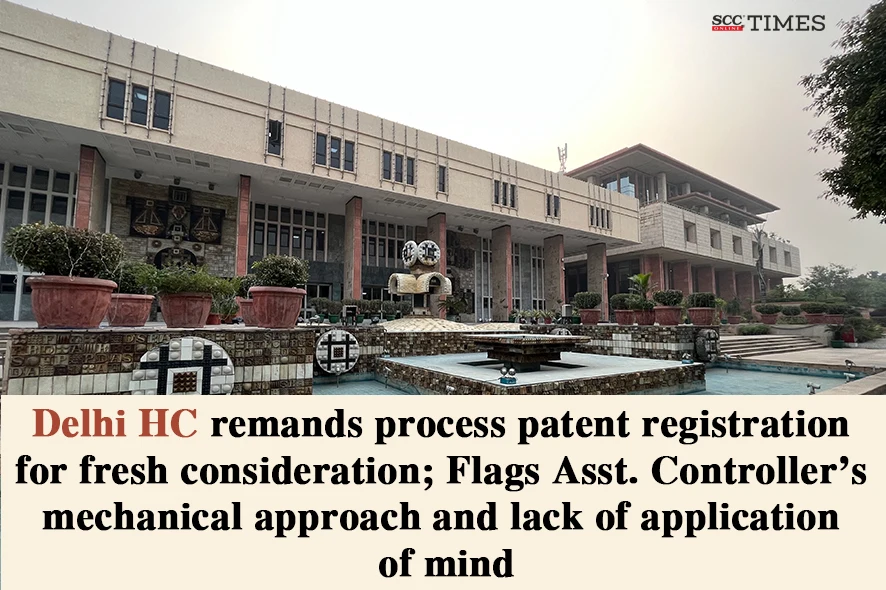
Delhi High Court: In the present case, a Letters Patent Appeal was filed against the judgement passed by the Single Judge upholding the order by the Assistant Controller of Patents and Designs (‘AC’), whereby the appellant’s application for registration of a process patent was rejected. The Division Bench of C. Hari Shankar* and Ajay Digpaul, JJ., stated that order passed by the AC gave rise to a legitimate grievance of the adoption of a mere mechanical approach, uninformed by any serious application of mind.
The Court stated that both the Single Judge, as well as the AC failed to notice that the process was not merely for recovering potassium sulphate, but also for recovering other valuable products from spent wash and the mere fact that potassium sulphate could be one of the products that finally emerged from the process that the appellant sought to patent couldn’t result in the two processes being the same. Accordingly, the Court set aside the impugned judgement and remanded the application back to the Controller General of Patents, Designs, and Trade Marks (‘Controller General’) for fresh consideration and determination.
Background
In the present case, the appellant filed an application for registration of a process patent, titled ‘Recovery of Potassium Sulphate and other valuable products from Spent Wash leading to ZLD System’. The aim of the said invention was recovery of potassium sulphate, magnesium sulphate, activated carbon and other value-added products, which could be used either as fuel or as cattle feed from the effluent from the molasses-based alcohol distillery, in such a manner as to attain zero liquid discharge.
A pre-grant opposition to the application was filed by the Council of Scientific and Industrial Research (‘CSIR’) opposing the application as being barred by Section 25(1)(b), 25(1)(e), 25(1)(f), 25(1)(g) and Section 3(d) of the Patents Act, 1970 (‘Patents Act’). In December 2021, the AC rejected the opposition of CSIR under Section 25(1)(b) and Section 25(1)(f) to the extent it asserted that the subject invention was not patentable in view of Section 3(a) and Section 25(1)(g), but upheld the opposition of CSIR under Section 25(1)(f) to the extent it asserted that the subject invention was not patentable in view of Section 3(d), and Section 25(1)(e). As a result, the AC rejected the application.
The appellant appealed under Section 117-A of the Patents Act to the Intellectual Property Division of this Court. However, it was dismissed by the Single Judge who found the subject invention to be non-patentable and lacking in inventive step. Aggrieved by the same, the appellant approached the present Court.
Analysis and Decision
The Court stated that an invention, to be patentable, should demonstrate an inventive step in its creation, vis-à-vis prior art and any product or process which was not ‘inventive’, or ‘obvious’, when compared to prior art, is ipso facto not patentable. This obviousness had to be examined from the mythical eye of a “person skilled in the art”. Unfortunately, there are no guidelines to steer this process, in the Patents Act and as a result, the Examiners in the office of the Controller General routinely decided such applications in a rule of thumb manner, purely based on their subjective opinions. The Court opined that this case was a classic illustration of the inherent perniciousness in such a system.
The Court expressing concern about the manner in which the AC decided the matter, noted that there was no explanation in AC’s order as to how a person skilled in art would be able to arrive at the subject invention by going through the prior art documents. The Court stated that there was no guidance whatsoever in the Patents Act as to how one was to assess whether a person skilled in the art would be able to arrive at the invention that was sought to be patented and the manner in which the order had been passed by the AC underscored the danger of this situation.
The Court stated that the way the AC had dealt with the matter, especially regarding CSIR’s objection based on the alleged lack of inventive step, had reduced the proceedings to a mere mockery. The order of the AC gave rise to a legitimate grievance of the adoption of a mere mechanical approach, uninformed by any serious application of mind. In such cases, it was incumbent on the Adjudicating Officer to set out, clearly and explicitly, his reasons for holding that the teachings in the prior art document would by themselves suffice to enable a person skilled in the art to arrive at the claims in the subject invention, and not be left to a mere finding.
The Court opined that in the present case, the fact that these findings had arrived at with complete non-application of mind, was clear from the order of the AC as it showed no independent application of mind to any of the individual prior arts or the effect that would have arisen if they were combined. Thus, the Court set aside the order of the AC for the manner in which it came to be passed.
Further, the Court specified that it was to be remembered that the subject application was for a patent process and not a product patent. The steps in the process and the various products and by-products which emerged from the said steps were, therefore, of crucial significance. The Court emphasized that the appellant was candid in his application in acknowledging the fact that production of potassium sulphate and potash fertilizer from spent wash was subject matter of pre-existing patents and inventiveness was claimed for the process. According to the appellant, the said process was environmentally and economically more advantageous with the existing processes, involving fewer steps and fewer reagents, and was ‘Zero Liquid Discharge’.
The Court pointed that there was no denial, either in the AC’s order or in the impugned judgment of the Single Judge, regarding the advantages of the processes claimed in the subject application, vis-a-vis the processes which form the subject matter of pre-existing patents. Thus, it had to be presumed that the claim of the said advantages of the processes had gone untraversed.
The Court stated that in the present case, it was to be examined that whether the processes in the subject application stood disclosed in the prior art so as to enable a person skilled in the art to obtain the same products and by-products, using the same process. The Court stated that the said issue was a complex one and a detailed explanation would be necessary before it can be said that the process that the appellant sought to patent was obvious from the process forming subject matter of the prior art documents. Therefore, the Court held that it required to be re-examined by the office of the Controller General.
Highlighting the erroneous application of the test laid down in F. Hoffmann La Roche Ltd. V. Cipla Ltd. 2013 SCC OnLine Del 1725, the Court opined that the way the Single Judge had applied the principles in the present case were contrary to the judgment itself. Thus, the Court set aside the impugned judgement.
The Court examined Section 3(d) of the Patents Act and stated that both the Single Judge and the AC failed to notice that the process that the appellant desired to patent was not merely for recovering potassium sulphate, but also for recovering other valuable products from spent wash. The Court opined that the mere fact that potassium sulphate could be one of the products that finally emerged from the process that the appellant sought to patent, as well as from the prior art document, could not result in the two processes being the same.
The Court further stated that the invocation of Section 3(d), by the AC and by the learned Single Judge, is unjustified for two reasons:
-
There was no material based on which it could be said that the process forming subject matter of the claims in the subject application were ‘known’, or a ‘mere use’ of the processes envisaged in the prior art documents, and
-
At the very least, magnesium sulphate and activated carbon were among the products which resulted from the process that the appellant desired to patent, and which found no mention in the prior art documents.
Thus, the Court held that the subject process was not rendered non-patentable by virtue of Section 3(d); firstly, because there were marked differences in the process claimed in the subject application and the processes forming subject matter of the prior art documents and, secondly, because the process that the appellant desired to patent resulted in products which were not claimed outcomes of the processes envisaged in the prior art documents.
The application submitted by the appellant, as well as the pre-grant opposition filed by CSIR were remanded to the Controller General for fresh consideration and determination subject to no new material being placed on record.
[Tapas Chatterjee v. Controller, Patents and Designs, 2025 SCC OnLine Del 6369, decided on 6-10-2025]
*Judgement authored by Justice C. Hari Shankar
Advocates who appeared in this case:
For the Appellant: Pravin Anand, Prachi Agarwal, Ms. Arpita Kulshrestha and Elisha Sinha, Advs.
For the Respondents: Vijay Joshi, Kuldeep Singh and Shubham Chaturvedi, Advs., Vindhya S. Mani, Ritvik Sharma, Naina Gupta, Bhuavan Malhotra, Surbhi Nautiyal, Harshita Agarwal, Devesh Aswal and Vedika Singhvi, Advs.