


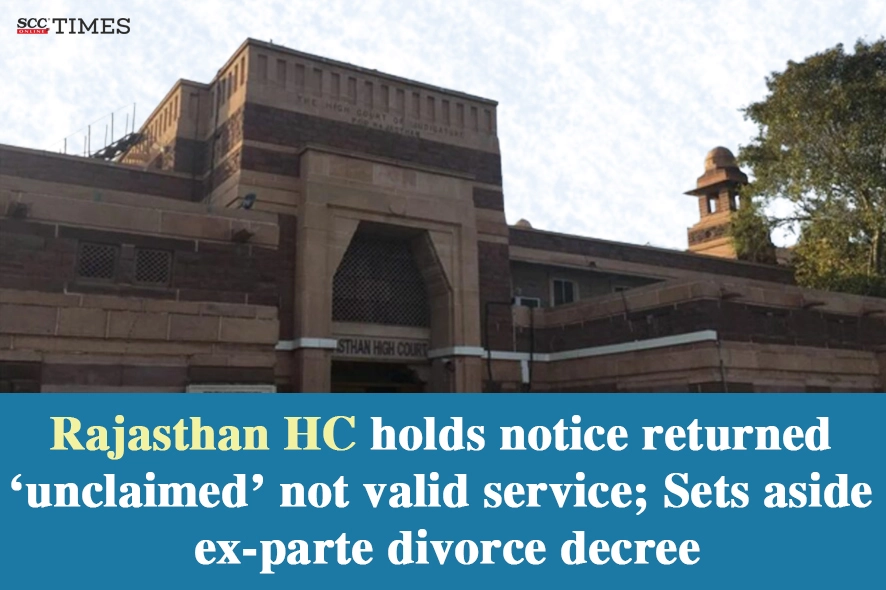
Rajasthan High Court: In a civil miscellaneous appeal filed by the appellant husband against the ex-parte decree dated 15-09-2023 passed by the Family Court which allowed the respondent-wife’s application under Section 13 of the Hindu Marriage Act, 1955 (‘1955 Act’) and granted a decree of divorce, the Division Bench of Dinesh Mehta* and Sandeep Taneja, JJ., allowed the appeal, holding that the service of summons, which was returned with the postal endorsement ‘unclaimed’, did not constitute a valid and effective service in the absence of tender to the addressee or his authorized agent. The Court set aside the ex-parte decree, and the matter was remanded to the Family Court for fresh adjudication.
Background
The respondent-wife filed an application under Section 13 of the 1955 Act seeking a divorce decree. The Family Court issued summons to the appellant-husband. The summons sent via registered post was returned with the postal endorsement ‘unclaimed’. Subsequently, the Family Court, vide order dated 19-04-2023, held that the service of summons on the appellant was complete. Consequently, the appellant was proceeded ex-parte, leading to the impugned ex-parte judgment and decree of divorce dated 15-09-2023. Aggrieved the appellant filed the present appeal.
Analysis and Decision
The Court observed that the Family Court has drawn presumption of service of the notice, based on endorsement ‘refusal’ found on the envelope, which was sent to the appellant. Though the notice was sent on the correct address, but the note on the envelope does not show as to who refused to take the notice.
The Court further observed there was endorsement of the Postman going to appellant’s address total 6 times. It was true that a seal has been affixed on the said envelope on which the black mark for ‘refused’ has been ticked. But if the appellant’s family member or mother had to refuse the same, they could have at the first instance refused it. The fact that the envelope shows remark of approaching the addressee on six occasions is indicative of the fact that the addressee was not at the address, as claimed by him.
It was clear from the facts that the notice was offered to the mother of the appellant, who had in express terms stated that the appellant (her son) had gone to Ahmedabad and is not available in the house. The Court observed that such stand taken by the appellant’s mother could not be considered as refusal when the notice was not at all offered to the notice i.e. the appellant.
The Court observed that,
“A refusal for the purpose of service of notice should be taken to be a sufficient service, if such refusal is by the addressee or by the noticee himself/herself. A denial by any other person other than the noticee or his agent, including the mother to receive or accept the notice on someone else’s behalf cannot be said to be a refusal in the eye of law.”
The Court noted that Order V Rule 9(5) of the Civil Procedure Code, 1908 (‘CPC’) states that when a defendant refuses to accept the summons, the court, after hearing, may declare that the summons has been duly served. However, the Court drew a critical distinction between an envelope returned with the endorsement ‘refused’ and one returned with ‘unclaimed’. Furthermore, there is nothing on record to show that the appellant had authorised his mother as his agent to receive the postal article on his behalf.
The Court noted that sending of notice is not synonymous with its receipt, as giving is only a process of which receipt is the culmination. Even if it is assumed that the notice was duly sent on the correct address by the registered post, it would be highly improbable for the addressee to be aware of its content when the same was neither tendered to him nor to his authorized agent, when is a pre-condition under Order V Rule 9 of CPC.
The Court noted that the Supreme Court in Gujarat Electricity Board v. Atmaram Sungomal Poshani, (1989) 2 SCC 602, held that there is a presumption of service only when the letter is returned with the postal endorsement that the addressee refused to accept the same. The presumption is rebuttable. The Supreme Court had emphasized the difference between ‘refused to accept’ and ‘unclaimed’.
The term ‘unclaimed’ merely indicates that the addressee was not available to receive the post after attempts by the postal authority and does not establish that the notice was tendered to the addressee or his authorized agent. The Court noted that tender is a precondition under Order V Rule 9 of the CPC.
The Court distinguished the judgment relied upon by the respondent of C.C. Alavi Haji v. Palapetty Muhammed, (2007) 6 SCC 555, noting that the statutory provisions involved therein, Section 138(b) of the Negotiable Instruments Act, 1881 and Section 27 of the General Clauses Act, were clearly distinguishable as they deal with the aspect of sending/tendering of notice, which is not synonymous with its receipt. The Court reiterated the view that giving is only a process of which receipt is the culmination.
The Court observed that the burden to rebut the presumption raised under section 114 of the Indian Evidence Act, 1872, was concerned, the same had been effectively discharged by the appellant as on previous six occasions as the notice was never tendered upon the appellant or his authorized agent to qualify it as a valid refusal.
The Court held that the ex-parte divorce decree passed by the Family Court was unsustainable in the eyes of law. The Court allowed the appeal, set aside the ex-parte judgment and decree dated 15-09-2023, and remanded the matter to the Family Court with a direction to provide an opportunity to the appellant to file his reply and proceed with the case afresh in accordance with the law.
[X v. Y, 2025 SCC OnLine Raj 5080, decided on 19-09-2025]
*Judgment authored by: Justice Dinesh Mehta
Advocates who appeared in this case:
For Appellant(s): Kshitij Vyas with Sukhadev
For Respondent(s): Siddharth Mewara with Ramawatar Singh



Insightful analysis this judgment from the Rajasthan High Court makes it clear that a notice marked “unclaimed” cannot automatically count as valid service, especially in ex-parte divorce proceedings.