








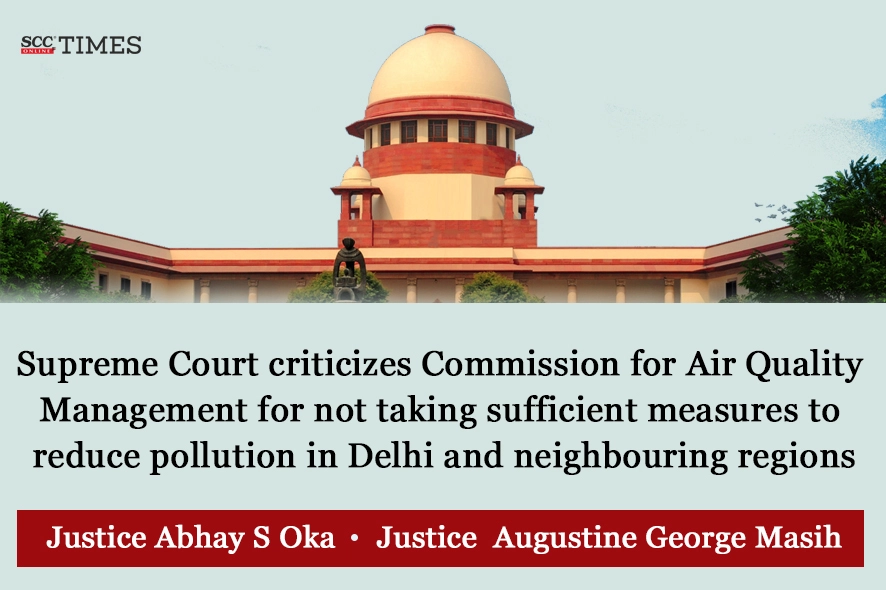
Supreme Court: In a case concerning air pollution in Delhi, the division bench of Abhay S Oka and Augustine George Masih, JJ. called out the Commission for Air Quality Management (‘CAQM’) for failing to take adequate steps to curb pollution in Delhi and adjacent areas.
The Court viewed that although the panel has taken some steps, it has fallen short of the Court’s expectations in discharging its functions, more so when it vast powers including the power to close polluting units. The Court said that the Commission needs to be more active and must ensure that its efforts and directions actually translate into reducing the problem of pollution.
Noting that 3 sub committees hold only 1 meeting every 3 months, the Court remarked that how CAQM is performing those tasks by meeting only once in three months.
The Court emphasized that stubble burning, identified as a significant contributor to pollution and deteriorating air quality in Delhi, must cease immediately.
The Court stressed that efforts must be made to ensure that alternative equipment for stubble burning is utilized at the grassroots level.
CAQM submitted that it has been trying very hard to act against the environmental lapses, however, the Court was not convinced and asked the CAQM to file a better affidavit in the matter by the next hearing on 03-10-2024.
The Court directed the commission to apprise about the subcommittee meetings and decisions issued thereunder, and to ensure that the equipment to avoid stubble burning is actually used by the farmers.
The Court also condemned the Delhi government for its delays in implementing the Regional Rapid Transport System projects, which are promoted as a more environmentally friendly mode of transportation.
The Court later noted that filing criminal cases against farmers who burn paddy stubble is not an effective way to address the resulting air pollution. Instead, the Court suggested that the government should contemplate withholding minimum support prices (MSP) for these farmers’ crops.








1 reply