Supreme Court: In an appeal filed under Section 62, Insolvency and Bankruptcy Code, 2016 (IBC), the Division Bench of S.V.N. Bhatti and N.V. Anjaria, JJ., held that the limitation period for an appeal under Section 62 commences from the date of pronouncement of the NCLAT order, and only the time requisite for obtaining a certified copy can be excluded under Section 12(2), Limitation Act, 1963. The Court stated that the period of inaction before applying for the certified copy cannot be excluded. As the appeal was filed beyond the statutory limit of 45 days and the further condonable period of 15 days, the Court dismissed it for being barred by limitation.
Background
The present civil appeal filed before the Supreme Court on 21 November 2023 by the Assistant Commissioner of Central Tax, CGST Division under Section 62 IBC sought to challenge the judgment and order dated 2 August 2023 passed by the National Company Law Appellate Tribunal (NCLAT), Chennai, which confirmed the resolution plan approved by the National Company Law Tribunal (NCLT), Hyderabad, on 13 August 2021.
The Central Excise and Service Tax Department initiated multiple recovery proceedings between 2013 and 2017 against the corporate debtor, which was registered as an Export Oriented Unit. Its manufacturing activities stopped around November/December 2016, and it challenged the demands before the Customs, Excise and Service Tax Appellate Tribunal (CESTAT).
Andhra Bank, now Union Bank of India, a financial creditor of the corporate debtor, initiated the corporate insolvency resolution process (CIRP) by filing an application under Section 7 IBC, which was admitted by the adjudicating authority. During the CIRP, the Department convened a meeting on 4 November 2019 to fix the reserve price for auctioning attached machinery. The resolution professional informed the Department that the moratorium prohibited third-party authorities from disposing of the corporate debtor’s assets.
On 27 November 2019, the Deputy Commissioner of Central Tax submitted a proof of claim for ₹22,60,32,948. The resolution professional subsequently presented a settlement scheme under the Sabka Vishwas (Legacy Dispute Resolution) Scheme, 2019, for ₹4,32,80,741. Under the resolution plan approved by the NCLT on 13 August 2021, ₹1,34,657 was approved towards the excise arrears payable to the Department.
The Department challenged the resolution plan before the NCLAT. By judgment dated 2 August 2023, the NCLAT confirmed the resolution plan. Respondent 2 objected that the appeal before the Supreme Court was time-barred. It argued that limitation ran from 3 August 2023 and expired on 1 October 2023, and that even on excluding 6 September to 11 October 2023, the appeal was due by 5 November 2023.
The Revenue contended that time under Section 62(1) runs from the ‘date of receipt’ of the order. It relied on the non obstante clause in Section 61 and compared Sections 421 and 423 of the Companies Act, 2013, and said the appeal was filed within 41 days of receipt on 11 October 2023.
Analysis and Findings
Limitation period under Section 62
The Court examined the limitation framework applicable to an appeal to the Supreme Court under Section 62 read with Section 238-A IBC and Section 12, Limitation Act, 1963.
Section 62(1) IBC provides for an appeal to the Supreme Court on a question of law arising from an NCLAT order, within 45 days from the date of receipt of the order. Section 62(2) permits the Supreme Court, if satisfied that sufficient cause prevented the filing within the prescribed period, to allow a further period not exceeding 15 days. The statutory outer limit is therefore 60 days.
Section 238-A IBC makes the provisions of the Limitation Act applicable, as far as may be, to proceedings and appeals under the IBC. Section 12(2), Limitation Act provides for exclusion of the time requisite for obtaining a copy of the order appealed against. Its “Explanation” excludes from that calculation any time taken by the Court to prepare the order before an application for a copy is made.
The Court emphasised that exclusion of time for obtaining a copy and condonation of delay are distinct concepts. The time permitted for obtaining a certified copy may be excluded where the statutory requirements are satisfied, but that exclusion does not enlarge the maximum period within which the appeal can be filed beyond the statutory ceiling under Section 62.
Effect of the IBC limitation scheme and earlier decisions
The Court considered the principles laid down in Sagufa Ahmed v. Upper Assam Plywood Products (P) Ltd., (2021) 2 SCC 317; V. Nagarajan v. SKS Ispat and Power Ltd., (2022) 2 SCC 244; and CA Ramchandra Dallaram Choudhary v. Adani Infrastructure and Developers (P) Ltd., 2026 SCC OnLine SC 1097.
In V. Nagarajan, the Court had examined the IBC’s limitation framework and the requirement to obtain and file a certified copy of the order under the applicable procedural rules. The judgment explains that a litigant must exercise due diligence in applying for a certified copy and cannot exclude time spent in inaction before making that application. It also reiterates that the IBC prescribes strict timelines and that the condonable period cannot be extended beyond the statutory limit.
The Court also considered CA Ramchandra Dallaram Choudhary, which addressed the strict and time-bound nature of the IBC’s limitation scheme and the outer limit for filing an appeal under Section 62.
The Court distinguished the context of Sagufa Ahmed, where the statutory scheme under the Companies Act, 2013, read with the applicable NCLT Rules, provided for the receipt of a free certified copy. For an appeal under Section 62, the applicable requirements for obtaining and filing a certified copy are governed by Order 19 Rule 3(2)(i) read with Rule 40, Supreme Court Rules, 2013. The Court held that a litigant cannot wait to apply for or collect a certified copy in a manner that keeps the limitation period suspended.
Commencement of limitation and exclusion of time for obtaining a certified copy
The Court held that the expression “from the date of receipt of such order” in Section 62(1) IBC cannot be interpreted as the date on which a party chooses to apply for and collect the certified copy. The Court observed:
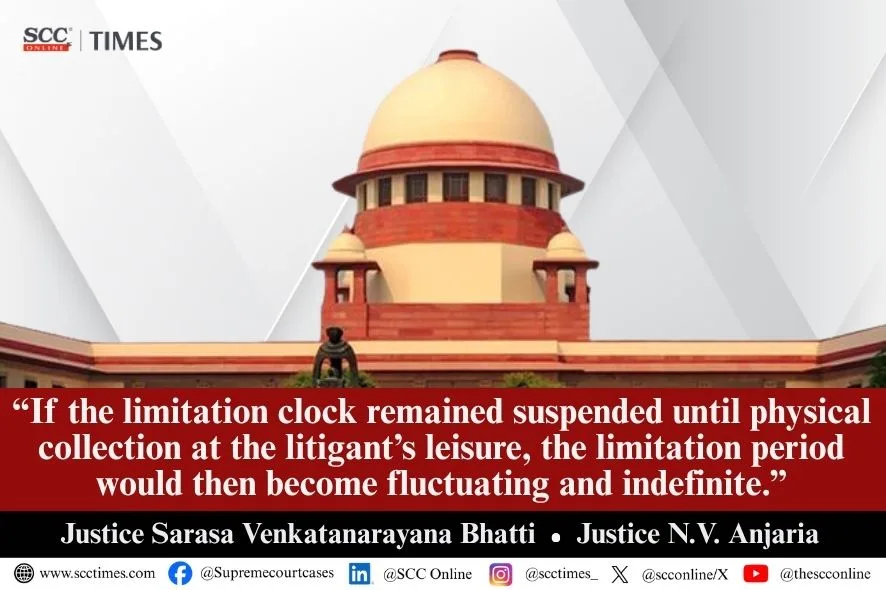
“If the limitation clock remained suspended until physical collection at the litigant’s leisure, the limitation period would then become fluctuating and indefinite.”
The Court reasoned that such an interpretation would render Section 12(2), Limitation Act redundant. If limitation did not commence until the litigant physically received the certified copy, there would be no reason for the statutory provision permitting exclusion of the time requisite for obtaining the copy.
The Court then referred to Rule 91, NCLAT Rules, 2016. Under Rule 91(2), where an order is reserved, the date of pronouncement notified in the cause list constitutes valid notice of the pronouncement. Rule 91(3) provides that reading the operative portion of the order in open Court is deemed to be pronouncement.
On reading the Rule, the Court held that knowledge and limitation commence on the date the NCLAT pronounces the order. Under Section 12(2), Limitation Act, only the time requisite for obtaining the copy, calculated from the date of application until the certified copy is ready, is excluded. Any period of inaction before the application for the certified copy is made cannot be excluded.
Application to the present case
The Court considered the following dates:
-
2 August 2023: NCLAT pronounced the impugned judgment.
-
6 September 2023: The appellant applied for a certified copy, on the 35th day after pronouncement.
-
6 September to 11 October 2023: The application remained pending with the Registry for 35 days. The Court treated this period as “time requisite” for obtaining the copy and excluded it under Section 12(2), Limitation Act.
-
11 October 2023: The appellant received the certified copy. Having already consumed 35 days of the initial 45-day period before applying for the copy, the appellant had 10 days remaining in the prescribed period, followed by a further condonable period of 15 days.
-
21 November 2023: The appellant filed the civil appeal, 41 days after receiving the certified copy.
The Court held that the 35 days of inaction before applying for the certified copy could not be excluded. After excluding only, the 35 days taken by the Registry to provide the copy, the actionable periods before the application and after receipt of the copy totalled 76 days. This exceeded the absolute statutory ceiling of 60 days by 16 days.
The Court further held that accepting the appellant’s interpretation, under which limitation began only when the certified copy was received, would nullify both the prescribed limitation period and the condonable period, making the right of appeal subject to an indefinite and fluctuating period of limitation.
Decision
The Supreme Court sustained the preliminary objection and held that the appeal under Section 62 had been filed beyond the prescribed limitation period and the maximum condonable period.
Accordingly, the civil appeal was dismissed as barred by limitation. There was no order as to costs, and any pending applications were disposed of.
[Commr. of Central Tax v. Sreenivasa Rao Ravinuthala, 2026 SCC OnLine SC 2150, decided on 14-10-2026]
*Judgment authored by Justice S.V.N. Bhatti.
Advocates who appeared in this case:
For the appellant: K. M. Nataraj, ASG and AOR Gurmeet Singh Makker- 2357, Saurav Roy, Sharath Nambiar, Vinayak Sharma, Indira Bhakar, Vatsal Joshi, Chitransh Sharma, Anuj Srinivas Udupa, Satvika Thakur, Nikita Capoor, Yogya Rajpurohit, Ritika Ranjan, S. Subramanium, Ishan Bhaduri, Sahaj Joshi, Advocates
For the respondents: Shradha Agrawal- 3468, and Ayshwarya Chandar- 3463, AORs; Senior Advocate Ritin Rai for Respondent 2