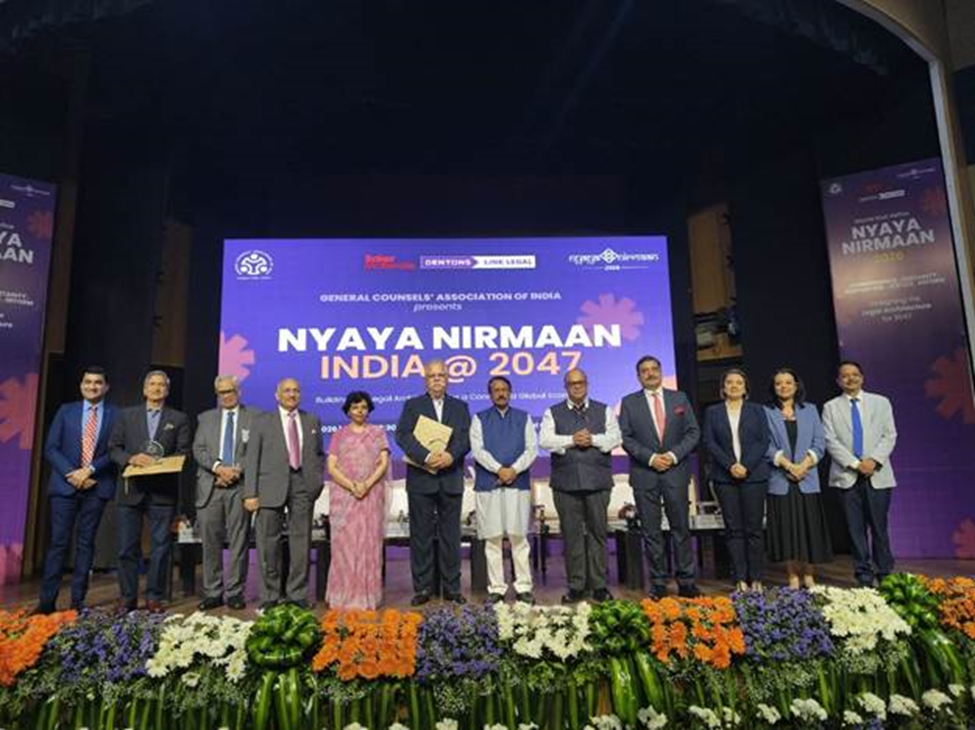
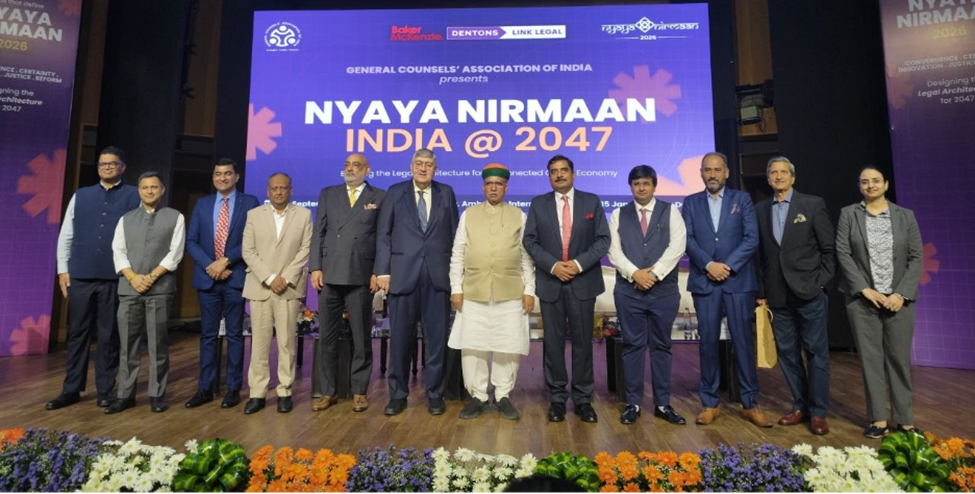
Against the backdrop of India’s ambition to emerge as a Viksit Bharat by 2047, leading members of the legal fraternity came together at Nyaya Nirmaan 2026: India @ 2047 to deliberate on the legal architecture needed to support the country’s economic, technological and institutional transformation. The insights brought into focus the future of the legal profession, commercial certainty, global legal convergence, technology-enabled justice and the need to build an integrated legal ecosystem capable of responding to the demands of a connected global economy.
The programme primarily examined the legal implications of an increasingly interconnected economy, where capital, technology, data, energy, supply chains and innovation operate across national boundaries while legal systems remain jurisdictionally distinct. The discussions covered global economic interdependence, cross-border investment, artificial intelligence, ESG and energy transition, convergence of legal principles, commercial certainty, judicial development of law, technology-enabled justice, arbitration and dispute prevention, and institutional reforms necessary for Viksit Bharat @ 2047.
The programme followed the Indian intellectual tradition of Bharatiya Shastrartha, with discussions structured around Prastavana, Purva Paksha, Uttara Paksha, Prativad and Samanvaya. The format was intended to encourage reasoned disagreement, test competing propositions and ultimately identify common ground and practical pathways for reform.
Also Read: Legal luminaries on building India’s legal architecture for Viksit Bharat at Nyaya Nirmaan @ 2047
Aligning the legal framework with India’s changing economic architecture: Dr. Haseeb Drabu
The discussion then moved from the administration of justice to the wider relationship between law, economic policy and structural change. Economist and Former Minister of Finance, Government of Jammu & Kashmir, Dr Haseeb Drabu began by observing that much of the conference had centred on artificial intelligence and technology. He said this itself reflected the period in which the legal profession was operating but suggested that the question of India’s legal architecture in 2047 should also be examined through the transformation of the Indian economy.
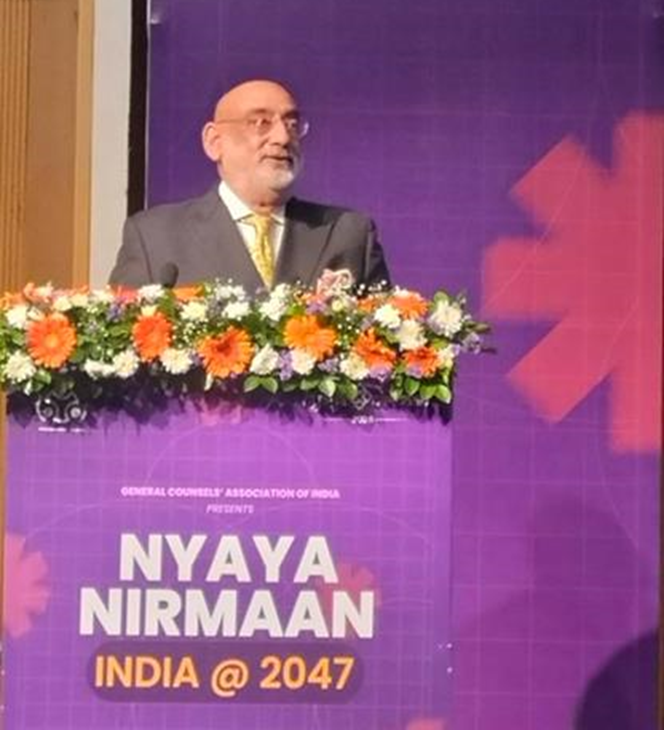
Dr Drabu framed that transformation through the shift from “Garibi Hatao” to “Viksit Bharat”. He contrasted the economic priorities associated with the two periods, describing the earlier phase as one centred on redistribution and the contemporary objective as one focused on creating assets and enabling growth. In his view, however, the legal framework had not evolved at the same pace as the economic model. “One thing seems to be constant and that is the legal framework,” he said.
Developing the analogy further, Dr Drabu described law as the “operating system of the commercial sector”. His point was that an economic system cannot function smoothly when its legal framework is not aligned with the model of economic activity it is intended to support. He traced India’s movement from an economy based on state ownership, through a phase of control and command, to a more open economy in which the legal system increasingly had to operate as an enabling framework rather than simply as a mechanism of control.
He identified regulation as one of the consequences of that transition. As the State withdrew from direct control over parts of the economy, regulators emerged to address market failures. Dr Drabu questioned how the growing number of regulators fit within the wider legal structure and referred to tensions between the government and regulators, as well as between regulators and the judiciary. He also argued that the judiciary’s intervention in economic matters must be considered in the context of the changing role of the executive and the regulatory State.
A further concern, he said, was centralisation. Dr Drabu called attention to what he described as the need for greater “federalisation of the judiciary”, particularly in the context of commercial powers. He argued that the legal system should better account for the differing conditions and capacities of States and regions, and that lawyers and judges would need to be equipped to operate within this increasingly complex economic and institutional environment.
Technology, in his view, raises a different kind of systemic concern from the question of whether individual lawyers or judges will be replaced by AI. Dr Drabu said he was less concerned about AI disrupting individual human existence and more concerned about technological disruption to markets, industries and investment. He warned that future disruptions could occur at a scale and speed capable of producing significant socio-economic consequences. “What I do worry about is how will the system survive in the middle of disruptions,” he said, pointing to the need for the legal framework to anticipate and mitigate risks arising from technological and economic change.
He concluded by returning to the federal structure of India. Dr Drabu observed that India operates not as a single uniform economy but through multiple economies at different levels of development, with differing constraints and land laws. In that context, he argued for bringing these variations into a more coherent legal direction through what he described as the “federalising” of the legal ecosystem.
From Vidhi to Nyaya- Recognising the role of General Counsel: Dr. Lalit Bhasin
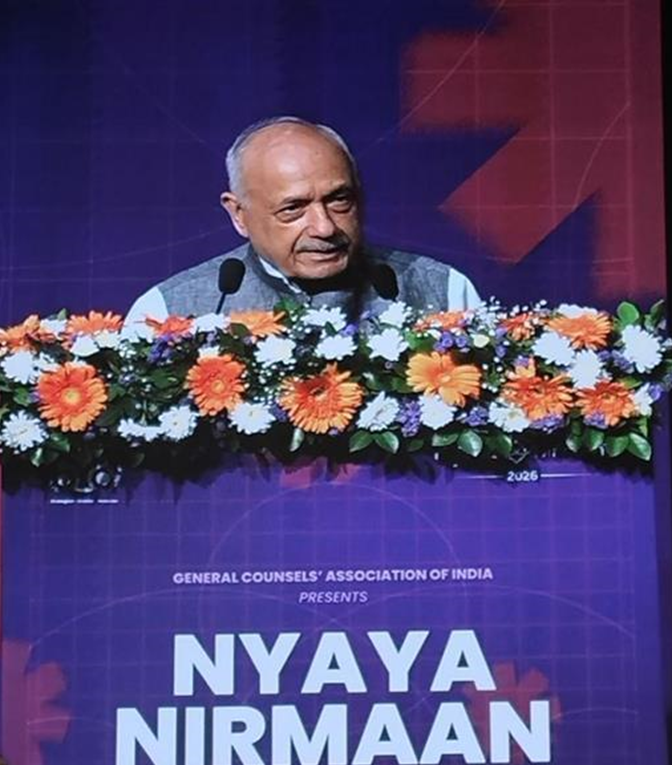
Bringing the discussion back to the purpose of the legal system, Dr. Lalit Bhasin, Managing Partner, President, Society of Indian Law Firms (SILF), and Chairman, CII, called for a shift from Vidhi to Nyaya i.e., from law to justice.
Mr. Bhasin referred to the constitutional commitment to social, economic and political justice and questioned whether citizens were receiving justice in practice when the legal discourse remained centred largely on law. He described the Nyaya Sammelan as an important initiative in bringing the question of justice to the forefront.
He then turned to the evolving role of General Counsels. Mr. Bhasin observed that General Counsels must constantly respond to changes in Government policy, legislation and compliance requirements. Their responsibilities therefore extend beyond conventional legal advice and require an understanding of the changing business and regulatory environment.
Mr. Bhasin questioned why eminent General Counsels should not be permitted to practise law for their own employers or the corporates they represent, given their legal knowledge and professional experience. He also raised the possibility of creating a pathway for such professionals to be considered for elevation as Senior Counsel if they are willing to relinquish their General Counsel positions. He called for these questions to be examined by the Bar Council of India and other relevant institutions.
From fragmented laws to a future-ready legal architecture: Dr. Sanjeev Gemawat
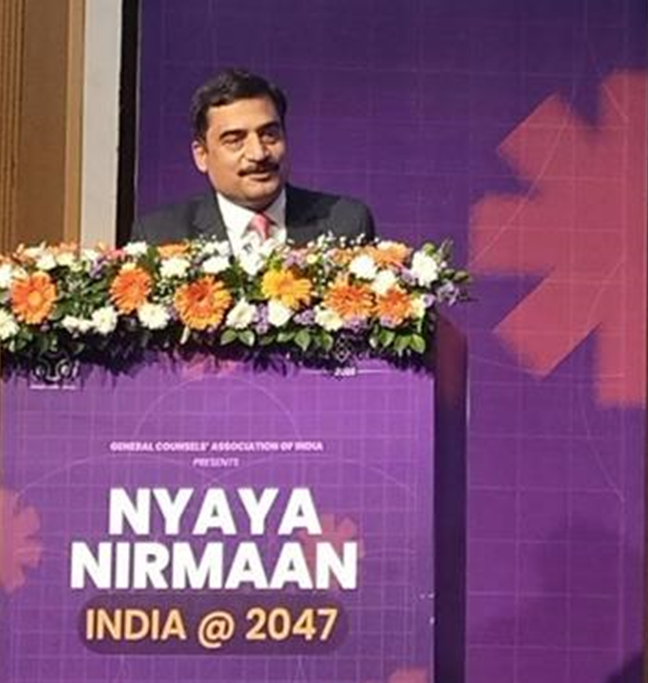
Explaining the philosophy behind Nyaya Nirmaan, Dr. Sanjeev Gemawat, Managing Director & Group General Counsel, Essar Group and Co-founder, GCAI said the use of Shastra was deliberate. Unlike a conventional conference where one speaker puts forward a proposition and the audience listens, Shastrartha requires propositions to be questioned, assumptions to be challenged and opposing arguments to be heard before an attempt is made to arrive at Samanvaya meaning synthesis. The purpose, he said, was not to establish who was right or wrong, but to ask what was right, understand the problem, examine competing viewpoints and consider their consequences.
Mr. Gemawat placed this method of deliberation within the nature of law itself. Law, he said, is a continuing dialogue between legislation and adjudication, certainty and flexibility, individual rights and collective interest, and national sovereignty and global commerce. The different sessions of Nyaya Nirmaan were therefore intended to form parts of one larger conversation on the legal system India would need by 2047.
One of the central questions was the idea of the lawyer of the future. Mr. Gemawat said that a lawyer practising in 2047 could not remain confined to knowledge of one statute or one jurisdiction. Legal professionals would increasingly need to understand business, technology, data and artificial intelligence. But alongside technological competence, he raised a more fundamental question as AI and other technologies take over an increasing number of legal tasks, what remains uniquely human about the lawyer?
The discussion then moved to the relationship between globalisation and legal sovereignty. Mr. Gemawat referred to the idea of Vasudhaiva Kutumbakam and asked whether it could coexist with sovereignty in a world where capital, businesses and technology routinely move across jurisdictions. India, he said, would necessarily have to engage with a degree of legal convergence as its economy becomes increasingly integrated with the global economy, while retaining the ability to make its own legal and policy choices.
Another significant issue was the tension between codification and judicial law-making. Mr. Gemawat pointed out that several Indian statutes were framed in a very different social and economic environment. The interpretation of provisions has consequently developed over time, sometimes moving beyond the context in which the legislation was originally enacted. He referred to areas including damages and indemnity as examples of the questions that arise when statutory language meets changing commercial realities.
For businesses and investors, however, the concern is not simply whether the law evolves but whether its application can be reasonably anticipated. Mr. Gemawat stressed the importance of certainty and predictability, particularly for entrepreneurs making long-term commercial decisions. Law cannot remain frozen, he said, but evolution of law must also be accompanied by a degree of predictability.
Mr. Gemawat also addressed the relationship between the Bench and the Bar and the wider question of what the justice system should look like in 2047. He suggested that the debate should not be reduced to the familiar question of how many cases can be disposed of. A future-ready justice system must also ask how unnecessary disputes can be prevented in the first place and whether every dispute necessarily needs to travel through the traditional court process.
This led to the proposed Nyaya Nirmaan Declaration 2047, which Mr. Gemawat said would be built around six broad pillars: (i) a future-ready legal profession; (ii) global compatibility with national sovereignty; (iii) predictability and commercial certainty; (iv) technology-enabled and human-centred justice; (v) a multi-door justice delivery system; and (vi) positioning India as a global legal hub for cross-border commerce, investment, legal services, arbitration, mediation and innovation.
The idea of a multi-door justice system, he explained, extends the conversation beyond courts to arbitration, mediation, conciliation, online dispute resolution and mechanisms for preventing disputes before they arise. The objective is not merely faster disposal but ensuring that the right dispute reaches the right forum.
Mr. Gemawat also stressed that the exercise could not be undertaken by one stakeholder alone. Government, judiciary, Bar, industry and other participants in the legal ecosystem would all have to contribute to the process. “Nyaya Nirman must be a collective enterprise,” he said, emphasising that the discussions should ultimately result in an actionable vision rather than remain a series of speeches.
Building the legal ecosystem begins with the next generation: Dr. Akhil Prasad
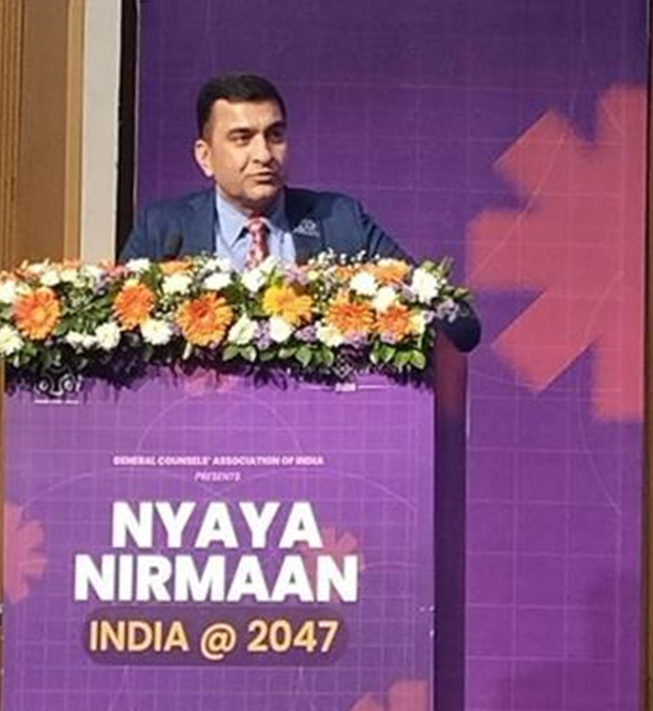
Dr. Akhil Prasad, Co-founder, GCAI and Company Secretary at Boeing India, approached the larger question from the perspective of developing the people who will eventually operate this legal architecture. He noted that the present gathering marked the fifth Nyaya Nirmaan, following earlier editions in India and international editions in London and Singapore.
Dr. Prasad said GCAI’s objective was to work towards the development of the entire Indian legal ecosystem, beginning with students. Recalling Justice Mithal’s description of students as “Bharat ke Bhaagya Vidhata”, he said the observation had stayed with him and reflected the importance of preparing young members of the profession for the changing demands of legal practice.
This objective has found practical expression in YUKTI, GCAI’s flagship four-week internship programme. Dr. Prasad explained that the programme brings students into contact with professors, industry representatives, members of the judiciary and senior advocates. The idea is to expose students to the wider legal ecosystem rather than restrict their learning to the conventional law-school curriculum.
Importantly, Dr. Prasad emphasised that GCAI’s work is not confined to conducting Nyaya Nirmaan or running internships. The organisation has been preparing notes, publishing books and making submissions to the Government on changes considered necessary to take India towards Viksit Bharat @ 2047. In this sense, the discussions at Nyaya Nirmaan are intended to feed into a continuing process of legal and institutional reform.
He also highlighted the move from basic internship exposure to specialised professional skilling. Through a collaboration with Grant Thornton, three YUKTI students were selected for higher-level training, including exposure to forensic sciences and the interpretation of the financial position of an insolvent company. Discussions with EY and PwC were also underway to develop similar opportunities. Dr. Prasad said the objective was to equip students with capabilities extending beyond the LLB curriculum and make them better prepared for professional practice.
The January 2026 edition of YUKTI involved approximately 120 students from 21 law schools, who also documented their experiences during the programme. Dr. Prasad announced that another edition of YUKTI for India would be held in January 2027.
His intervention thus connected the institutional questions being discussed at Nyaya Nirmaan with the human capital required to implement them. A future-ready legal system, he suggested, would require lawyers who understand not only law but also technology, finance, business and the wider environment in which legal decisions operate.
As India moves towards 2047, the vision emerging from the discussions was not simply of a larger legal system, but of a more accessible, trusted, efficient and globally credible justice ecosystem, one capable of serving citizens, supporting businesses and contributing to India’s emergence as a significant global legal and dispute resolution hub. Nyaya Nirmaan @ 2047 thus provided a platform for diverse legal and policy voices to reflect on the institutional foundations that will shape India’s legal future.