litigation AI access to justice wellbeing LegalTechTalk 2026
Events & CollaborationsInternationalLegalTechTalk

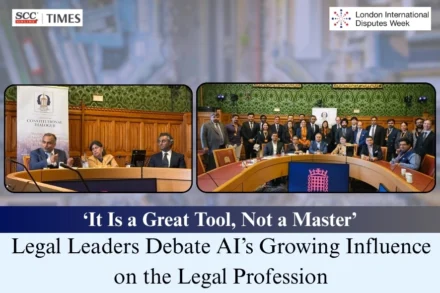
The panel brought together perspectives from social impact litigation, litigation support services and legal leadership to discuss contemporary developments in litigation. The speakers reflected on technology’s growing role in litigation practice, questions of accessibility and inequality in the use of AI tools, and the importance of wellbeing, leadership and organisational culture within legal teams.

technology and AI in international mediation India UK
Events & CollaborationsInstitutional Events

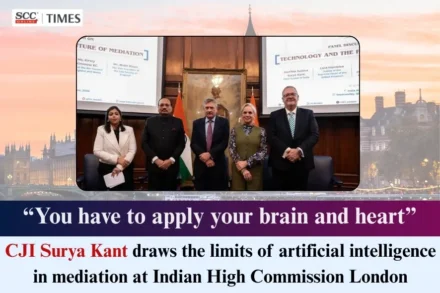
At the Mediation Event organised by the Indian High Commission in London, the panelists reinforced that the future of mediation lies not in replacing human mediators with artificial intelligence, but in creating a collaborative model where technology strengthens human-led dispute resolution while preserving its core values of trust, human perception, and understanding.

CJI Surya Kant Oxford Union address
Events & CollaborationsInstitutional Events

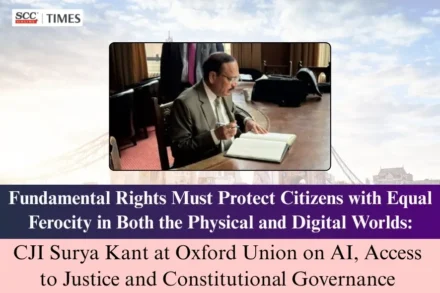
Delivering an address at the Oxford Union, Chief Justice of India Justice Surya Kant said technology has the power to democratise justice but must remain anchored to constitutional values and human judgment, emphasising that innovation should complement rather than replace the human heart of justice.

AI in the Legal Profession
Events & CollaborationsLondon International Disputes Week

Artificial intelligence is making lawyers faster, research more accessible and legal services more efficient. But as AI systems become increasingly sophisticated, legal practitioners are confronting a more difficult question: how can the profession embrace technological transformation without surrendering the human judgment, ethics and accountability that lie at the heart of legal practice?

AI arbitrators replace human arbitrators
Events & CollaborationsLondon International Disputes Week

At a formal LIDW 2026 debate hosted by RPC and Stephenson Harwood, counsel argued both sides of a motion to replace human arbitrators with AI while the Tribunal called the whole question a false binary. The debate on AI arbitrators was more candid surprising than most.

AI future international dispute resolution
Events & CollaborationsLondon International Disputes Week

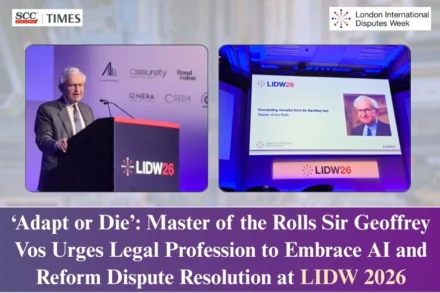
Reflecting on nearly five decades in the legal profession, from manual typewriters to AI, Sir Geoffrey warned that the competition to develop national AI capabilities is simultaneously a competition to preserve the influence of established legal systems, and that courts which resist this reality risk making themselves irrelevant.

AI and access to justice
Events & CollaborationsLondon International Disputes Week

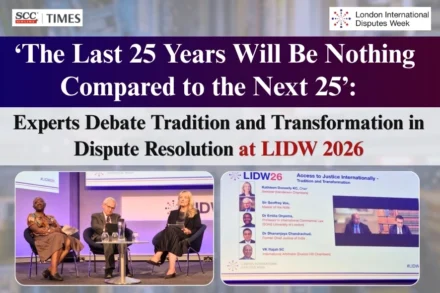
Sir Geoffrey Vos, Former Chief Justice of India D.Y. Chandrachud, VK Rajah SC and Dr. Emilia Onyema examined whether digital justice systems, AI and accountability can deliver meaningful access to justice or whether the technology divide will deepen the inequalities they are meant to solve.

in-house lawyer career path
Events & CollaborationsLondon International Disputes Week

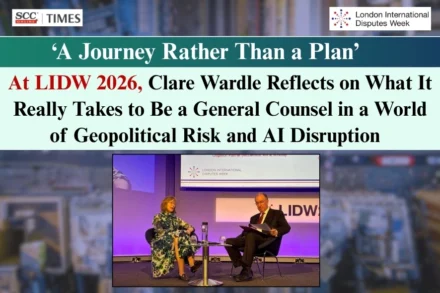
In a wide-ranging interview at LIDW 2026, the former Coca-Cola Europacific Partners General Counsel reflects on cross-border disputes, AI’s impact on legal practice, access to justice, and why she would choose the same career again. In an interesting segment of LIDW 2026, Mr. Hilton Mervis, Litigation Partner, McDermott Will & Schulte, held an engaging conversation with Ms. Clare Wardle, Former General Counsel and Company Secretary, Coca-Cola Europacific Partners, on her insights as a general counsel.

force majeure geopolitics sanctions renewable energy arbitration
Cyprus Arbitration DayEvents & Collaborations

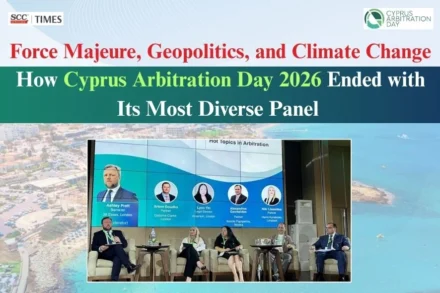
In the last panel of the event titled “Hot Topics in Arbitration”, the panellists examined how recent global developments were reshaping arbitral practice and creating new procedural and substantive challenges for parties, arbitrators, and institutions alike.

Parole for effective legal representation
Case BriefsHigh Courts

The Court noted that mechanical police objections without substantive reasoning cannot be a valid ground to deny parole.

Legal Aid Reform
Case BriefsSupreme Court

“In India, the concept of legal aid is closely tied to the vision expressed in the Preamble of the Constitution, which promises justice be it social, economic, and/or political, along with equality of status and opportunity, and affirms the secular character of the State.”

audit of court facilities
Case BriefsHigh Courts

The present writ petition was filed by an advocate seeking provision of amenities for specially abled persons to access the Court premises.

execution petitions jurisdiction
Case BriefsHigh Courts

“There can never be any threshold bar to a party filing a matter before the Registry of a Court.”

Legal Aid Centres
Legislation UpdatesNotifications

Law Minister Arjun Ram Meghwal informed the Parliament about the expansion of legal aid and alternate dispute resolution systems, improved legal aid accessibility in Odisha, and ongoing efforts to support SC/ST communities.

Ajmer Sharif blast
Case BriefsSupreme Court

The Court issued specific direction to the Trial Court to expedite the hearing… particularly when the petitioner is languishing under incarceration for more than 8½ years.

Constitution Day address Justice Surya Kant
Hot Off The PressNews

CJI Surya Kant’s Constitution Day address reaffirmed access to justice as central to India’s constitutional design.

Justice Spectrum 2025 GGSIPU
Law School NewsOthers

The Legal Aid Centre, University School of Law and Legal Studies (USLLS), GGSIPU, is hosting Justice Spectrum: Rethinking Free Legal Aid in India on 4th November 2025. The event will feature a panel discussion, PIL drafting, quiz, and extempore competitions aimed at reforming India’s legal aid system and promoting access to justice.

NALSAR conference justice capacity
Events/WebinarsNews

The report is a starting point for reform, it gives policymakers and civil society a clearer sense of where attention is needed; but the work of reform requires persistent, coordinated action across data governance, institutional capacity and on-the-ground legal assistance.

Maharasthra RERA to restore hybrid hearings
Case BriefsHigh Courts

Procedural fairness includes the right of parties to choose their mode of hearing, especially when both physical and virtual modalities are feasible. Tribunals must not only be accessible in form, but also in substance.

Retrial of blind POCSO accused
Case BriefsHigh Courts

“The failure to provide documents to the accused in a language in which the accused could not read, would definitely scuttle the chances for the accused to instruct and assist his counsel in canvassing the defence on his behalf.”