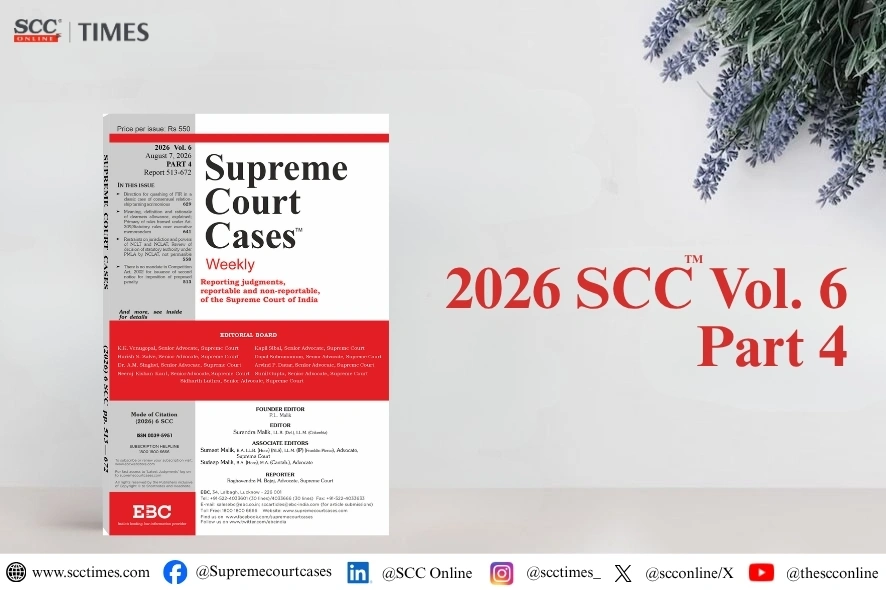
This volume of the Supreme Court Cases (SCC), Part 4 of Volume 6, embodies landmark cases decided by the Supreme Court on issues like imposition of proposed penalty, withdrawal/modification of resolution plan, jurisdiction and powers of NCLT and NCLAT, and more.
Competition Act, 2002 — Ss. 3(1), 3(3)(b), 26, 27, 36 and 48 (as existing prior to 18-5-2023) — Second notice for imposition of proposed penalty — Non-requirement of: All that the Act contemplates after the receipt of a report from the DG indicating contravention is to set the procedure in motion under S. 26(8), as it then stood, r/w S. 48, Regns. 21 and 48 of the Commission (General) Regulations, 2009. There is no mandate in the statute for the issuance of a second show-cause notice setting out the proposed penalty, [CCI v. Kerala Film Exhibitors Federation, (2026) 6 SCC 513]
Insolvency and Bankruptcy Code, 2016 — Ss. 30(4) and 31(1): Withdrawal/modification of resolution plan by resolution applicant, after such plan is approved by Committee of Creditors (CoC), not permissible, [Deccan Value Investors L.P. v. Metalyst Forgings Ltd. (Resolution Professional), (2026) 6 SCC 624]
Insolvency and Bankruptcy Code, 2016 — Ss. 30, 32-A, 60 and 61 — Jurisdiction and powers of NCLT and NCLAT — Restraints on: Review of decision of statutory authority under PMLA by NCLAT, not permissible, [Kalyani Transco v. Bhushan Power & Steel Ltd., (2026) 6 SCC 558]
Penal Code, 1860 — S. 376(2)(n) r/w Ss. 90 and 375 — Repeated rape — Quashing of FIR: Direction for quashing of FIR in a classic case of consensual relationship turning acrimonious, issued, [Pramod Kumar Navratna v. State of Chhattisgarh, (2026) 6 SCC 629]
Service Law — Allowances — Dearness pay/Dearness allowance — Dearness allowance: Meaning, definition and rationale of dearness allowance, explained. There is primacy of rules framed under Art. 309/Statutory rules over executive memorandum, [State of W.B. v. Confederation of State Government Employees, (2026) 6 SCC 641]