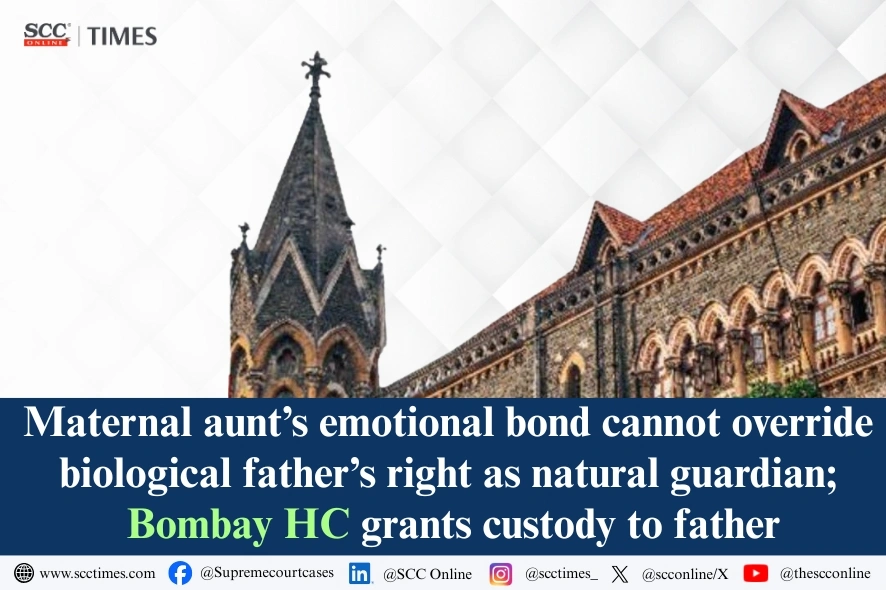
Bombay High Court: While considering a father’s petition seeking a writ of habeas corpus for restoration of custody of a minor child from the child’s maternal aunt, the Division Bench of Urmila Joshi-Phalke* and Nivedita P. Mehta, JJ., held that the maternal aunt’s emotional bond cannot override biological father’s right as natural guardian and that the father was entitled to custody in the absence of any material demonstrating his inability to care for the child or any detriment to the child’s welfare.
Also Read: Ker HC directs Cal HC’s Child Custody Guidelines to be followed by Family Courts
Background
The dispute related to the custody of a minor child aged about 7 years. After the death of the child’s mother on 6 June 2023 due to breast cancer, the child came to reside with her maternal aunt. The petitioner (father) contended that the child’s custody was abruptly taken by the aunt without any legal right of guardianship. The aunt was claiming to be the testamentary guardian of the minor child based on a purported will executed by the mother 2 weeks before her death.
The father asserted that the alleged will was executed under suspicious circumstances, when the mother’s physical and mental condition was not fit to execute it and thus, it could not supersede his status as natural guardian under Hindu law. He further contended that although custody proceedings were pending before the competent court, he was being denied access to meet the child despite having sought appropriate reliefs. Additionally, the father also stated that initially considering the tender age of the child it was the mutual understanding between the father and the maternal aunt to keep the custody of the child with the aunt.
On the other hand, the maternal aunt contended that custody was entrusted to her as per the last wishes of the deceased mother to take care of her child as well as her property. She alleged that the father had never attempted to meet the child and approached the Court only after she initiated probate proceedings with the motive to grab the deceased’s property. According to her, the custody was permissive and therefore did not amount to illegal detention. The State also opposed the petition on the ground that there was no illegal detention and that the writ of habeas corpus was therefore not maintainable.
Also Read: Raj HC on territorial jurisdiction in child custody matters
Analysis
The Court referred to Somprabha Rana v. State of M.P., (2024) 9 SCC 382, wherein it was held that habeas corpus is an extraordinary and discretionary remedy and that even where custody is found to be illegal, the Courts can decline to exercise jurisdiction under Article 226 of the Constitution. As far as the decision regarding custody of the minor children is concerned, the only paramount consideration is the welfare of the minor. The parties’ rights cannot be allowed to override the child’s welfare.
The Court observed that there was no dispute regarding the father’s status as the natural guardian of the minor child. The Court noted that the child had been residing with the maternal aunt since the age of 4 year, and emphasised that, in such matters, a child cannot be treated as property whose custody can be transferred casually. Such issues require to be decided sensitively on humanitarian ground, and the doctrine of parens patriae cannot be ignored.
The Court noted that there had been no matrimonial dispute between the father and the deceased mother. The alleged will relied upon by the maternal aunt was unregistered and did not disclose any conflict between the spouses, rather it recognised certain rights in favour of the father. The Court also noted that although the father had remarried, there was nothing on record to indicate that he was unable to maintain or care for the child.
The documents on record showed that the aunt had filed an application under Section 20, Hindu Adoption and Maintenance Act, 1956 (HAMA), and the father had filed a petition under Sections 6, 7, 9, 17 and 25, Guardians and Wards Act, 1890 (1890 Act) for the guardianship and custody of minor child. He had also moved an interim application seeking custody and access. Despite these efforts, access to the child was not granted. The Court observed that while the child’s custody may initially have been entrusted to the maternal aunt owing to the tender age, the continued denial of access even after execution of a memorandum of understanding between the parties showed that the child was being illegally detained by the maternal aunt.
The Court relied on Gautam Kumar Das v. State (NCT of Delhi), (2024) 10 SCC 588, wherein it was held that temporary custody of a child with relatives cannot be a ground to deny custody to the natural guardian. The Court also referred to Tejaswini Gaud v. Shekhar Jagdish Prasad Tewari, (2019) 7 SCC 42, where it was observed that:
“The writ of habeas corpus is maintainable where it is proved that the detention of a minor child by a parent or others was illegal and without any authority of law. The writ also extends its influence to restore the custody of a minor to his guardian when wrongfully deprived of it. …For restoration of the custody of a minor from a person who according to the personal law, is not his legal or natural guardian, in appropriate cases, the writ court has jurisdiction.”
The Court observed that it is the settled law is that a writ of habeas corpus is maintainable only when it is proved that detention of minor child by parents or otherwise was illegal or without any authority of law and hence in a peculiar facts and circumstances of the case, the order of the High Court granting writ of habeas corpus is justified one.
The Court opined that the petitioner being the biological father and natural guardian has an undisputed legal right to claim custody of the child. Though the maternal aunt shared an emotional bond with the child, but it did not confer upon her a superior right to custody over that of the biological parent. The Court clarified that the rights of the father and mother as the natural guardian may be curtailed only if it is shown that the custody of the child with the father or the natural guardian would be detrimental to the child’s welfare.
The Court noted that the father had a sound economic condition and could maintain the child. The Court relied on Gautam Kumar Das, wherein in similar facts the child’s custody was handed over to the father. The Court observed that the present case had a stronger foundation because there was no evidence of matrimonial discord between the parents and the father had already applied for the custody.
Also Read: Supreme Court on Work from Home and child custody cases
Decision
Accordingly, allowing the petition, the Court directed the maternal aunt to hand over custody of the minor child to the father within two weeks from the date of the order. The Court further directed that the aunt would be permitted to have access to the child.
[Nikhil v. State of Maharashtra, Criminal Writ Petition No. 301 of 2026, decided on 30-6-2026]
*Judgment authored by: Justice Urmila Joshi-Phalke
Advocates who appeared in this case:
For the Petitioner: P. C. Malviya, Advocate.
For the Respondents: S. S. Hulke, APP, Bhagyashree N. Gavhale, Advocate.