Disclaimer: This has been reported after the availability of the order of the Court and not on media reports so as to give an accurate report to our readers.
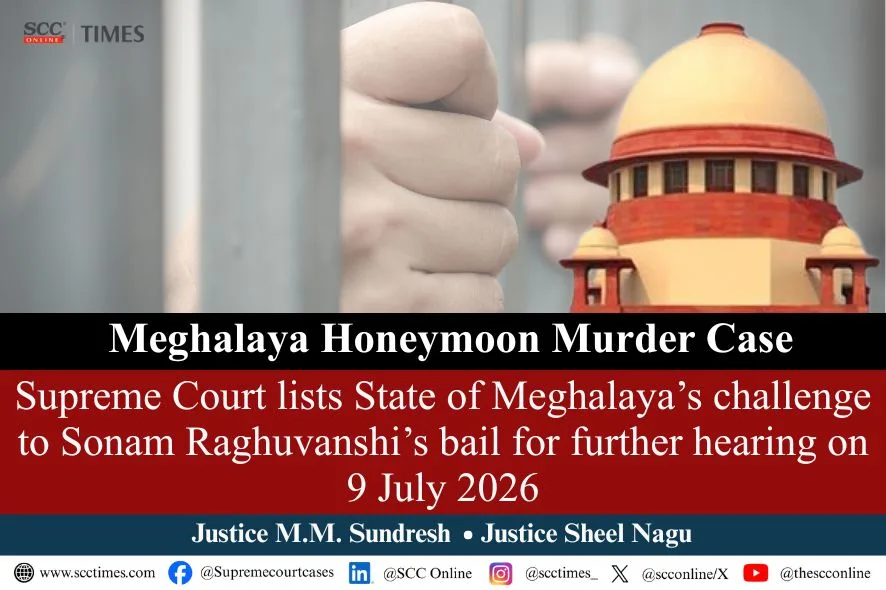
Supreme Court: In a criminal appeal filed by the State of Meghalaya challenging the bail order passed by the trial court and upheld by High Court, the Division Bench of M.M. Sundresh, and Sheel Nagu, JJ., heard State’s submissions and granted the respondent time to file a counter affidavit, permitted the State to place additional documents on record; the matter was thereafter listed for further hearing on 9 July 2026.
Case Timeline
|
Date |
Particulars |
|
9 July 2026 |
Listed for further hearing. |
|
3 July 2026 |
The State challenged the bail order before the Supreme Court. |
|
29 June 2026 |
Meghalaya High Court dismissed the State’s petition and upheld the Trial Court’s order granting bail to the respondent on the ground that the grounds of arrest had not been effectively communicated. |
|
27 April 2026 |
Shillong District Court allowed the respondent’s bail application, holding that the requirements regarding communication of the grounds of arrest had not been complied with. |
|
10 February 2026 |
A supplementary charge sheet filed arraying an additional accused, invoking offences under the Arms Act, 1959 against certain accused, including the respondent. |
|
28 October 2025 |
Charges under Sections 103(1), 238(a), 309(6) and 3(6) Nyaya Sanhita, 2023 (BNS), were framed against the respondent. |
|
5 September 2025 |
The investigating agency filed the charge sheet. |
|
9 June 2025 |
Sonam Raghuvanshi was arrested from Ghazipur, Uttar Pradesh. |
|
3 June 2025 |
Vipin Raghuvanshi lodged the FIR at Sohra Police Station, Meghalaya regarding the recovery of Raja Raghuvanshi’s body. |
Background
Vipin Raghuvanshi, brother of the deceased Raja Raghuvanshi, lodged an FIR on 03 June 2025 with Sohra Police Station, Meghalaya, in connection with the recovery of the deceased’s body during a search operation conducted by the police authorities. Pursuant thereto, Sonam Raghuvanshi, wife of the deceased, was arrested from Ghazipur, Uttar Pradesh, on 09 June 2025 and remained in judicial custody thereafter.
The investigating agency filed the charge sheet on 05 September 2025, following which charges under Sections 103(1), 238(a), 309(6) and 3(6) Nyaya Sanhita, 2023 (BNS), were framed against the respondent on 28 October 2025. She pleaded not guilty and claimed trial. The prosecution thereafter commenced leading evidence, and four out of the ninety listed prosecution witnesses were examined.
Subsequently, on 10-02-2026, the investigating agency filed a supplementary charge sheet arraying Shilom James as a co-accused for offences under Sections 103(1), 238(a), 309(6) and 3(6) BNS read with Sections 25(1)(A) and 35 Arms Act, 1959, while also seeking discharge of two co-accused, Balla Ahirwal and Lokendra Tomar. The supplementary charge sheet also invoked Sections 25(1)(A) and 35 Arms Act against the respondent, Raj Singh Kushwaha and Vishal Singh Chauhan. Consequent thereto, summons were issued to Shilom James and to the informant. The respondent stated that, in view of the supplementary charge sheet, the Court was required to reconsider the charges before proceeding further with the trial. It was further stated that, for this reason, the trial had not progressed since 03-02-2026, without any fault on her part.
On the aforesaid factual basis, the respondent sought bail. Apart from relying upon the period of custody and the delay in the progress of the trial, she raised, for the first time, the plea that the investigating authorities had failed to intimate the grounds of arrest at the time of her arrest, as mandated under Article 22(1) of the Constitution. It was submitted that the arrest records contained only a format of purported intimation without disclosing the grounds of arrest and that such non-compliance rendered the arrest and the subsequent remand illegal. The respondent further submitted that all the evidence collected by the investigating agency was already before the Court, that there was no likelihood of tampering with the evidence, that she had no criminal background, and that, being a woman, her case also deserved consideration for grant of bail.
The prosecution opposed the application, contending that the plea regarding non-intimation of the grounds of arrest had been raised belatedly in the fourth bail application after charges had already been framed. It was submitted that the arrest memo and the intimation of the grounds of arrest bore the signatures of the respondent and the witnesses, giving rise to a presumption that the grounds of arrest had been communicated. According to the prosecution, the omission to tick the relevant check boxes was, at best, a procedural irregularity, and the respondent had neither pleaded nor demonstrated any prejudice on account of the alleged omission.
Shillong District Court Order
-
Analysis and Findings
The Court noted that the State had relied upon State of Karnataka v. Sri Darshan, 2025 SCC Online SC 1702, and distinguished it on facts, observing that in that case the respondents had been informed of the grounds of arrest orally at the time of arrest and were served with the written grounds immediately thereafter. The Court noted that the arrest memos, checklists and intimation documents had also been produced before the Magistrate and counter-signed by persons acquainted with the accused, thereby satisfying the requirement under Section 50A of the of Criminal Procedure Code, 1973.
Upon examining the material placed on record in the present case, the Court found that the FIR had been registered under Sections 103(1), 238(a), 309(6) and 3(6) BNS, whereas the format titled “Intimation of Grounds of Arrest” referred to Sohra PS under Sections 403(1), 238(a), 309(6) and 3(6) BNS. The Court further noted that none of the check boxes in the format had been ticked to indicate the accusations against the petitioner. It observed that the same discrepancy appeared not only in the intimation of grounds of arrest but also in the checklist for justification of arrest, memo of arrest, inspection memo, intimation of rights of the arrested person and the extract of the case diary. The Court found that none of these documents intimated to the petitioner that she had been arrested for the offence under Section 103(1) BNS. The Court observed that the formats did not communicate the specific facts constituting the offence to the petitioner. In these circumstances, the Court held that Darshan case had no application to the facts of the present case.
The Court further observed that the intimation of grounds of arrest did not indicate that the charges against the petitioner had been communicated to her. The Court held that the material on record showed that sufficient knowledge of the facts constituting the grounds of arrest had not been effectively communicated to the petitioner in clear terms. The Court observed that prejudice could therefore be said to have been caused to the petitioner in relation to her defence. The Court noted that there was nothing on record to show that the petitioner had been represented by counsel when she was first produced before the Court at Ghazipur, where such a plea could have been raised.
-
Decision
In view of the peculiar facts and circumstances of the case, the Court held that the petitioner had made out a case of not having been effectively communicated the grounds of arrest upon her arrest. Relying on Vihaan Kumar Vs State of Haryana 2025 INSC 162 and Labius Areng Vs State of Meghalaya BA No. 09 of 2026, the Court held that the petitioner was entitled to be released on bail. Accordingly, it directed her release on bail subject to conditions that she would not abscond or tamper with the evidence or witnesses, would appear before the Court on every date fixed, would not leave the jurisdiction of the Court without prior permission, and would execute a personal bond of Rs. 50,000/- with two sureties of the like amount to the satisfaction of the Court.
Proceeding before Meghalaya High Court
Assailing the impugned order, the State contended that the respondent had earlier filed three bail applications, all of which had been rejected, and that the plea regarding non-intimation of the grounds of arrest had been raised for the first time only in the fourth bail application before the Trial Court.
-
Analysis and Findings
Compliance with Article 22(1) and Section 47 BNSS
At the outset, the Court deemed it necessary to examine the legal position governing compliance with Article 22(1) and Section 47 BNSS. The Court observed that in Pankaj Bansal, the Supreme Court had held that the grounds of arrest must be communicated to the arrestee in writing under due acknowledgment at the time of arrest to ensure that the arrestee was made aware of the offence alleged against him and was enabled to prepare his defence.
The Court noted that although the principle had been laid down in the context of the Prevention of Money Laundering Act, 2002, it had subsequently been extended to offences under the Unlawful Activities (Prevention) Act and other criminal offences in Prabir Purkayastha, and reiterated in Vihaan Kumar in the context of offences under the IPC, now BNS.
The Court further observed that it was no longer res integra that the grounds of arrest contemplated under Article 22(1) were required to be furnished in writing to the arrestee at the time of arrest or, at the latest, before expiry of two hours prior to remand. Referring to Mihir Rajesh Shah, the Court noted that the grounds of arrest were also required to be furnished in a language known to the arrestee.
Supply of written grounds of arrest
The Court proceeded to examine the form and content of the grounds of arrest necessary to satisfy the requirement of law. Referring to Prabir Purkayastha, the Court noted that the Supreme Court had held that failure to provide the accused or his counsel with the written grounds of arrest before the order of remand vitiated the arrest and the subsequent remand.
The Court further referred to Kasireddy Upender Reddy v. State of Andhra Pradesh and noted that the Supreme Court had held that, although Article 22(1) did not require the authorities to furnish complete details of the offence, the information communicated had to be sufficient to enable the arrested person to understand why he had been arrested. The Court further noted that the Supreme Court had held that the grounds of arrest should be substantially similar to the charge framed for trial and that, in cases of arrest without a warrant, the arrested person must be informed not only of the offence alleged but also of the precise acts attributed to him constituting that offence. The Court noted that the Supreme Court had clarified that merely informing the arrested person of the statutory provisions applicable would not amount to sufficient compliance with Article 22(1).
Prospective applicability of Mihir Rajesh Shah judgment
The Court considered the State’s contention regarding the prospective applicability of the decision in Mihir Rajesh Shah, particularly the use of the expression “henceforth” in paragraph 68 of the judgment. Referring to Dr. Rajinder Rajan, the Court noted that the Supreme Court had extended the benefit of the ratio in Mihir Rajesh Shah to persons who had been arrested and remanded prior to the pronouncement of that judgment. The Court further referred to the decision of the Delhi High Court in Brijesh Kothia, wherein it was held that Mihir Rajesh Shah did not create a fresh prospective regime but reaffirmed the constitutional requirement under Article 22(1) as elucidated in Pankaj Bansal, Prabir Purkayastha and Vihaan Kumar, and that the decision did not alter the date from which the dictum in Pankaj Bansal took effect. Agreeing with the principles laid down in Dr. Rajinder Rajan and Brijesh Kothia, the Court held that the same were applicable to the case of the respondent.
Non-application of mind in framing grounds of arrest
The Court proceeded to examine whether the respondent had been communicated the grounds of arrest in writing, in a language known to her, at the time of her initial arrest and, if so, whether the communication was sufficiently clear to enable her to understand the basis of her arrest and prepare her defence. Upon perusing Annexure titled “Intimation of Grounds of Arrest”, the Court noted that the document, issued to the respondent on 09 June 2025 at the One Stop Centre, Ghazipur, bore her signature and was in the form of a tabular template containing about seventeen entries.
The Court observed that the document appeared to have been prepared without application of mind, as it did not contain any specific allegation or information regarding the actual charges against the respondent. The Court further noted that several entries in the template, including references to desertion from the Armed Forces, involvement in an offence committed outside India and failure of a released convict to notify residence under Section 394 Nagarik Suraksha Sanhita, 2023 (BNSS), had no apparent relevance to the case. Holding that the manner in which the grounds of arrest had been intimated reflected total non-application of judicious mind on the part of the arresting agency, the Court concluded that the respondent had made out a strong case that the grounds of arrest had not been effectively communicated to her at the time of her arrest. The Court accordingly held that the requirements of Article 22(1) of the Constitution read with Section 47(1) BNSS, had been violated.
The Court observed that even if the reference to Section 403(1) BNS in the arrest documents were treated as a typographical error, the recurrence of the same error across several records reflected non-application of mind on the part of the authorities concerned. The Court held that where the foundational basis for the arrest was found to be deficient, subsequent attempts to rectify the process could not cure the defect. At the same time, the Court clarified that it was not commenting upon the investigation, the findings thereof, the charge sheet or the framing of charges, and that the trial itself was not vitiated. The Court stated that its concern was confined to the procedure adopted at the initial stage, namely, the communication of the grounds of arrest to the arrestee.
The Court further referred to its decision in Labius Arengh and observed that the authorities ought to re-look the manner in which proper and specific grounds of arrest were prepared and communicated to the arrestee.
-
Decision
Having found that there had been no effective initial intimation of the grounds of arrest to the respondent, the Court held that the Trial Court was justified in granting bail on that ground. The Court further held that no ground had been made out for exercising its inherent powers to interfere with the impugned order.
Accordingly, the petition was dismissed without costs.
Proceeding before Supreme Court
On 1 July 2026, the State of Meghalaya filed a petition challenging the bail order contending that both the Trial Court and the High Court had failed to consider the material against the respondent, including the recording made by the Judicial Magistrate on an earlier occasion.
The State submitted that the nature of the allegations against the respondent was serious, that three earlier bail applications had already been rejected by the Trial Court, and that the plea regarding the grounds of arrest had not been raised in those proceedings. It was also contended that the case was not one of non-service of the grounds of arrest, but of alleged inadequacy of the reasons communicated, coupled with a typographical error. Reliance was placed on the order passed by the Judicial Magistrate in the presence of the respondent.
The respondent sought time to file a counter affidavit and informed the Court that the order granting bail had already been given effect to and that the respondent had been released.
The Court directed that the matter be listed for further hearing on 9 July 2026 and permitted the State to place additional documents on record in the meantime.
[State of Meghalaya v. Sonam Raghuvanshi, 2026 SCC OnLine SC 1294, ordered on 3-7-2026]
Advocates who appeared in this case:
For the petitioner: Tushar Mehta, Solicitor General, Amit Kumar, Advocate General and AOR Avijit Mani Tripathi with Vishakha, Arushi Malik, Luv Kumar, Himanshu Sehrawat, Advocates
For the respondent: AOR Abhay Singh with Zenith Chhablani, Jishnu Adhikari, Advocates