Civil procedure forms the foundation of the administration of civil justice, governing the resolution of disputes from trial courts through appellate forums. A sound understanding of procedural law enables both Judges and legal practitioners to ensure the effective, efficient, and timely adjudication of civil disputes. Conversely, procedural complexities and delays often prolong litigation, increase the burden on litigants, and undermine confidence in the justice delivery system. The work underscores the importance of a clear and practical appreciation of procedural law for both the Bench and the Bar.
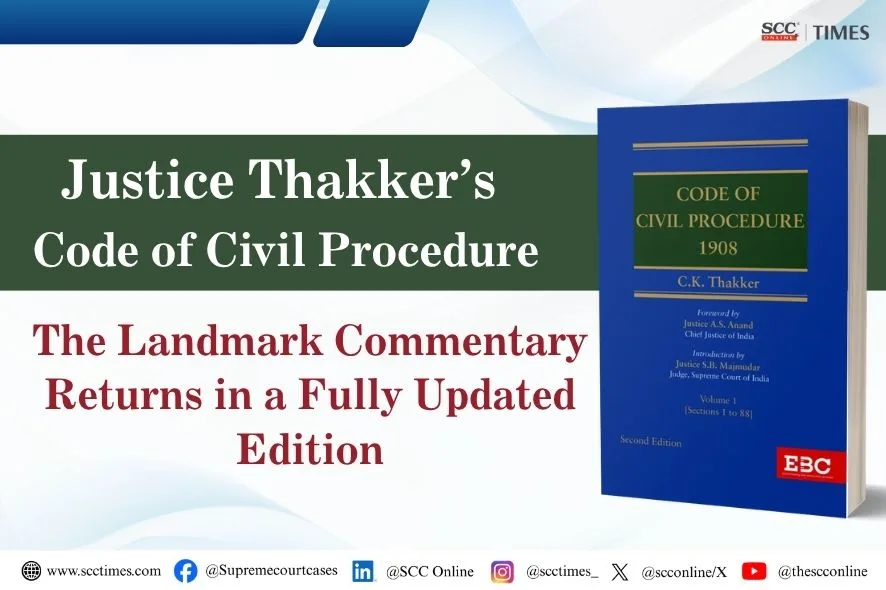
Against this backdrop, the second edition of Justice C.K. Thakker’s Code of Civil Procedure, 1908 (Lawyers’ Edition, 2026) presents a lucid, comprehensive, and scholarly exposition of the various facets of civil procedural law. Drawing upon his extensive judicial experience, Justice Thakker offers an authoritative commentary that bridges legal theory with judicial practice. While originally conceived as a Lawyers’ edition, the work is equally valuable to all those engaged in the administration of civil justice, whether on the Bench or at the Bar.
The commentary is marked by its exhaustive analysis of the provisions of the Civil Procedure Code, 1908 (the Code), supported by extensive judicial precedent and practical insights. Particular emphasis is placed on clarifying procedural nuances that frequently arise in litigation, enabling practitioners and Judges alike to navigate complex procedural issues with confidence. The work has been recognised as an indispensable guide for advocates appearing before civil courts, providing practical direction while helping avoid unnecessary procedural complications.
About this edition
The Second Enlarged Edition of Justice Thakker’s Code of Civil Procedure, 1908 (Lawyers’ Edition) builds upon the remarkable success of the first edition, which was widely acclaimed by the legal fraternity, the judiciary, and academia for its comprehensive, scholarly, and practical approach to civil procedural law.
The overwhelming appreciation received by both the Lawyers’ Edition and the widely used Civil Procedure (Student Edition) encouraged the authors to prepare this enlarged and updated edition. The present work reflects significant legislative and judicial developments, ensuring that it continues to serve as an authoritative reference for Judges, practitioners, academicians, and students.
Volumes 1 to 5 examine the provisions of the Code in the order in which they appear. The substantive provisions (Ss. 1—158) are discussed in Volume 1 and part of Volume 2, while Volumes 2 to 5 provide an exhaustive commentary on the procedural framework contained in the First Schedule (Orders and Rules).
The commentary combines an analytical examination of both substantive and procedural provisions with extensive coverage of leading decisions of the Supreme Court and various High Courts. Particular attention has been devoted to landmark judgments, including the decisions in Salem Advocate Bar Assn. (I) v. Union of India1 and Salem Advocate Bar Assn. (II) v. Union of India2, which are critically analysed in light of the reforms introduced to the Code.
Recognising the diversity of procedural amendments across jurisdictions, the work incorporates all relevant State and High Court amendments together with the judicial precedents interpreting them. It also includes the latest case law, identifies provisions that merit legislative reconsideration, and offers well-reasoned suggestions for reform.
Maintaining the practical approach that has distinguished Justice Thakker’s writings, this edition includes model formats of plaints, written statements, issues, first appeals, second appeals, revisions, and other essential pleadings, making it an invaluable resource for legal practice.
Prepared with the assistance of distinguished legal researchers and supported by extensive judicial materials, this enlarged edition seeks to present the Code of Civil Procedure in a manner that is comprehensive, systematic, and reliable. It continues Justice Thakker’s enduring commitment to making procedural law accessible, authoritative, and practically relevant for every member of the legal profession.
About the contents
The present edition has been extensively updated to incorporate the significant changes introduced by the Civil Procedure Code (Amendment) Act, 1999 and Civil Procedure Code (Amendment) Act, 2002, as well as subsequent legislative developments, including the Mediation Act, 2023, the Commercial Courts Act, 2015, the Factoring Regulation Act, 2011, and other relevant enactments. It also includes the latest State and High Court amendments, together with a comprehensive analysis of recent and significant decisions of the Supreme Court and various High Courts.
Organised in the sequence of the Code itself, Volumes 1 to 5 provide an exhaustive examination of its provisions. The substantive provisions (Sections 1—158) are covered in Volume 1 and part of Volume 2, while Volumes 2 to 5 comprehensively analyse the procedural framework contained in the First Schedule (Orders and Rules).
The commentary combines a detailed analysis of both substantive and procedural provisions with extensive reference to leading judicial precedents from the Supreme Court and High Courts. Recognising the diverse amendments introduced by various High Courts, the work not only incorporates these legislative variations but also examines the case law interpreting them, offering readers a complete and jurisdiction-sensitive resource.
A distinctive feature of the work is its critical engagement with the law. Alongside incorporating the latest judicial developments, Justice Thakker identifies provisions warranting legislative reform and offers well-reasoned suggestions for amendment. Enhancing its practical utility, the work also includes model formats of plaints, written statements, issues, first appeals, second appeals, revisions, and other pleadings, making it an invaluable reference for Judges, practitioners, academicians, researchers, and students of law.
Key features
1. Comprehensive coverage of Sections 1—158 and the First Schedule (Orders and Rules) across five well-structured volumes.
2. Incorporates major legislative reforms, including amendments introduced by the CPC (Amendment) Act, 1999 and CPC (Amendment) Act, 2002.
3. Updated with recent developments such as the Mediation Act, 2023, Commercial Courts Act, 2015, and Factoring Regulation Act, 2011.
4. Critical analysis of leading and recent decisions of the Supreme Court and various High Courts.
5. Includes updated State and High Court amendments for enhanced jurisdiction-specific relevance.
6. Detailed examination of all important decisions of the Supreme Court and various High Courts, including two very important judgments of the Supreme Court in Salem Advocate Bar Assn. v. Union of India3 and Salem Advocate Bar Assn. v. Union of India4.
7. Highlights provisions requiring legislative reconsideration and offers thoughtful suggestions for reform.
8. Contains practical model formats for plaints, written statements, issues, appeals, revisions, and other court pleadings.
About the first edition
In the Preamble, Justice Thakker provides a comprehensive overview of the provisions of the Civil Procedure Code, 1908, along with the settled principles of statutory interpretation, offering readers a broad understanding of its key provisions and underlying framework.
The commentary on the definition clause, particularly the concept of a decree and deemed decree, is supported by an extensive analysis of leading decisions of the Supreme Court and various High Courts. Frequently used but undefined terms and expressions occurring throughout the Code have also been carefully explained.
Section 9 (Jurisdiction of Civil Courts) receives detailed treatment, including an examination of the jurisdiction of tribunals, quasi-judicial bodies, and administrative authorities. The work analyses errors of fact, law, and jurisdiction with reference to leading English and Indian authorities, including the landmark House of Lords decision in Anisminic Ltd. v. Foreign Compensation Commission5. Seminal Supreme Court decisions such as Dhulabhai v. State of M.P.6, Premier Automobiles v. Kamlakar7, and Rajasthan SRTC v. Krishna Kant8 have been critically discussed, alongside relevant jurisprudence under Article 226 of the Constitution.
The doctrine of res judicata (S. 11) has been examined exhaustively. The discussion encompasses Roman, English, American, and Indian jurisprudence, and explores the doctrine’s application across diverse fields, including industrial adjudication, taxation, writ jurisdiction, and arbitration. Landmark decisions such as Daryao v. State of U.P.9 are analysed in depth, together with nuanced discussions on questions of fact, law, jurisdiction, and the implications of dismissal of writ petitions and special leave petitions.
The commentary on Section 12 (Bar of Further Suit) catalogues all important statutory provisions that bar subsequent suits. Similarly, the chapters on foreign judgments present an analytical examination of significant Indian, English, and American authorities.
Territorial, pecuniary, and subject-matter jurisdiction are discussed with extensive reference to statutory provisions and judicial precedents. The work also analyses issues such as overvaluation and undervaluation of suits, the concept of cause of action, and the doctrine of choice of forum.
The commentary critically examines Section 21-A, identifying drafting deficiencies and suggesting legislative reforms. Sections 22—25, dealing with transfer of cases, comprehensively discuss the powers and duties of courts while balancing judicial propriety with litigants’ rights.
The discussion on Section 34 provides a detailed analysis of the law relating to interest, including the concepts of “principal sum adjudged”, “commercial transactions”, and the arbitrator’s power to award interest. Sections 35, 35-A, and 35-B are similarly analysed with reference to costs in civil proceedings, writ petitions, and public interest litigation, while distilling the governing legal principles.
The provisions governing execution proceedings are treated comprehensively, covering representative parties, the powers and duties of executing courts, execution of decrees, and the evolving jurisprudence under Section 47. The commentary critically evaluates the effect of the 1976 Amendment to the definition of “decree”, concluding that orders passed under Section 47 are no longer appealable as decrees.
The work further examines the enforcement of decrees, attachment and sale of property, benami transactions, the doctrine of rateable distribution (Section 73), and the principle of Crown priority, supported by extensive analysis of legislative developments and judicial decisions.
Special attention is also devoted to the law relating to Commissions under the Code of Civil Procedure as well as Articles 32 and 226 of the Constitution, drawing upon leading judicial authorities.
Throughout the work, Justice Thakker incorporates all significant amendments to the Code, including the far-reaching changes introduced by the Civil Procedure Code (Amendment) Act, 1976, Civil Procedure Code (Amendment) Act, 1999, and Civil Procedure Code (Amendment) Act, 2002, along with all relevant State and High Court amendments. The commentary also considers the Statement of Objects and Reasons, Law Commission Reports, Notes on Clauses, and the latest judicial pronouncements, making it a comprehensive, analytical, and authoritative exposition of the Code.
About the author
Born on 10 November 1943, Justice Thakker obtained his LLB degree from M.P. Shah Law College, Jamnagar and his LLM degree from Gujarat University. He enrolled as an advocate on 28 February 1968 and started practice in the Gujarat High Court. He also rendered services as Assistant Government Pleader and Additional Public Prosecutor from December 1975 to 1982. He was also offered services as a part-time lecturer in law in Sir L.A. Shah Law College, Ahmedabad. He was appointed as a Judge of the High Court of Gujarat in 1990, and was elevated as the Chief Justice of the High Court of Himachal Pradesh in 2000, and of the High Court of Judicature at Bombay in 2001. In 2004, he was appointed as a Judge of the Supreme Court of India. Justice Thakker was also the Acting Governor of the State of Maharashtra from July 2002 to October 2002.
Justice Thakker has authored several publications for Eastern Book Company, including Civil Procedure (the six-volume lawyer’s edition and a student’s edition) and Administrative Law (lawyer’s and student’s editions). He was also the revising author for the much-acclaimed work, V.G. Ramachandran’s Law of Writs.
Appreciation for the book
The book received an enthusiastic response from the legal fraternity. In his Foreword, Dr Justice A.S. Anand, former Chief Justice of India, described the work as “thorough, comprehensive and scholarly”, observing that it elucidated several grey areas of procedural law and even suggested amendments to certain provisions.
Dr Justice Anand further remarked that, like many legal publications of exceptional merit, Justice Thakker’s work is a meticulous, comprehensive, and scholarly treatise that addresses and explains numerous complex aspects of procedural law. According to him, the Commentary on the Code of Civil Procedure leaves virtually no relevant issue unexplained, reflecting Justice Thakker’s remarkable scholarship. He also expressed the view that Civil Procedure would be of immense assistance to lawyers, Judges, law students, and all others engaged in civil litigation before courts and other adjudicatory authorities.
Justice S.B. Majmudar, former Judge of the Supreme Court of India, observed that Justice Thakker had rendered yeoman service to the cause of justice by authoring the Code of Civil Procedure, 1908: Lawyers’ Edition. In his opinion, the work would serve as “a mariner’s compass to learned advocates practising before courts dispensing civil justice so that they can steer clear out of troubled waters…”
Lord Denning also praised the author’s contribution, stating that it “rivals that of Sir William Wade” in India.
Who is this book for?
This work is an indispensable resource for Judges, lawyers, and legal practitioners seeking authoritative guidance on the Civil Procedure Code. Its comprehensive analysis, extensive treatment of judicial precedents, and practical insights also make it an invaluable reference for academicians, researchers, and law students. Whether consulted in the courtroom, the classroom, or for scholarly research, the book serves as a reliable companion for anyone engaged with civil procedural law.
A copy of the volumes can be purchased here.
5. (1969) 2 WLR 163: (1969) 2 AC 147 (HL)