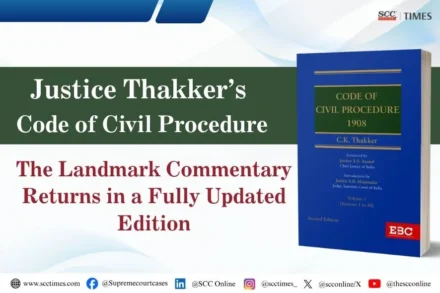
Justice Thakker Code of Civil Procedure
Book Review

Written by: Nilufer Bhateja*

counsel express authority compromise
Case BriefsSupreme Court

Supreme Court has held that a compromise under Order 23 Rule 3 CPC must be signed by the parties or a duly authorised representative, and that an advocate cannot bind a client to a compromise affecting valuable property rights solely on implied authority

Less than 75% attendance
Case BriefsHigh Courts

The Bombay High Court dismissed a review petition filed by a law student barred from appearing in semester examinations due to less than 75 per cent attendance, holding that the application merely sought to reargue issues already decided and failed to satisfy the requirements for review under Order XLVII CPC.

Compelling witness attendance
Op EdsOP. ED.

by Vishno Sudheendra* and Kevin Preji**

High Court Weekly Roundup
High Court Round UpLegal RoundUp

A quick legal roundup to cover important stories from all High Courts this week.

Case Law to Reform
Op EdsOP. ED.

by Jade da Silva*

Unresolved Dilemmas
Op EdsOP. ED.

by Simarpreet Kaur Matharoo*

Gujarat High Court
Case BriefsHigh Courts

“Where the additional evidence sought to be adduced removes the cloud of doubt over the case, the evidence has a direct & important bearing on the main issue in the suit and interest of justice clearly renders it imperative that the evidence must be permitted to be taken on record, then such an application may be allowed.”

Plaint Based on Arbitration Clause
Op EdsOP. ED.

by Chetna Alagh1

Emerging Procedural Complexities
Op EdsOP. ED.

by Piyush Jain*

Sikkim High Court
Case BriefsHigh Courts

The amendments were imperative for the proper and effective adjudication of the dispute; refusal to allow the amendment application would have caused injustice or resulted in multiple litigations; and the amendments did not constitutionally or fundamentally change the nature of the case.

Sikkim High Court
Case BriefsHigh Courts

The Court decided under the aegis of Or.14, R.2 of the CPC that where a question of law is dependent on the determination of a question of fact, then such question of fact cannot be decided as a preliminary issue by the Trial Court.

Inherent Powers of Recall
Op EdsOP. ED.

by Abhijith Christopher*

easementary rights and powers
Case BriefsSupreme Court

“The easementary right is essentially a right claimed by the owner of land upon another land owned by someone else so that he may enjoy his property in the most beneficial manner.”

madras high court
Case BriefsHigh Courts

“District Registrar is duty bound to draw a distinction between the summary proceeding and the trial nature proceedings with reference to the Registration Act and the Code of Civil Procedure”

Jurisdiction
Case BriefsSupreme Court

“No tribunal, far less a civil court, in exercise of judicial power ought to play ducks and drakes with the rights of the parties.”

Examining the Procedural Contours
Op EdsOP. ED.

by Saksham Chaturvedi†

Civil Cases by Parties
Op EdsOP. ED.

by Shrikrishna Dagliya† and Vidhi Dagliya††

executing court to decide inter se claims
Case BriefsSupreme Court

Supreme Court commented that “The situation is indeed disquieting, viewed from the perspective of the decree holders, but the law, as it stands, has to be given effect whether the court likes the result or not.”

allahabad high court
Case BriefsHigh Courts

In a suit instituted by the Hindu worshippers to secure their right to darshan and pooja of deities Virajman within the premises of the Gyanvapi Mosque Complex, the Allahabad High Court said that merely seeking right to worship Hindu deities does not change the Mosque’s character into a Temple.