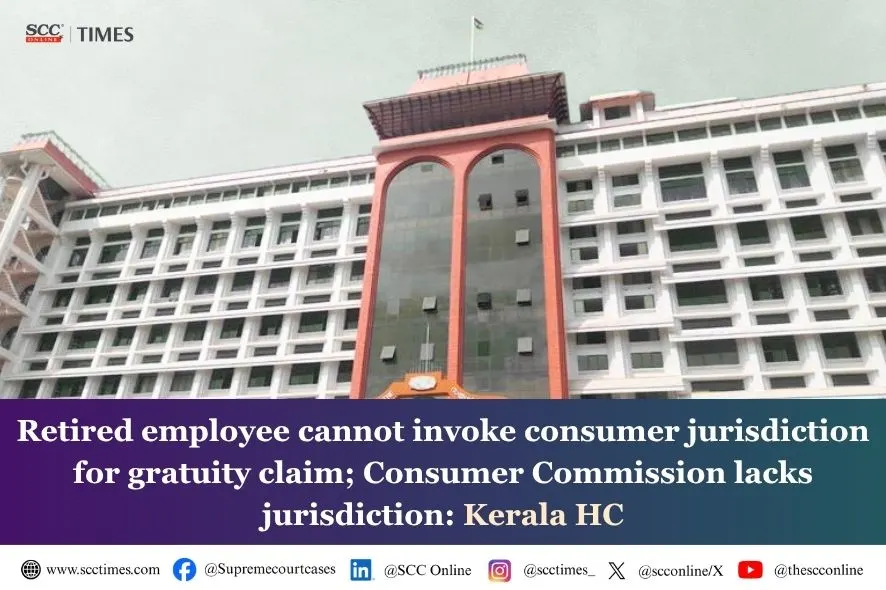
Kerala High Court: While considering a writ petition challenging an order of the District Consumer Disputes Redressal Commission, Malappuram (District Commission), which had allowed a complaint filed by a retired employee claiming arrears of gratuity, the Single Judge Bench of Ziyad Rahman A.A., J., held that a retired employee cannot invoke consumer jurisdiction for gratuity claim as he cannot be treated as a “consumer” under Section 2(7), Consumer Protection Act, 2019 (CP Act) and that the District Commission lacked jurisdiction to entertain such a complaint.
Also Read: Del HC: State Gratuity Authorities lack jurisdiction in multi-state establishments
Background
The petitioner was a Primary Agricultural Credit Society (society), registered under the provisions of the Kerala Co-operative Societies Act, 1969 (1969 Act). The dispute arose from a complaint instituted before the District Commission by a retired employee of the society seeking the arrears of gratuity amount. The employee had been in service from 1 November 1978 till 31 March 2016 and retired after rendering 38 years of service. According to the employee, the gratuity payable under the Payment of Gratuity Act, 1972 (Gratuity Act) amounted to ₹12,20,217. However, only ₹10,00,000 was paid by the society at the time of his retirement.
The society contested the complaint and raised a preliminary objection regarding its maintainability on the ground that the employee was not a “Consumer” as defined under Section 2(7), CP Act. The society submitted that Section 69, 1969 Act provided an exclusive remedy for resolution of disputes between the society and its employees, and therefore, the employee could not have invoked the jurisdiction of the District Commission. It argued that the claim was barred by limitation since the employee had accepted the gratuity amount paid in 2016 and raised the dispute only in 2022, and that gratuity being a statutory entitlement, the appropriate remedy was before the Controlling Authority specified under the Gratuity Act. An interlocutory application raising the issue of maintainability was rejected by the District Commission, and it directed payment of ₹2,20,217 towards balance gratuity, ₹25,000 as compensation and ₹10,000 as costs. Aggrieved thereby, the society approached the High Court.
The retired employee opposed the writ petition and raised a preliminary objection regarding maintainability on the ground that the CP Act provided an alternate remedy of appeal before the State Commission. The society, on the other hand, contended that the challenge was founded on lack of jurisdiction. Since the employee was not a consumer under the CP Act, any decision taken by the District Commission was a nullity and could be challenged in a writ petition.
Also Read: Section 2(e) of Payment of Gratuity Act not apply to Heavy Water Plant Employees: SC
Analysis
The Court first considered the preliminary objection regarding maintainability of the writ petition. The Court referred to Godrej Sara Lee Ltd. v. E&TOCAA, (2023) 109 GSTR 402, wherein it was observed that where the controversy is purely a legal one and it does not involve the disputed questions of fact, but only questions of law, then it should be decided by the High Court on merits, instead of dismissing the writ petition on the ground of alternate remedy.
The Court also relied on Kerala SEB v. Kerala State Consumer Disputes Redressal Commission, 2018 SCC OnLine Ker 3136, wherein it was held that when the order under challenge is per se without jurisdiction, the same can be challenged, by filing a writ petition under Article 226 of the Constitution, and that the jurisdiction of the High Court in entertaining the writ petition due to existence of alternate remedy will not be affected, in a case where, the authority against whom the writ is filed, is shown to have had no jurisdiction or had purported to usurp jurisdiction without any legal foundation.
The Court opined that the controversy involved no disputed questions of fact. The employer-employee relationship between the parties was admitted and the dispute pertained to entitlement towards gratuity arising out of service conditions of the employee. The Court observed that the question involved was purely one of law touching upon the jurisdiction of the District Commission. The Court therefore held that the writ petition was entertainable.
While deciding the question of jurisdiction of the District Commission, the Court examined the definitions of “consumer” under Section 2(7) and “service” under Section 2(42), CP Act. The Court noted that a person can become a consumer only when such person must have hired or availed any service for a consideration. The Court further highlighted that the definition of “service” expressly excludes services rendered free of charge or under a contract of service.
The Court observed that the statutory scheme contemplates a relationship between a person availing a service for consideration, and the party from whom such service was availed. The Court noted that in the present case, there was an employer-employee relationship which is different from a person availing the services of another, who is a service provider. And further, in a case of employer-employee, the service is being rendered by the employee to the employer in return of a specified remuneration in the form of salary and other allowances, and not vice versa. Thus, the employer cannot be treated as a service provider, and the employee cannot be treated as a person who availed the services from the employer.
The Court relied on Jagmittar Sain Bhagat v. Health Services, Haryana, (2013) 10 SCC 136, which held that by no stretch of imagination can a government servant raise any dispute regarding service conditions, payment of gratuity, GPF or any of his retiral benefits before any forum under CP Act. It was held that the government servant does not fall under the definition of a “consumer” as defined under Section 2(1)(d)(ii), Consumer Protection Act, 1986.
The Court relied on ICICI Bank Ltd. v. Digamber Vaman Gurjar, 2023 SCC OnLine NCDRC 1318, wherein the distinction between a “contract of service” and a “contract for service” was highlighted. The Court noted that a “contract for service” denotes the relationship between a consumer and a service provider, whereas a “contract of service” indicates the employer-employee service.
Also Read: Arbitration Clause Does Not Bar Consumer Forum Jurisdiction: SC
Decision
Accordingly, the Court held that the jurisdiction exercised by the District Commission was without any jurisdiction as the employee under no stretch of imagination, would come within the definition of “consumer” as per Section 2(7), CP Act. The Court allowed the writ petition and quashed the order passed by the District Commission directing payment of the balance gratuity amount along with compensation and costs.
[Tirur Service Coop. Bank Ltd. No. 10094 v. Moideen M., 2026 SCC OnLine Ker 6280, decided on 29-6-2026]
Advocates who appeared in this case:
For Petitioner: Arjun Raghavan, T.R. Harikumar, Advocates.
For Respondent: Thareeq Anver, K. Salma Jennath, K. Shamsudheen, Arun Chand, Rassal Janardhanan A., Moyin K.P., Advocates.